Showing posts with label Renforsen. Show all posts

Thursday, 3 December 2020

The Lower Falls of the Labrofoss - and thoughts of Renforsen


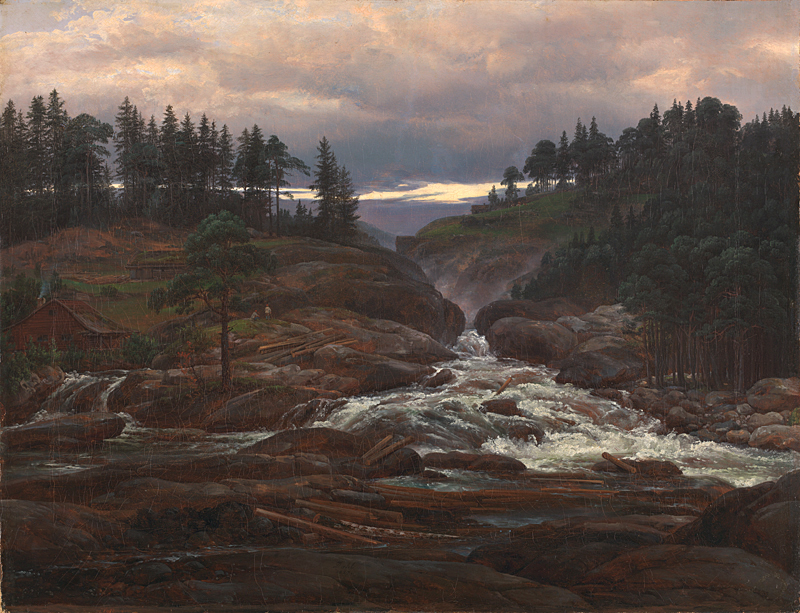
Johan Christian Dahl’s The Lower Falls of the Labrofoss (1827) provides a striking image of the power of water. It is a painting of the sublime and there is much to see within the work [for a large-scale image click on the link in 1]. The waterfall (foss in Norwegian) charges towards us from between large rocks before the river bends away to our right and the mist that we see in the middle distance provides evidence of even greater turbulence upstream. We just make out a mountain in the far distance, so we know the landscape setting, but Dahl’s low-level view focusses our attention on the middle distance and foreground. 

We note that many tree trunks are scattered around, having become snagged after they were heaved into the river to be carried to sawmills downstream, a practice that was common in Scandinavia before trucking. To the left, we see logging activity and two men are seen on rocks just to the left of the river and these loggers, together with the occupied wooden cottage, give scale to the picture. There are more cottages in the distance, one precariously close to the chasm through which the river flows, while the other has a meadow on which cattle are seen. The combination of dramatic landscape and rural activities is typical of Dahl, who followed the tradition established by the 17th century painters Jacob van Ruisdael and Allaert van Everdingen [2]. 

Johan Christian Dahl was brought up in Bergen, and the surrounding mountainous landscape, with its cascading rivers, formed an impression that stayed with him for the rest of his life. After being apprenticed to a painter in Bergen, he continued his studies in Copenhagen, where he saw Nordic landscapes by Dutch masters [3]. He began to be recognised for the paintings he exhibited there, and his success allowed him to become a professional artist. 

Dahl had an elevated view of landscape painting, his chosen genre, and, as Marie Bang states [2]: 

 …he claims that “landscape painting can have the same effect on the heart as history painting, when the painter presents the objects in an interesting way.” Here we see Dahl under the influence of academic coercion and the hierarchy of genres, where history painting with its moral message stood at the top of the ladder and landscape painting at the bottom; topographical prospectus painting being hardly regarded as art at all, but as a purely mechanical copying of nature without the artist’s creative influence. 

Dahl’s Romantic, emotional view of landscape permeates all his work and he was fortunate in having Prince Christian Frederik (later to become King Christian VIII of Denmark) as a patron and supporter. On travelling to Dresden in September 1818, Dahl gained further support from Caspar David Friedrich who was [2]: 

..fourteen years older and an established artist, but the two found in each other a common love of nature and a sincere depiction of nature based on self-study more than on the well-established academic clichés that they both deeply hated. 

The enclosed, melancholy Friedrich expressed his transcendental longing in distinctive mood landscapes, while the outgoing, lively Dahl tended towards more down-to-earth and dramatic motifs. Despite their close friendship and their deep love for nature, the two had no profound influence on each other; they were too different in temperament and artistic goals. 

As was mentioned earlier, Dahl retained a passion for Norway and its dramatic topography describing himself as [2]:

..a “more Nordic painter” with a “preference for sea shores, mountain nature, waterfalls, sailing ships and harbour pictures in daylight and moon light” 

He made a long-awaited trip back to his homeland in 1826, visiting the Labro falls, among other places - the inspiration for the 1827 painting. Sketches were made and these formed the basis of works to be completed in his studio [3]. In the Introduction to Forests, Rocks, Torrents, Christopher Riopelle [3] writes: 

A painting like The Lower Falls of the Labrofoss of 1827, executed for an English client, results directly from Dahl’s long study of the Norwegian landscape at its most tumultuous. At the same time, it is the product of slow and painstaking studio work.. 

..For Dahl, the aesthetic merit of the painting lay not in the motif but in the artist’s ability to ennoble it. It was this higher, more complete vision – the eternal Norway of the mind’s eye, fruit of long reflection – at which Dahl always aimed.. 

..it did not matter where Dahl was when he chose to paint Norway. The snowy peaks, the cascading torrents, the impenetrable forest of the true north did not need to be in his line of sight; rather, memories of Norway, contemplated in the tranquillity of the studio, could be prompted by oil sketches made on the spot.. 

I, too, love Nordic landscapes but by adoption, having been fortunate to make many visits to Sweden, Denmark, Finland and Norway. In the summer of 1975, I joined researchers from the University of Lund on a project on a tributary of the Vindel River in Swedish Lapland and I returned in 1976, not only to continue the project, but because I was captivated by the landscape and the beauty of the river. After a spell working on the biology of a lake outlet in Finland, I returned to the Vindel river and a project with my late, and much missed, colleague Björn Malmqvist from the University of Umeå. Renforsen on the Vindel was especially important to me, and, during ice-melt in the mountains, the rapids are indeed sublime. You will gain an impression of the majesty of Renforsen from the video clips cited below [4,5], where you will note the barriers to prevent the build-up of logs at the margins, for the river was used, like the river in Dahl’s painting, for the transport of tree trunks to mills downstream. 

The Vindel River is unregulated, but many other rivers have been dammed to provide a head of water to drive hydro-electric schemes. This fate also befell the Labro falls, as can be seen in an aerial view from Google Earth (see below, together with an image taken by Per Vestøl of the power station located close to the point shown in the painting). The natural falls are still in existence (see the Google Earth image), but their flow is controlled – quite different to the Labrofoss of the early Nineteenth Century. 


I wonder what Dahl would have thought of the change? As a passionate supporter of Norwegian identity, maybe he would be proud to see that natural resources were being harnessed. But the sense of the sublime has been diminished. Instead of the power of Nature over humans, so evident in Dahl’s painting, we now have the opposite. Most of the magic has gone. 


[1] https://www.nationalgallery.org.uk/paintings/johan-christian-dahl-the-lower-falls-of-the-labrofoss 

[2] Marie Lødrup Bang (2020) Johan Christian Dahl. Store Norske Leksikon [in Norwegian] https://nbl.snl.no/Johan_Christian_Dahl 

[3] Christopher Riopelle (2011) Forests, Rocks, Torrents: Norwegian and Swiss Landscape Paintings from the Lunde Collection. London, National Gallery Company.

[4] https://www.youtube.com/watch?v=os6fCk2CTWk&ab_channel=johnjairo41 

[5] https://www.youtube.com/watch?v=9qK4-5YOKcg

Thursday, 17 October 2013

More on the Natural History of the Unmentionable


The Renforsen rapids on the Vindel River in Sweden are at their most tumultuous during snow melt in the mountains and surrounding lands. A large volume of water then passes downstream and Renforsen becomes highly turbulent, as can be seen in the photograph below. The water contains many fine mineral particles and fragments of organic matter, but also some most important aggregates.


In 2001, the late Björn Malmqvist and I, together with Yixin Zhang, took water samples at Renforsen and found that they contained faecal pellets that we recognised came from blackfly larvae living on, and within, the substratum of the river. These insects collect particles from the water passing over them and push the material collected through their tube-like gut in about 45 minutes. There is no mixing and less than 5% of the material taken in is digested or otherwise assimilated, with the final section of the gut compressing the gut contents to produce pellets. Larvae feed continuously, so each larva is like a machine for converting very many tiny particles into much larger faecal aggregates. As there are millions upon millions of larvae on the bed of the river, it would be expected that there will be huge numbers of faecal pellets in transport. That is what we found. 1


93.7, 47.5 and 69.2 tonnes dry mass of blackfly larval faecal pellets passed an imaginary line across the river at Renforsen each day during three successive summers. 1 Without the blackfly larvae producing aggregates, it is likely that much more material would have been carried downstream and, eventually, to the sea. Of course, this is the fate of some of the faecal pellets, but many are retained within the river as they fall through the water of the slower-flowing reaches. They thus have an important impact on the river community in transferring matter from the water column to the substratum, where most micro-organisms, algae and animals live. Our findings so impressed the producers of the Swedish children’s TV series Myror i brallan (“Ants in your pants”) that a section of one of their programmes in November 2011 was devoted to the story of this transformation, 2 with the presenter saying: “Every day, the amount of blackfly poo drifting down a river would fill a whole house.......”


If the numbers of pellets produced is impressive, so is their constitution, as most of them appear to be intact despite the highly turbulent flow. This is partly because they are small and are thus bounced around in the current, but also results from the way they are stuck together. In the photograph above, the blackfly faecal pellet from the Vindel River (about 0.5 mm across) is blue in colour and this was the result of staining with a dye for complex carbohydrates (exopolymers). It is clear that these binding agents are found throughout the aggregate, yet the exopolymers are not produced by the larva, but are collected from the water column or exuded by micro-organisms and algae that have been ingested. The secretions are “Nature’s glue” and are the principal binding agent of the faecal pellets of all animals, although some animals produce their own exopolymers in the form of mucus from cells in the gut wall.

Not only do pellets remain intact as they pass through rapids, but they stay as aggregates for weeks after they pass to the substratum, so their value to the microbial, plant and animal community is not only short term. They provide nutrients and also food for the many animals that eat them. It is a pity that faecal pellets and their fate has been so little studied, although attitudes to their importance in flowing fresh waters is changing. 3 Perhaps scientists are affected by the general approach to the subject? It is not what most people first think of when discussing the Natural History of streams and rivers and one can imagine this conversation as being typical:

“So, you’re an Aquatic Biologist”

“Yes. I’m so pleased to be able to have spent a lot of time doing something that I loved from childhood”

“What do you study? Whales and dolphins?”

“I’m afraid not. I have spent most of my career looking at rivers and streams”

“At salmon and trout?”

“Actually, I’m fascinated by the importance of faecal pellets produced by invertebrates”

“Faecal pellets? Oh... ...how interesting...”

Of course, the exchange has not taken place, but it might have done, as it shows the popular liking for large organisms and distaste for excreta, as discussed in my previous blog post on this subject. Fortunately, the young viewers of Swedish TV were provided with an enlightened exception to this general rule and that is an example for us all.


1 Malmqvist, B., Wotton, R.S. and Zhang, Y. (2001) Suspension feeders transform massive amounts of seston in large northern rivers. Oikos 92: 35-43.


My thanks to Dr Brendan McKie for alerting me to the Myror i brallan programme.


Thursday, 13 December 2012

Ammarnäs and Renforsen


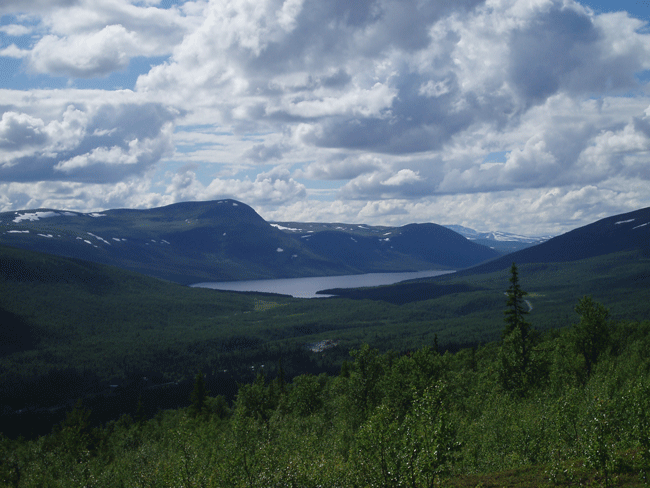
         West of Ammarnäs (from obj.utsida.se)


In his brilliant book Fishing in Utopia: Sweden and the Future that Disappeared, Andrew Brown writes: “......where the mountains rise out of the forests towards Ammarnäs”. It must be one of the few references in an English book to the village of Ammarnäs in Swedish Lapland. I lived there for several weeks in the summer of 1975 and it was one of those places to which I felt I must return. Fortunately, I did the following year.

They were working trips, as I had been invited to join a group of Biologists from the University of Lund in an investigation of rivers draining from lakes, trying to find out why these habitats support huge numbers of insect larvae that capture tiny particles from the water flowing over them. Those Biologists were wonderful people to work with and we enjoyed spirited conversations, and spirits, but also worked hard on the field work. They were good times, but that wasn’t the pull of Lapland for me. It was the sense that one could find areas that very few people had visited and no-one could dispute that the region has great natural beauty. If you can fall in love with a place, that’s what I did.

Bordering Ammarnäs to the east is the Vindel River, un-regulated along its length, and with some dramatic cascades. It was to the Vindel River that I returned in the late 1990s to work with Björn Malmqvist, one of my friends from the Lund group of fifteen years earlier, who was now at the University of Umeå. We were still both interested in insect larvae and travelled much of the length of the Vindel on occasions, although our main interest was in the lower reaches and in cascades and in runs between the regions of white water. So many of the locations for our work were beautiful and I developed a special fondness for one of the cascades – Renforsen.

       Renforsen (from www8.tfe.umu.se)


When winter snow and ice melts in the mountains, Renforsen is a magnificent sight and the river sometimes goes over its banks here – even carving a new channel through the forest on one occasion. It is awe-inspiring and it’s impossible not to be impressed. I found it another place to which I had to return and was fortunate that I did many times. I never tired of visiting Renforsen and always looked forward to my first trip of the year with great enthusiasm. 

After working on the river, Björn and I would buy a cup of coffee in the cafe nearby, listen to the roar of the cascade and not say very much. Very sadly, those times will never be repeated, as tragedy struck when Björn developed a brain tumour and died two years ago. So now I have memories of a very special place and a very special friend and colleague with whom I spent time there. I don’t believe in souls but, if I had one, a part would contain the powerful and emotive effects of Renforsen.