Showing posts with label Memories. Show all posts

Monday, 19 July 2021

Memories of privet in Torbay


In an earlier blog post, I described the wonderful scent of honeysuckle and its reputation for inciting thoughts of love, especially in girls [1]. Another plant that flowers in July is privet, very common as a hedging plant and described by the Royal Horticultural Society as having “panicles of small, often unpleasantly scented white flowers” [2] (see above). This is a subjective judgement, of course, but most people would agree with the RHS, as they walk past flowering privet hedges. 

For me, the smell of privet flowers brings back a very strong childhood memory of trainspotting on summer Saturdays in Torbay. This is what I wrote in Walking with Gosse [3]:  

For me, the constant arrival of trains was exciting. Not because of the crowds of holidaymakers, that were just a blur, but for the chances of trainspotting and seeing locomotives from distant places far beyond Bristol. I don’t know why trainspotting was such a passion for me as a boy, but it was. Even today, the smell of privet flowers reminds me of happy walks through the local park to the railway station and the anticipation of gaining new entries in my Ian Allan Combined Volume. 

I was brought up in Paignton and, as a child, Bristol to me was in the far north. Large numbers of visitors swelled the local population during the summer months and an indication of the amount of holiday traffic is shown in the photograph below (taken from the excellent book Summer Saturdays in the West [4] and showing a typical scene at Torquay from August 1957, the time when I pressed up against the railings at Paignton railway station). On the left, we see a crowded platform of returning holidaymakers about to board their train home, while the opposite platform is empty and awaiting the next delivery of excited passengers coming to start their holiday by the sea. The small locomotive at the rear of the heavy train was needed to assist the train engine in tackling Torre bank and another of these “bankers”, having drifted back from Torre station, waits on the central line ready to buffer up to the rear of the next arrival from Paignton. Once past the bank, there was a clear passage to Newton Abbot, where the lines from Torquay joined those from Plymouth and Cornwall. Newton Abbot was a mecca for trainspotters in those days, as pilot engines were needed over the South Devon banks and the locomotive shed that provided them (code 83A) was adjacent to the station. There was always lots to see, and three years after the time mentioned in the quote above, I still made occasional trips up to Newton Abbot to spend a day trainspotting. They didn’t have the same spell as those of earlier days, perhaps because powerful diesels were starting to appear and, anyway, I was growing away from my childhood passion for collecting numbers. I think my Ian Allan Combined Volume was thrown away. 

The scent of privet doesn’t only evoke memories for people, it also attracts pollinating insects that allow fertilisation of the plant in return for the “gift” of nectar. This association evolved way before humans came on the scene, and privet is also used as a food plant by insects, including the privet hawk moth caterpillar (see below), with the dark berries produced in autumn providing food for birds. It is a successful hedging plant because of its vigorous growth and its ability to tolerate some loss of leaves; strategies that evolved to cope with attacks by insects and other animals. But back to privet flowers: “unpleasantly scented” they may be, but they are special for me. Isn’t it strange how smells, transient as they are, can have such a strong effect on the memory? 

(As an aside, it is also of note that privet has been used in folk medicine for centuries, as a means of reducing inflammation [5]. Studies continue to examine some of the component chemicals in leaves and this may lead to the development of new medicines [5,6].)


[1] https://rwotton.blogspot.com/2021/06/the-beauty-of-honeysuckle.html 

[2] https://www.rhs.org.uk/plants/10108/i-Ligustrum-vulgare-i/Details 

[3] Roger S Wotton (2020) Walking with Gosse: Natural History, Creation and Religious Conflicts. e-book. 

[4] David StJohn Thomas and Simon Rocksborough Smith (1973) Summer Saturdays in the West. Newton Abbot, David & Charles. 

[5] Anna Macková, Pavel Mučaji, Ute Widowitz and Rudolf Bauer (2013) In vitro anti-inflammatory activity of Ligustrum vulgare extracts and their analytical characterization. Natural Products Communications 8: 1509-1512. 

[6] A. Pieroni, P. Pachaly, Y. Huang, B. Van Poel and A. J. Vlietinck (2000) Studies on anti-complementary activity of extracts and isolated flavones from Ligustrum vulgare and Phillyrea latifolia leaves (Oleaceae). Journal of Ethnopharmacology 70: 213-217.


Friday, 13 April 2018

Tempus fugit


More than 45 years ago, I spent two summers at the Moor House Field Station. It was a remote place, only accessible by a track from Garrigill near Alston in Cumbria: an idea of how remote is provided by the videoclip below [1]. Originally, the building was a hunting lodge, but a succession of outbuildings was then added and a laboratory (the large square structure shown clearly at 3.04 in the video) constructed for those working on the  IBP (International Biological Programme) in the 1960s and 1970s. In addition to research on the biology of vegetation and grouse, the laboratory was an outstation of the FBA (Freshwater Biological Association), with scientists investigating the effects of building Cow Green Reservoir on local rivers. Most of the “permanent” members of the Field Station came in by Land Rover each day, but there were also residents, including a cook/housekeeper in the summer months to cater for visitors, staying for days to months, from Universities and other establishments.


I first visited Moor House as a research student of the University of Durham from 1970-1973 but returned during the time of my first academic post at the University of Newcastle-upon-Tyne. In the summer of 1972, I lived at Moor House during the week and walked to the local streams that I was studying, as well as driving to sites in Upper Teesdale in a Land Rover. My interest was in the distribution and biology of blackfly larvae in moorland streams (it was usual at that time to have an interest in one group of animals or plants) and compare the effects of altitude on distribution and production. All the collections needed to be processed and this work was carried out in the laboratory at Moor House (see the photograph below, taken by Patrick Armitage of the FBA).


All the hours of work resulted in a PhD thesis and some research papers, although my contribution to science was at that time minimal. By the time of my second summer, in 1974, my interests were broadening into studies of feeding in freshwater invertebrates and, serendipitously, these led to a paper in Nature [2], regarded as something of a “holy grail” for scientists starting out on their careers. It was from this work that I became a little more widely known and I then began a collaboration with the Rheo-Group in Lund in Sweden that provided both a jumping off point for my studies on particulate and dissolved organic matter in water bodies and for many research visits to Sweden and Finland. I never went back to Moor House.

So, what became of the Moor House Field Station? Sadly, it was regarded as being of limited use to the research community after the 1980s, except for those who continued to make day visits, and “permanent” staff left for other posts. The buildings began to decay and were then demolished, the rubble being used to reinforce the track – providing an odd memorial to the achievements of many who stayed, or worked, at Moor House (see below for how the site looks now [3]). My study streams remain – they were there long before the House, of course – and there will otherwise be no record of my research other than a few pieces of paper in journals. Of course, my memories are strong and there are many happy times to recall. These included playing Layla (Derek and the Dominoes) and All the Young Dudes (Mott the Hoople) at full volume on some evenings and, more reflectively, listening to Bruch’s Scottish Fantasia so often that it almost became a theme for the place. Then there was the excellent food cooked by Mrs Dunn in the large AGA in the kitchen and the pleasure to taking a bath at the end of a long day – once one became used to the peat-stained water.


Like I say, just memories and little else, yet it all seemed so important at the time.


[2] R.S.Wotton (1976) Evidence that blackfly larvae can collect particles of colloidal size. Nature 261:697.

[3] John Adamson (2009) Moor House Memories. (access through http://www.ecn.ac.uk/publications/moor-house-memories).

Monday, 27 March 2017

Our family's box of curios


I mentioned our family's box of curios - a mini "cabinet of curiosities" - in an earlier blog post [1]. The objects in the box fascinated me as a child and provided a connection to exotic parts of the World, far removed from my insular life, but the only contents I could recall were a tiger's claw and some hairs from a giraffe's tail. That may have been because, even as a young child, I had a fascination with Natural History.

Last Wednesday, I visited Torquay Museum to give a talk about Philip Henry Gosse and during the previous evening I was able to visit my brother David who still lives in Paignton, our home town. When reading the blog post [1], he had remembered the box of curios and was sure that it had been stored in the loft of his house after we emptied the contents of our family home during the clear-out after my father died nearly fifty years ago. Why the box was selected to be saved when much else was thrown out was not clear to either of us, but much searching in the loft of David's house didn't turn it up and we left it at that. Then, by looking in another place, the box was found and David was able to show it to me last week. Its contents are shown below.

 
There was the tiger claw and a label mentioning the hair from a giraffe's tail (I'm sure that there were at least three, all having now disappeared). The other curios were a pipe, two combs, two wooden spoons and a ring with plastic "charms" attached by woven threads. The origins of all the artefacts remain a mystery, but it was good to know that most of the contents of the box of curios were still there. When I was very young, they were my introduction to an interest in the fascinating objects found in Museums and similar collections.

The items are shown in more detail below (photographs by David Wotton) – can anyone provide information on these artefacts?


Thursday, 13 December 2012

Ammarnäs and Renforsen


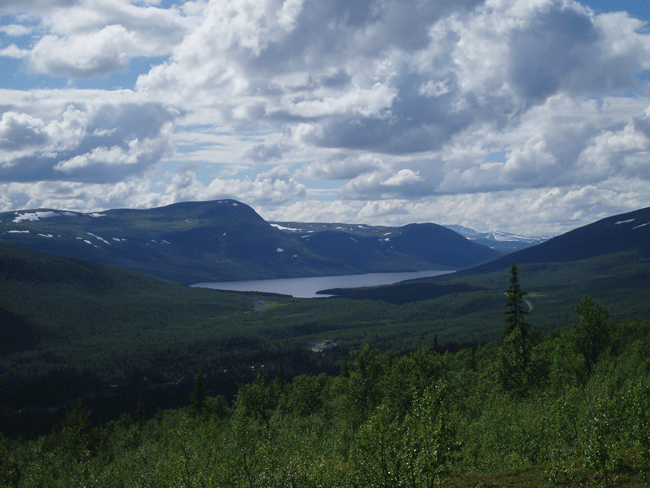
         West of Ammarnäs (from obj.utsida.se)


In his brilliant book Fishing in Utopia: Sweden and the Future that Disappeared, Andrew Brown writes: “......where the mountains rise out of the forests towards Ammarnäs”. It must be one of the few references in an English book to the village of Ammarnäs in Swedish Lapland. I lived there for several weeks in the summer of 1975 and it was one of those places to which I felt I must return. Fortunately, I did the following year.

They were working trips, as I had been invited to join a group of Biologists from the University of Lund in an investigation of rivers draining from lakes, trying to find out why these habitats support huge numbers of insect larvae that capture tiny particles from the water flowing over them. Those Biologists were wonderful people to work with and we enjoyed spirited conversations, and spirits, but also worked hard on the field work. They were good times, but that wasn’t the pull of Lapland for me. It was the sense that one could find areas that very few people had visited and no-one could dispute that the region has great natural beauty. If you can fall in love with a place, that’s what I did.

Bordering Ammarnäs to the east is the Vindel River, un-regulated along its length, and with some dramatic cascades. It was to the Vindel River that I returned in the late 1990s to work with Björn Malmqvist, one of my friends from the Lund group of fifteen years earlier, who was now at the University of Umeå. We were still both interested in insect larvae and travelled much of the length of the Vindel on occasions, although our main interest was in the lower reaches and in cascades and in runs between the regions of white water. So many of the locations for our work were beautiful and I developed a special fondness for one of the cascades – Renforsen.

       Renforsen (from www8.tfe.umu.se)


When winter snow and ice melts in the mountains, Renforsen is a magnificent sight and the river sometimes goes over its banks here – even carving a new channel through the forest on one occasion. It is awe-inspiring and it’s impossible not to be impressed. I found it another place to which I had to return and was fortunate that I did many times. I never tired of visiting Renforsen and always looked forward to my first trip of the year with great enthusiasm. 

After working on the river, Björn and I would buy a cup of coffee in the cafe nearby, listen to the roar of the cascade and not say very much. Very sadly, those times will never be repeated, as tragedy struck when Björn developed a brain tumour and died two years ago. So now I have memories of a very special place and a very special friend and colleague with whom I spent time there. I don’t believe in souls but, if I had one, a part would contain the powerful and emotive effects of Renforsen.