Showing posts with label Beauty. Show all posts

Wednesday, 30 August 2017

Elgar's Enigma


I've been re-reading Patrick Turner's scholarly book on Elgar's Variations on an Original Theme (Enigma) Op. 36 [1]. He explains how the piece acquired its title and also puts forward an explanation of the enigma – that the variations originated with the French folk melody to which we sing the nursery rhyme Twinkle, Twinkle, Little Star. As Elgar never explained the origin of the Variations we will never know whether Turner is correct, but we do know that Elgar played a tune to his wife, Alice, in the manner of several of his friends and that this led to the dedication of the Variations by Elgar "to my friends pictured within".

The link below is to the acclaimed interpretation of the work by Toscanini.

Even if one knows little of the origins of the piece, the Enigma Variations are certainly popular and "Nimrod", the variation based on Elgar's friend August Jaeger of the music publisher Novello, is the best known. I knew it before I knew the rest of the piece, largely from hearing "Nimrod" many times on radio programmes of music requests. We didn't have a record player (this must sound so odd to readers brought up in the modern era) and it wasn't until I was a student that I was able to buy an LP of the Enigma Variations and that began my exploration of Elgar's beautiful and inspiring music.

I have already written about Elgar and soul, complete with a tease that neuroscientists will never understand how music affects the emotions [2], but I wanted to write more after reading quotes in Turner's book [1]. The first came from the conductor Leopold Stokowski after he conducted the Variations in Philadelphia and New York in 1929:

We had not played them for four seasons, and the impression I received from them was of such depth of feeling and beauty that I was stirred by this music far more profoundly than I can express in words. Often when we play a work after not having heard it for several seasons, we have the impression of its being the expression of another period and of being alien to the life of today. But your Variations gave me the most powerful impression of eternal vitality and architectural design – and also something very difficult to express, a floating upward into a mystical level where time and space seem to cease.

The other quote is from Turner himself:

..I never cease to wonder what it was about Elgar that enabled him to produce music which succeeds in moving me in a way in which no other music does. What is the strange alchemy that draws people to his music and, once drawn, traps them?

Both quotes imply that Elgar had a special quality that enabled him to communicate something deep and intimate. I alluded to this in the earlier post [2], yet I have no idea whether the moving feelings that I have when listening to the piece are the same as those that Stokowski, Turner and many others describe. The imagery that I have must be personal, yet the result is the same for all of us – almost being in contact with a higher sense. What is the rational explanation of that and why is Elgar so good at creating that feeling? It's another enigma.


[1] Patrick Turner (1999) Elgar's 'Enigma' Variations – a centenary celebration. London, Thames Publishing.


Thursday, 18 May 2017

A common name quiz


In my last blog post, I championed the use of common names of organisms, some of which are vividly descriptive [1]. For fun, I've compiled a list of common names of marine organisms that illustrate their beauty and would love to know your favourites (I've limited the list to organisms of marine coasts to reduce the huge number of potential examples).


To make the post into a quiz, the group to which each organism belongs is given at the end (in the order of the list of common names) and the illustration above gives a clue to four of them. All are in English, but those who speak other languages may like to compile their own list of favourites.

Here's the list:

Brown-lined paper bubble
Burnt hotdog 
Crimson pufflet   
Dabberlocks  
Dead man's bootlaces
Flamingo tongue 
Hairy mushroom   
Immaculate damsel 
Landlady's wig 
Lond-spined sea scorpion 
Magnificent foxface  
Pepper dulse 
Prickly redfish 
Red rags 
Red-specked pimplet  
Sea gherkin  
Sea hedgehog  
Sea lemon   
Sea potato  
Spiny mudlark 
Topknot 
Trefoil muzzlet 
Warted corklet 
White-lipped castor bean 
Yellow Fiji leather 


snail
sea cucumber
sea anemone
brown seaweed
brown seaweed
snail
coral
fish
red seaweed
fish
fish
red seaweed
sea cucumber
red seaweed
sea anemone
sea cucumber
brown seaweed
sea slug
sea urchin
sea urchin
fish
sea anemone
sea anemone
snail
coral

Thursday, 13 December 2012

Ammarnäs and Renforsen


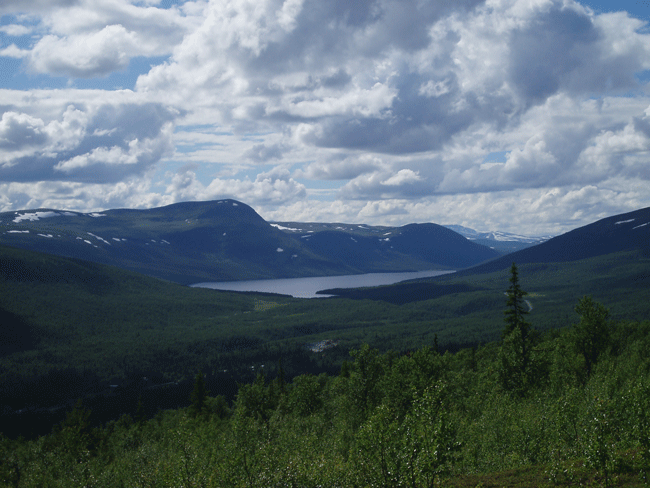
         West of Ammarnäs (from obj.utsida.se)


In his brilliant book Fishing in Utopia: Sweden and the Future that Disappeared, Andrew Brown writes: “......where the mountains rise out of the forests towards Ammarnäs”. It must be one of the few references in an English book to the village of Ammarnäs in Swedish Lapland. I lived there for several weeks in the summer of 1975 and it was one of those places to which I felt I must return. Fortunately, I did the following year.

They were working trips, as I had been invited to join a group of Biologists from the University of Lund in an investigation of rivers draining from lakes, trying to find out why these habitats support huge numbers of insect larvae that capture tiny particles from the water flowing over them. Those Biologists were wonderful people to work with and we enjoyed spirited conversations, and spirits, but also worked hard on the field work. They were good times, but that wasn’t the pull of Lapland for me. It was the sense that one could find areas that very few people had visited and no-one could dispute that the region has great natural beauty. If you can fall in love with a place, that’s what I did.

Bordering Ammarnäs to the east is the Vindel River, un-regulated along its length, and with some dramatic cascades. It was to the Vindel River that I returned in the late 1990s to work with Björn Malmqvist, one of my friends from the Lund group of fifteen years earlier, who was now at the University of Umeå. We were still both interested in insect larvae and travelled much of the length of the Vindel on occasions, although our main interest was in the lower reaches and in cascades and in runs between the regions of white water. So many of the locations for our work were beautiful and I developed a special fondness for one of the cascades – Renforsen.

       Renforsen (from www8.tfe.umu.se)


When winter snow and ice melts in the mountains, Renforsen is a magnificent sight and the river sometimes goes over its banks here – even carving a new channel through the forest on one occasion. It is awe-inspiring and it’s impossible not to be impressed. I found it another place to which I had to return and was fortunate that I did many times. I never tired of visiting Renforsen and always looked forward to my first trip of the year with great enthusiasm. 

After working on the river, Björn and I would buy a cup of coffee in the cafe nearby, listen to the roar of the cascade and not say very much. Very sadly, those times will never be repeated, as tragedy struck when Björn developed a brain tumour and died two years ago. So now I have memories of a very special place and a very special friend and colleague with whom I spent time there. I don’t believe in souls but, if I had one, a part would contain the powerful and emotive effects of Renforsen.