Showing posts with label Exudates. Show all posts

Wednesday, 12 February 2014

Impressive sea foams


Ten years ago, I had a holiday in Denmark with my wife and daughter and we spent a few days in the wonderful city of Copenhagen. As we wandered along the waterfront, I noticed that there were large amounts of foam accumulated at one end of a dock and I started explaining (how typical of an academic) that this was the result of natural processes and not pollution. We were surprised to then turn round and find a TV crew just behind us. The reporter had been sent to cover the appearance of the foam and she had overheard my comments and asked me to talk about the origins of the foam to camera. I explained that, although the accumulations look unpleasant, they disperse and do not usually create a bad odour.

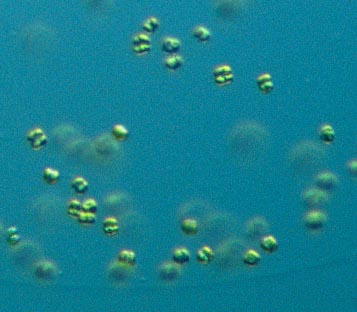
In contrast to this small accumulation in Copenhagen, sea foams can be of much larger dimension, creating banks of foam over a metre deep on shore, with winds carrying the flocs inland. One genus of algae is well-known as the origin of foams - Phaeocystis. These algae are found as single cells or, commonly, in large groups embedded in a globe of transparent mucus (see below). When nutrients are plentiful, and when day length increases, the excellent conditions for algal growth result in blooms. Excess carbohydrate, resulting from photosynthesis, is exuded from the cells to form a field of exopolymers 1 around each cell and, in Phaeocystis, the exudates from cells combine and a globe of mucus results, in which individual algae become embedded. The globe protects individual cells from capture by herbivores and acts as a means of retaining nutrients close to each cell. As the mucus consists largely of water bound within a matrix of carbohydrate to give structure, it is energetically cheap to produce. 1


So, how does Phaeocystis contribute to masses of sea foam? Let’s begin with an analogy. When we make meringue, we whip transparent egg whites (mainly protein in water) to include air, and the masses of tiny bubbles that we create are trapped within the developing meringue, each coated by some of the protein. The trapped bubbles then give the whole its white appearance. Now back to Phaeocystis. When huge numbers of globes at, or near, the surface of the sea are whipped up by waves, the mucilaginous colonies are broken up and their organic matter covers bubbles, so the whole becomes whisked into foam. The more algae, the more foam, and it is easy to see how this light, floating mass can then be blown ashore. Like all foams, it consists largely of gas and is white because of all the bubbles that are included, although green or brown colouration sometimes occurs. This is because algae or brown organic compounds are also bound into the mass, or become stuck to its surface.


All surf creates foams because bubbles are covered with the organic matter that accumulates at the water surface and this means bubbles do not collapse instantly, like those produced by shaking tap water vigorously, for example. We’ve all seen the white masses of coated bubbles that form when waves break, but the huge accumulations that can occur after Phaeocystis blooms are in a different league.


1 Roger S Wotton (2005) The essential role of exopolymers (EPS) in aquatic systems. Oceanography and Marine Biology: An Annual Review 42: 57-94.


Thursday, 6 December 2012

Rotifers, Henry Gosse and me


This image by Charles Krebs of Floscularia ringens was posted yesterday on the “Walking with Gosse” Facebook page by Dr Susan England of Clio Publishing. It is of a rotifer that lives in fresh water and builds a tube that acts as protection, support and a means of attachment. Looking closely at the image we can see the groups of cilia which it uses to produce a feeding current. The tube is composed of balls largely of detritus, which are stuck together and the balls maintain their integrity for weeks, Floscularia extending the tube to take it further out into the water as the individual rotifer grows. The whole is approximately 1 mm in length and we see only a small portion here.

Henry Gosse, the great Natural Historian and illustrator, was fascinated by rotifers and assisted C.T.Hudson in a two-volume monograph on the animals. Despite Hudson’s protests, Gosse insisted on his attribution as assistant and this was typical of the man. The two enthusiasts were really co-authors and Gosse contributed much of his own detailed research to the volumes. In looking at rotifers, as with other living creatures, Henry Gosse saw evidence of the power of God and His Creation and it filled him with a sense of wonder.

As an evolutionist, I have several points to consider:

Why are the cilia used for feeding arranged in bundles?

Rotifers have many cells but had single-celled ancestors which used cilia for locomotion and feeding. Through evolution, cilia of some organisms became more complex and the bundles seen in Floscularia may promote increased feeding efficiency. The pattern of bundles seems very similar in form across the corona (the transparent lobes), so what caused their development in the first place? Did all the bundles appear simultaneously?

Building the tube

Several groups of rotifers build tubes and the tube of Floscularia is unusual in being made up of balls, primarily of detritus. The photograph shows the location of the “ball-forming device” in the cuticle of the rotifer and its constituent tiny particles will be collected readily from the water by the feeding current. We often ignore the presence of organic particles in water, yet they are found in vast numbers and have many important roles in the functioning of aquatic systems. Once a ball is formed, and compressed to a certain size, the rotifer can then locate it on the tube and having a tube with a wall of spherical balls is a very efficient use of materials. How did the “ball-forming device” and tube-building evolve?

Why do the balls in the tube maintain their shape and how do the balls stick together?

As mentioned, rotifers collect small particles of detritus and other organic matter. Detritus results from the breakdown of the bodies of living things and also consists of material that passes from living things as waste products or exudates. There will also be many different kinds of microorganisms (bacteria, etc.) that are attached to the fragments of detritus and are important in breaking them down into smaller and smaller pieces. To attach, microorganisms exude polymers and these are “Nature’s glue”, often becoming free from the microbes which produce them. It is these polymers which keep the balls intact as they are difficult to decompose and there are many "sticky" contact points when the ball is compressed. The exudates are in the form of minute fibrils and the rotifer could not make balls without the previous evolution of exudates by bacteria.

Amazing, isn’t it? 

Do I have any idea how Floscularia developed all these modifications? – No. Do I believe that they evolved by changes in genes occurring over huge numbers of generations? – Yes. Is a God responsible? – I don’t know, but do not think so. Evolution generates such a sense of wonder. I’m right with Henry Gosse in having that feeling when looking at living organisms, but we would not agree on the reasons why we felt that way.