The colloquial expression of "having a death wish"
is often applied to people who expose themselves to great danger, and especially
to those who enjoy extreme sports.
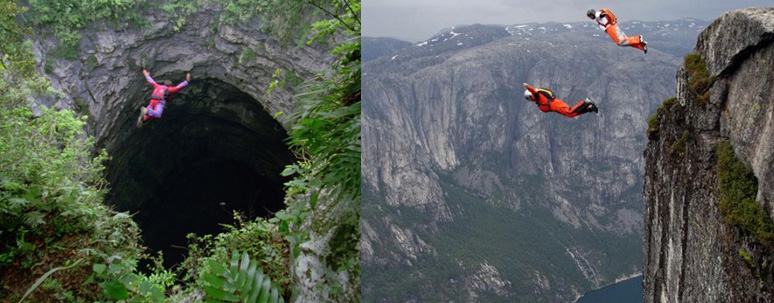
The most dangerous extreme sport is BASE jumping (above),
where an individual leaps from a cliff, bridge or a similar structure, and free
falls before opening a parachute. BASE jumping carries a five to sixteen times
greater risk of death than skydiving from an aeroplane or helicopter [1], and an
even more risky variant of BASE jumping is proximity flying using steerable
wing suits. These suits allow fliers to pass very close to terrain before
moving out into a region where there is sufficient altitude to allow safe
release of a parachute and return to the ground. Take a look at this video clip
and you'll see what I mean:
The fliers are Jeb Corliss (in the black suit) and Jhonathan
Florez (in the light suit) and one can sense their exhilaration in flying
quickly and so close to the ground. However, it can go wrong. Indeed, Jhonny
Florez was killed recently in Switzerland and he was a highly experienced wing
suit flier who had made many jumps of the same type as the one that resulted in
his death from "impact with terrain". For close proximity fliers,
then, death is a real possibility, but their attitude towards it is different
to that of the average person.
In a study entitled Personality
Characteristics of BASE Jumpers, Monasterio et al. [1] found that, while many personality traits showed a range
that was similar to that of their peers, BASE jumpers tended to have very low
HA (Harm Avoidance) scores:
The finding of low HA is not surprising
or counterintuitive, as individuals with low scores in this dimension are described
as carefree, relaxed, daring, courageous, composed, and optimistic even in situations
that worry most people. These individuals are described as outgoing, bold, and
confident. Their energy levels tend to be high, and they impress others as
dynamic, lively and vigorous. The advantages of low HA are confidence in the
face of danger and uncertainty leading to optimistic and energetic efforts with
little or no distress..
..In our study there was a high prevalence
of witnessed and experienced serious trauma, and near misses among BASE
jumpers; despite this participants persisted in the sport and this suggests
that they are likely to possess considerable psychological resilience to the
effects of trauma.
Far from being reckless, BASE jumpers are very careful in
their preparation, as they are aware of the danger of things going wrong, but
this awareness is exceeded by the pleasure provided in making flights and
jumps. Close proximity wing suit flying can be regarded as the pinnacle of the
sport when it comes to exhilaration and, in discussing a range of extreme
sports, Brymer and Schweitzer [2] point out that:
Fear was intimately related to decision
making in terms of decisions to engage in or not engage in activities and
potential consequences of such engagement. That is, the future which involved
the potential destruction of the physical self emerged in the present..
..participants live in relationship
to fear. Extreme sport participants perceive the experience of fear as an
essential element to their survival. Fear is spoken about as if it is a
healthy, productive experience..
..they are also able to objectify
fear. Fear is thus not something to be avoided, but embraced as contributing to
personal survival. Fear 'keeps you alive', revealing an intimate relationship
between fear and the living self.
There are shades of mindfulness in these statements and the
fear faced by BASE jumpers and wing suit fliers is not unlike the paralysing fear
of those suffering from severe anxiety as a mental illness. However, the jumpers and fliers look at fear as something that is felt, challenged
and benefitted from and the result is a feeling of release. Further in their article,
Brymer and Schweitzer [2] write:
Participation in the face of the fear
offers considerable benefits as participants note how the experience changes
their life..
..a BASE jumper related how BASE
jumping was the 'ultimate metaphor for jumping into life rather than standing
on the edge quivering'. She described an acceptance of the inevitability of
death and development of an intimate connection to nature as if just 'a leaf in
the wind': ' you're totally vulnerable and totally part of the environment at
the same time'..
.. Working through fear in an
extreme situation empowers everyday life.. ..Fear emerges as part of the experience
and meaning of extreme sports. Participants are very clear about the intense
feelings during the preparation and pre-activity stage. It would seem that participants
consider those who do not feel fear are a danger to themselves and others.
In another paper, Brymer and Schweitzer make a telling
statement [3]:
A number of participants described
a sense of freedom in terms of peace or being at one as participants were
immersed in the natural environment.
Immersion in the natural environment is important to mental health, whether
one is a BASE jumper, wing suit flier or, like me, a Natural Historian. Perhaps
the only difference comes in the scale of intensity of feeling?
A sense of fear can be so overwhelming in beginners at
free-fall parachuting that they have to make a first attempt by being strapped to
an experienced parachutist who makes the decision of when to jump. This sense of impending danger also affects
some bungee jumpers. Take a look at this clip (turn off the sound) and put
yourself in the woman's position:
Participants in this study also report
that facing fear in extreme sports and learning to participate despite the
intensity of the fear facilitates the management of fears in other aspects of
life. That is by facing our greatest 'true' fears whether they be death, uncertainty
or something else and taking action despite those fears we transcend our own limitations
and invite new possibilities into our lives.
Should we then encourage those with low HA scores in personality
tests to take up the most dangerous sports because they provide a quite different
perspective on life and one which is highly beneficial to the participant?
Close proximity wing suit flying provides personal fulfilment and a great deal
to the individual, but it is also selfish. If death results, the flier
presumably knows little about it, but others have to cope with the trauma of
recovery, and of bereavement, and this is the down side of the activity.
I don't know how many wing suit and proximity fliers believe in a supernatural force, but their sense of exhilaration in the face of death could
be termed a religious experience, while providing tools to conquer day-to-day
sources of anxiety and the fear of death. It all seems
so much more real than the conventional religious approach to death, with the
need to adhere to tenets throughout one's life, and the deep fear of judgement
and retribution.
[1] Erik Monasterio, Roger Mulder, Christopher Frampton and
Omer Mei-Dan (2012) Personality characteristics of BASE jumpers. Journal of Applied Sport Psychology 24:
391-400.
[2] Eric Brymer and Robert Schweitzer (2012) Extreme sports
are good for your health: a phenomenological understanding of fear and anxiety
in extreme sport. Journal of Health
Psychology 18: 477-487.
[3] Eric Brymer and Robert Schweitzer (2013) The search for
freedom in extreme sports: a phenomenological exploration. Psychology of Sport and Exercise 14: 865-873.