Showing posts with label Fish. Show all posts

Friday, 13 February 2026

The remarkable portraits by Giuseppe Arcimboldo


Giuseppe Arcimboldo (1527-1593) was the son of an artist in Milan and worked on the design of stained-glass windows in Milan Cathedral and on frescos and tapestries for the cathedrals in Monza and Como. He moved to Prague in 1562 and for the next twenty-five years was employed by the Holy Roman Emperors Ferdinand I, Maximilian II and Rudolf II, working in both Vienna and Prague and painting portraits of them and their families. An example - Maximilian II, His Wife and Three Children – is shown below (upper). He also painted religious subjects and drew an excellent self-portrait that makes us puzzle about what he might be thinking about (below, lower). 


It is not these works for which Arcimboldo became famous, but his series of portraits that ingeniously, and strangely, used fruits, vegetables and fishes to represent facial features, jewellery and clothing (The Admiral is shown at the head of this article). In Vertumnus [Emperor Leopold II]  of 1591 (below, upper), that was painted two years before Arcimboldo’s death, we see that every feature is made up of vegetables, whereas the earlier portrait of a woman in Water of 1566 (below, lower), is made up of marine organisms. This was one of four paintings of the elements; the others being Air, Earth and Fire. We can assume that, as this style of painting was used by Arcimboldo for so many years, it must have been celebrated by the Court of the Holy Roman Emperors. 


As Kriegeskorte writes [1]:

The documents of the time bear witness to the fact that monarchs and his contemporaries in general were quite enthusiastic about his art. We do not know why there was a sudden turning point.. ..during his time at the Imperial Court, these tendencies were undoubtedly reinforced by his acquaintance with pictures by Bosch, Brueghel, Cranach, [Hans Baldung] Grien and Altdorfer.”

Many fishes in Water are easily identified and beautifully, and accurately, painted, although there is no consistency of scale between them, and we can assume that they were available in fish markets, were known to Arcimboldo from visits to coastal regions, or brought to Prague as curiosities [1]:

Prague had now become a major European cultural centre. But Rudolph II’s interest lay mainly in his Art and Wonder Chambers.. ..[that] contained everything that was regarded as exotic at that time, all sorts of unusual objects and animals:.. ..stuffed birds (from the world as it was known then), gigantic mussels, sword- and saw-fish, precious stones, demons imprisoned in blocks of glass, mummies, objects from the newly discovered continent of America, precious things from India and a whole zoo of exotic animals

If we look closely at Water, there are two animals that capture our attention, a walrus and a spouting fish (below, upper). These are very unlikely to have been seen by Arcimboldo and his inspiration must have come illustrations that he had come across, but what were these? The walrus may have been influenced by Dürer’s (1521) illustration (below, mid), especially in the prominence of the nostrils and the eyes. The jets coming from the partially-hidden spouting fish are very similar to those in the representation of a whale in Olaus Magnus’ (1539) Carta Marina (below, lower). Arcimboldo probably saw copies of both, as they are likely to have been talking points in artistic circles in the decades before he produced Water in 1566. This is my speculation, of course.


There is nothing quite like Arcimboldo’s “still life portraits” in the history of art and their strangeness, and skill of execution, had an influence on Surrealist painters centuries later, Salvador Dali basing his Le grand paranoïaque (below, upper) on paintings by Arcimboldo, after conversations about the artist with Josep Maria Sert, who designed sets for Diaghilev’s Ballet Russe [2]. Perhaps Dali was especially inspired by Eve and the Apple (below, lower)?


[1] Werner Kriegeskorte (2000) Arcimboldo Taschen, Köln

[2] Marijke Peyser: https://www.boijmans.nl/en/collection/artworks/4293/le-grand-paranoiaque


Friday, 7 April 2023

Turner, Fish and Birds

Walter Fawkes was both an important patron and a good friend of J M W Turner, and the artist made regular visits to Fawkes’ home, Farnley Hall, from 1808 to 1824 [1], using it as a base for drawing tours of  sites in Yorkshire. Turner also enjoyed the shooting that was offered on the estate and there was also the prospect of fishing, a favourite pastime that allowed him the opportunity to make observations of water bodies and the land surrounding them.

Although best known as a painter of landscapes, in both watercolour and oils, Turner was also fascinated by architecture and the interiors of buildings, so it was natural that he made paintings in, and around, Farnley Hall [1]. Less well known are the watercolours that he made of fish and of birds and it is likely that all of these were made while Turner was staying at the Hall in visits from 1820-1824. Most were used as illustrations for the Farnley Hall Ornithological Collection, now owned by Leeds City Museum, and the subject of a splendid book by David Hill [1, and see above]. A few of the bird paintings were retained by Turner (and are part of the Turner Bequest), although the basis for his decision is not clear.


In the painting of fish (above, upper) we see two tench, a trout and a perch that reflect Turner’s interest in all types of fishing, while a small fish is shown captured by a heron (above, lower). The detail of the bird’s feathers show that this unlikely to have been painted from life, but from a bird that had been shot, possibly to then be stuffed and added to a cabinet, a practice that was very popular at the time [2]. The painting of a teal (below, upper) was obviously from a bird that had been shot – no teal flies with its head at this angle! Painting from life presented Turner with more of a challenge, since examination of the plumage in detail was then much more difficult [1]. An example is that of the goldfinch (below, lower).


These paintings show Turner’s skill as an artist, but they are quite different in feel to the majority of his work. He was less interested in detail, and in portraiture, than in conveying feeling through landscape, whether terrestrial or marine, and getting to the essence of the sublime. It is the large number of paintings that explore this theme that make him so admired, but the animal portraits show us that, as an artist, he could “do it all”.

[1] David Hill (1988) Turner’s Birds Oxford, Phaidon Press

[2] https://rwotton.blogspot.com/2023/03/seth-mosley-and-natural-history.html


The illustrations of the fish and the teal are from the Turner Bequest https://www.tate.org.uk/art/research-publications/jmw-turner/1819-1829-italy-and-after-r1130131

All other illustrations are from the Farnley Hall Ornithological Collection held by Leeds City Museum


Wednesday, 11 March 2020

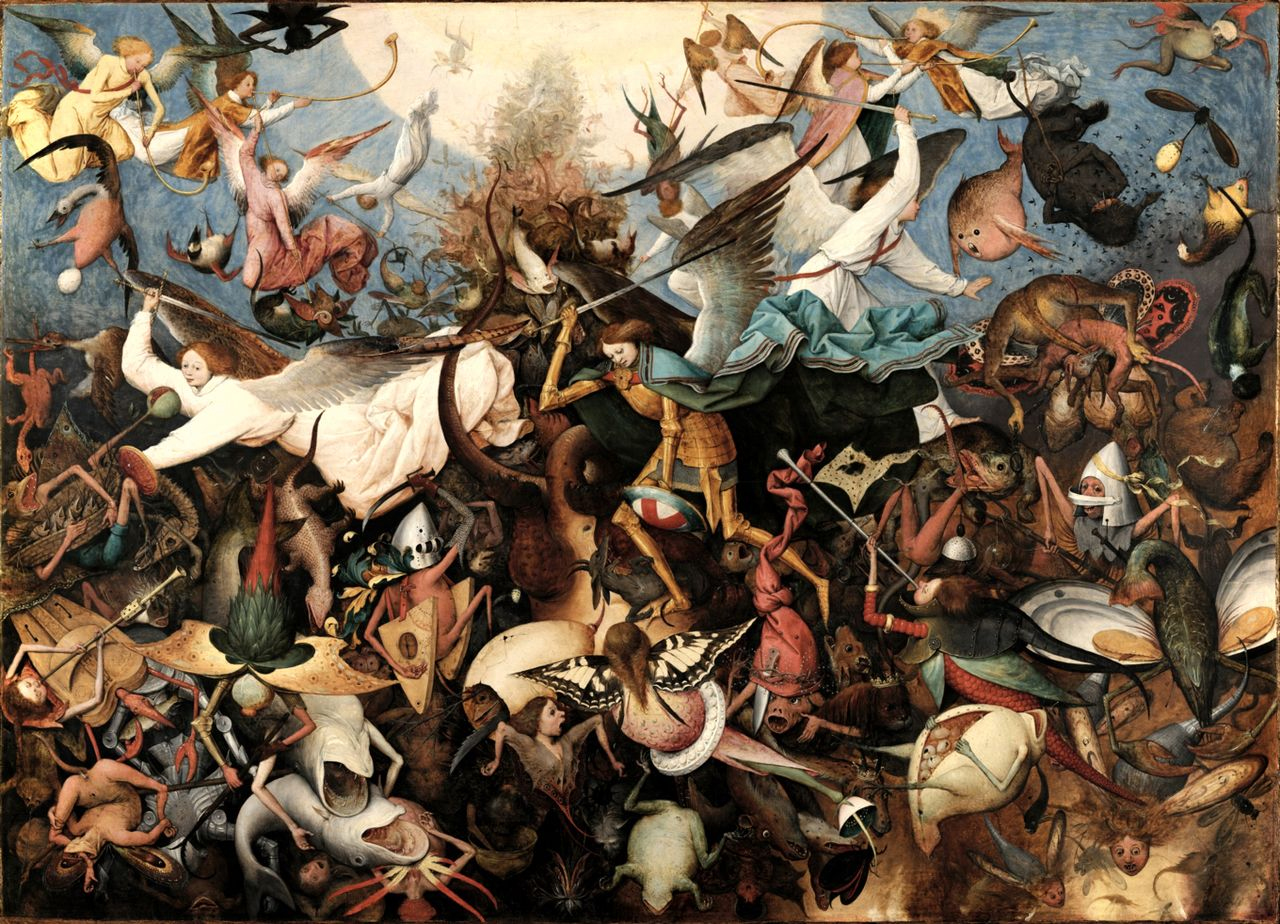
The zoology of Bruegel’s The Fall of the Rebel Angels


Pieter Bruegel the Elder is best known for scenes of everyday life and he can be regarded as the first well-known exponent of genre painting. The Fall of the Rebel Angels shows a quite different topic: the expulsion of Lucifer from Heaven by St Michael and a group of angels loyal to God. Bruegel shows us St Michael (with his shield bearing the cross of the resurrection), but it is difficult to make out Lucifer in his many-headed form. Heavenly light shines from the top of the picture, through the blue sky, and we then move down to the darkness of the abyss of Hell. Some animals are present in the sky, together with angels, and most are descending into Hell, which is not fiery, as it is described in The Holy Bible and as it is usually shown in paintings. The only hint of fire in Bruegel’s work turns out to be a feathery headdress.


An excellent commentary on the painting has been provided by the Royal Museums of Fine Art in Brussels, where the painting is exhibited [1]. As mentioned in this commentary, several of the animals shown are based on those from collections of curiosities, which were becoming popular as sources of wonder at the unfamiliar.

I would like to make some additional comments on some of the animals shown in the painting.

The puffer fish

Bruegel shows a puffer fish with the body distended. One defence mechanism used by these fish is to rapidly take water into the stomach to “inflate” the body and make spines stand out: the same mechanism is used when the fish gulp air should they be caught out of the water. In this state, puffer fish have been preserved by drying and it is likely that Bruegel saw a preserved specimen displayed in a collection of curiosities. While the eyes look unnatural, he shows the fused teeth that are used by the living fish to bite into their prey [2].

Interestingly, some puffer fish have another defence mechanism in the production of chemicals within the liver that are highly toxic to humans. So much so, that raw fugu – a delicacy in some parts of the world – requires preparation by specially-trained chefs. It tempts us to think that the inflation of the body, and the production of toxins, evolved to prevent predation by humans, but both must have existed long before the evolution of humans.


Two dead fish and bloated frogs

The fish are shown with their mouths open as if gasping, an indication of distress that Bruegel clearly wished to convey. The same intention of providing images that cause us to become frightened comes in the bloated frog, whether bloating was caused by decomposition or, should the frog be female, by being filled with eggs that will now not be laid. A second frog-like creature is shown with the abdomen split open to show what appears to be spawn, but this animal is different to Bruegel’s frog (having what looks like the “parson’s nose” of a chicken at the end of the abdomen). I have no idea what Bruegel was trying to show here.


Mussels + a crustacean

In this image we see two open mussel shells containing the body of each mollusc. The two mussels, each shown inside one of their shell valves, have clearly been cooked as, in life, the mantle (the pink/yellow fold) is closely applied to the shell for almost all of its length. Lying between the two mussels is what appears to be a crustacean, blue in colour like a lobster when alive, and the whole reminds us of a flying creature, with the mussel shells forming “wings”.


The stenogastrine wasp

Although stylised, the stenogastrine wasp is probably included as a threat and also as a bizarre creature that would also have occurred in a collection of curiosities. These wasps, like other social insects, are likely to be female and possessed of a mild sting. However, they are not usually aggressive and their appearance more frightening than reality, especially when shown at such a large size relative to other recognisable animals in the painting.


The falling birds

Two birds are shown falling into the abyss. One appears to be laying an egg, but it is impossible to identify what type of bird it might be: the other resembles a great auk, now extinct. Interestingly, Ole Worm (1588-1654), the Danish natural historian and physician, kept a great auk as a pet and, after its death and preservation, it might have found its way into his splendid cabinet of curiosities [3].


We can spend much time in speculating on what Bruegel intended in his use of images of animals, both real and imaginary. His view of the expulsion of Lucifer is certainly unique and is based on his imagination, with no attempt made to show the realistic scale of the different components. Dead terrestrial and aquatic animals are present in all parts of the painting, together with images that are supernatural and were likely to have been strongly influenced by the earlier works of Hieronymus Bosch (as mentioned in the commentary).

It is an extraordinary painting.


Monday, 31 August 2015

We can't exist without slime


What is your reaction to slime? Most people find the substance, and even the thought of it, distasteful and yet we would not be alive if it was not for slime in one form or another.

Slime consists of chemical polymers that expand on contact with water, producing a clear, sticky substance that is ubiquitous and which we recognise from its slipperiness and its ability to stick to surfaces. The compounds that make up slime are referred to as exopolymers, or EPS, by those that study them and they consist principally of carbohydrates and proteins, although many other chemicals may also be found in the EPS produced by different organisms. They are truly ubiquitous: bacteria using them to attach to substrates; single-celled algae release them when producing an excess of carbohydrate during photosynthesis; and multicellular organisms use them for protection, locomotion, to aid in feeding, to aid buoyancy, and as a means of attachment [1].


During evolution, some cells in multicellular organisms became adapted to have the sole function of producing the EPS that result in slime. These goblet cells (see above) discharge their contents to become hydrated and we are familiar with the resulting sliminess of animals like worms, slugs and fish. 

I talked about EPS to an audience of trout fishers and this was recorded by the Wild Trout Trust [2] and one of the illustrations is shown below, together with the link to the video. I could only give a very few examples, but you get the drift of my talk: EPS are everywhere and yet they are largely ignored, even by scientists who should know better. Of course, there are prejudices to be overcome and at one conference dinner I was given a special prize for "the most revolting talk" given during the sessions. An award made in good humour, of course, but indicating that the subject was one that most find unpleasant. This is a pity, because EPS are one of the most important families of chemicals known.


It is fair to say that humans would not exist if it was not for slime. This argument has two components: one that develops ideas on the evolution of humans and the other on the very important role slime plays in allowing our survival. Our most distant ancestors lived in water and left this medium when fish transitioned into the amphibians (and then into reptiles and mammals). Reptiles and mammals have body coverings that reduce the loss of moisture, something that is a threat to amphibians and also the first fish making visits to land. Anyone handling a fish is aware that they have a slippery covering and this protects the animal from attack by parasites and may aid locomotion: it is a feature that is retained by amphibians and serves to reduce water loss from their bodies when they are exposed to the air for long periods. It is also a common feature among soft-bodied terrestrial invertebrates such as worms and slugs, while others, like the arthropods, have an impervious exoskeleton that much reduces the threat of desiccation.

Fish slime protects the gills from abrasion and also provides a barrier against osmotic stress, a feature that is very important to salmon as they migrate from the sea to fresh waters. Yet gas exchange occurs from the water to the mucus and then to the tissue of the gill surface and this is a feature retained through the evolution of respiratory organs of amphibians, reptiles and mammals. Human lungs and nasal passages have a coating of mucus, moved by cilia that are a throwback to our very ancient protozoan ancestors, and it can be so plentiful that it has to be removed by blowing, coughing, or swallowing, the latter normally being a continuous and unconscious process. In addition to allowing gas exchange, this mucus acts as a trap for particles, both living and dead, and it is a convention that we blow an excess of the slime into handkerchiefs, often noting the extent of hydration once the mucus becomes dried, demonstrating admirably the extent to which the EPS had undergone considerable expansion when in contact with water. Larger quantities of slime than usual are produced when this first defence mechanism is triggered by infection.

It is not only nasal, and bronchial, tissue that produce mucus in humans, and other mammals, as slime is also found in the digestive tract and in the reproductive system. The slippery quality of mucus acts as a protection for the oesophagus and slime is produced elsewhere in the gut to allow smooth passage of the contents while protecting the wall of the digestive tract. The mucus is not broken down by enzymes and, when aqueous solutions of food chemicals are removed, characteristic compacted faeces result. These are bound with slime produced originally by the gut wall and also by EPS released by the many micro-organisms that are resident within the digestive tract; the microbes protecting themselves against digestion by secreting EPS that then become a binding material for the faeces.

The final use of slime in humans is in reproduction and, especially, in allowing the migration of sperm deposited within the female genital tract. Each sperm swims within seminal fluid that contains EPS and then traverses the cervical mucus and onwards into the uterus, where one sperm fertilises a waiting egg, if one is present. It should also be pointed out that mucus provides a lubricant to facilitate copulation. 

Vital rôles indeed and it is fair to say that we would not exist without slime in one form or another, nor would very many other organisms

Having read this far in the blog post, what are your reactions? Perhaps you agree that I deserve to be thought revolting in writing, and talking, about such things, even though I respect proper taboos in polite company? Yet I am only highlighting the remarkable diversity of uses for slime and EPS and this deserves to be much better known, rather than being given the "Ugh! response" that seems to be most people's reaction to the subject. Why do we feel that way?


[1] Roger S. Wotton (2005) The Essential Role of Exopolymers (EPS) in Aquatic Systems. Oceanography and Marine Biology: An Annual Review 42: 57-94.