Showing posts with label Camouflage. Show all posts

Friday, 26 June 2015

Decoration in humans and other animals


A wide variety of animals decorate their outer surface. In a review paper, Graeme D. Ruxton and Martin Stevens [1] have defined a decorator as:

..an organism that (by means of specialist behaviour and/or morphology that has been favoured by selection for that purpose) accumulates and retains environmental material that becomes attached to the exterior of the decorator.

This definition is a bit complicated as it is designed for an audience of scientists, but you get the drift. Ruxton and Stevens then give us some examples, beginning with decorator crabs (below left) that attach all sorts of materials to hooked hairs present over the body of the animal:

Several studies..have found that experimentally altering or removing decoration [from decorator crabs] increased vulnerability to predators.. ..Items used in decoration are often chemically defended plants or sessile animals, and it seems plausible that predators detect the crab but actively avoid attacking because of the repellent smell or taste from the decorations. However, not all decorations provide the animals with chemical defence, and it is likely that decoration often functions through crypsis via background matching, masquerade and/or disruption.


Another type of decoration is seen in insects that use faecal shields, an example being larvae of the tortoise beetle (above right), where faecal pellets are retained on an extension of the body, so that the solidified shield provides cover for attack by predators. The shield acts both in crypsis and as a physical defence [1], isolating the body from potential attacks; other insects use a covering of faecal material directly on the surface of the upper body. However, decoration in insects is not confined to the use of faeces: other components of "backpacks" may be cast skins from moults, or organic, and mineral, grains obtained from the surrounding environment and stuck on to the back by secretions, or held there on hairs extending from the body surface.

Decoration is also used by birds (and I am not including those, like bower birds, that make collections of bright objects remote from the animal itself). To quote Ruxton and Stevens [1]:

In birds, a range of species add substances to their feathers that alter their appearance (termed cosmetic coloration).. Staining of the feathers with soil has been observed in a number of large birds.. ..Both sexes [of the rock ptarmigan] sport all-white plumage at the start of the breeding season, as snow melts this becomes very conspicuous and females moult to produce feathers that appear to offer good camouflage. By contrast, males do not moult immediately, but smear their feathers with soil before later moulting into a brown plumage.

Free-ranging adult bearded vultures..typically have an orange colour on their underparts, neck and head conferred by iron oxide-rich soils.. .. Colour tends to be greater in (socially dominant) females than males and increases progressively from juveniles, to immatures, to sub-adults to adults.

Ruxton and Stevens conclude their review by saying [1]:

Decorating is a particularly diverse activity, and (like tool-use) it is difficult to produce an unambiguous definition that covers all cases effectively.. .. Anti-predator benefits are most commonly postulated, in contrast to humans where decoration functions strongly in social interactions.

Their last sentence set me thinking. Unless one believes in Creation, it is not possible for us to look at the behaviour of our own species without realising that much of it developed as we evolved so successfully away from the rest of the Animal Kingdom. In this post, I describe the origins of human decoration, confining myself to clothes, accessories and make-up, as these best fit the definition given above.

Humans lack a dense covering of hair over the whole body and it is likely that our first use of decoration was by draping ourselves in animal furs that were protective and helped to keep us warm. It could be argued that this enabled early humans to migrate to regions with cooler climates, something that was also facilitated by the discovery of fire, but it is unlikely that animal pelts provided camouflage against predators. Camouflage coverings are certainly important in providing crypsis in warfare and they form an important part of the clothing using by contemporary fighters (below), together with applied face paints. This is analogous to the main use of decoration used by animals but most of our clothing, in addition to its functions of keeping us warm and protected, is used in expressing social status, for mate selection, or for group identity.


Among contemporary costume, the business suit is currently de rigeur for men in many countries and in many walks of life, with only small changes in the design of a jacket and trousers. There is status in having a designer label and this is true also of all clothes, something that conveys both the quality of materials and tailoring, but also exorbitant cost. The expression of wealth in this way is important in Western Society, as is the quantity of items in an individual's collection. Surprisingly, while the business suit represents a work uniform (although casual clothes for men are more varied), women's fashion is based on variety, and it is considered acutely embarrassing to wear an outfit that is identical, or too similar, to that worn by someone else at the same social function. Despite trends in fashion, decoration in women is thus less about uniformity and more about the uniqueness of the individual. Why?

The answer to this question probably lies ancestrally in mate selection. Humans do not have a breeding season and mating can occur at any time through the year. Mate selection is based on genetic factors – the classic notion of handsome men and beautiful women pairing up – but also on decoration. Clothes are an important part of this and initial mate selection is often influenced by clothes, as these convey information about social status and identity, something that is important if mate selection is for the long-term and where breeding is likely. Of course, there are more factors than decoration involved in selection, but it forms an initial signal, with most encounters initiated by men.

In addition to the decoration provided by clothes, there are also accessories, especially used by women, and we all know individuals with a shoe and/or handbag addiction. The most similar parallel to animal decorators comes in jewellery in all its forms. This type of decoration may emphasise status, as in the integration of precious stones, or be used as a symbol of lack of availability, as in wedding rings. Similar forms of decoration are present in many tribal cultures, not just those of the Developed World, and extend to neck rings, necklaces, nose plugs and rings, ear plugs, earrings and many other forms. They are not confined to women either, as they are used by both sexes as indicators of cultures and sub-cultures, something unknown among animals other than humans.


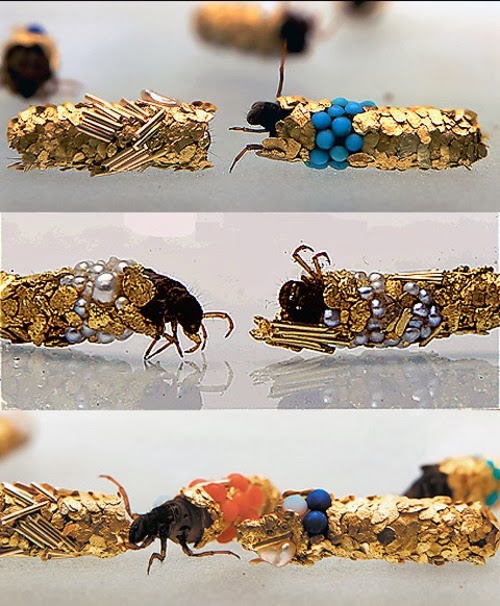
It is ironic that one design of earrings is based on the activity of an animal decorator. Larvae of some caddis flies make cases of stones that are bound together with silk secreted by the insect. This habit has been utilised by jewellers who give larvae semi-precious stones and wait for each earring to be produced [2]. It's the only example I can think of where the activity of one decorator animal is used by another, albeit for a different purpose.

In addition to clothes and accessories, considerable attention is given to enhancing the appearance using paints and powders of various kinds. Use of ochre and ash in face and body colouration is a characteristic of some "primitive" tribal groups, but make-up in Western Culture is usually more subtle, with concentration on the face. As with clothes and accessories, there are variations but, in general, powders are used to enhance the complexion and to hide blemishes, while various products are used to decorate the eyes and lips to provide emphasis. Although men use cosmetics, women are the main users and, as with other forms of decoration, the underlying message is related to mate selection and/or belonging to a social group.  


Just as humans evolved rapidly, so did our use of decoration. It now has many forms and is constantly changing, except in tribal cultures and where national costume, or work customs and uniforms, create an identity. However, we are animals and the origin of our use of clothing, accessories and make-up lies far back in evolutionary time.


[1] Graeme D. Ruxton and Martin Stevens (2015) The evolutionary ecology of decorating behaviour. Biology Letters 11: 20150325.


Wednesday, 30 July 2014

Two bugs, predation and evolution


I grew up by the sea, so it is not surprising that I developed a fascination for marine shores and the plants and animals that live there. 1 I loved looking in rock pools at low tide and seeing some creatures dart away, while others clung tightly; and lifting drying seaweed to see what sheltered under the wet fronds beneath. As a teenager, there were plenty of other things to occupy my mind, but I retained my love of Natural History and always enjoyed walking through the Devonshire countryside and around the coast. It was while at University that I discovered the flora and fauna of fresh waters and I then went on to have a research career looking at stream and river ecosystems, while retaining a fascination for all aspects of Aquatic Science. It fuelled my teaching and I hope that my curiosity rubbed off on some of my students, as it is enriching. Underlying my interest has always been a child-like approach - “Look at that!”, “Why is that?” etc. - and I’m pleased that I have failed to grow up in that regard.

While collecting damselfly larvae from a weedy lake for a University vacation project, I first came across two creatures that so interested me that I took them home and kept them in large jars. One was a solitary water stick insect, Ranatra linearis (below left, total overall length 7 cm) and then several specimens of the water scorpion, Nepa cinerea (below right, total overall length 3 cm). Although it is similar in appearance to a stick insect, Ranatra is not related to members of this group, but has evolved the same mechanism to avoid detection by resembling a twig. Nepa looks a little like a scorpion, at least at the front end, but it is not related to the scorpions and is very close, in evolutionary terms, to Ranatra, both being members of the Nepidae group of bugs. Nepa is dark brown in colour and resembles the decomposing leaves amongst which it lives so it, too, is camouflaged.


As they are closely-related, one would expect many similarities in the structure, and behaviour, of these insects. Both are true bugs and thus have incomplete metamorphosis, with larval stages that are similar in form to the adults and that undergo a series of moults, and thus increase in size, until the fully-grown insects emerge. During the larval stages, wing buds are present and the adults have wings, although they do not fly well - or often. All aquatic insects have terrestrial ancestors but these bugs spend almost their entire life in water, retaining a system of tubes within the body for air breathing. Whereas some aquatic insects have developed gills containing branched air tubes, both Ranatra and Nepa have two long extensions at the hind end of the body and these are closely applied and form the equivalent of a snorkel that is held at the surface when the bugs need to replenish air supplies.

The majority of insects have six walking legs, allowing them to move over the substratum by having three points of contact at all times, each tripod providing stability. Ranatra and Nepa have six legs, but the first pair is adapted for catching and holding prey, the other four legs being used to crawl slowly through vegetation. Their camouflaged appearance gives the bugs some protection against attack and, together with their lack of movement, makes them good “wait and see” predators. Any suitable prey that comes within range is grabbed by the fore-limbs and, in Nepa, these have become modified so that the lower part folds into a notch in the upper part, much as a blade folds into a penknife (see the video clip below). Any organism that is caught cannot escape and the bug uses its rostrum of piercing mouthparts to both inject salivary secretions and then suck up the body fluids and digested contents of their prey. It was this predation that fascinated me and the bugs that I kept in jars fed on a range of animals, including water fleas and insect larvae of several types. Especially impressive was the capture by Ranatra and Nepa of tadpoles and I was fascinated by their feeding. There’s something about watching predation that captures our attention, perhaps because it seems a little shocking, as we are witnessing "nature in the raw". I saw both bugs complete several meals and was impressed by how little effort appeared to be required from initial capture to the time the remains of the prey were discarded.


Unless one is a Creationist, Ranatra and Nepa provide excellent examples of evolution. They share the same method of catching prey, using modified fore-limbs, feed using a rostrum, they have invaded fresh waters form a previous terrestrial existence, and both have a breathing tube to enable them to remain submerged. It is likely that these were all features of a common, now extinct, ancestor and the two forms then diverged, with the evolution of different body forms that enable them to live in slightly different parts of habitats. Thinking about their structures, and how they evolved, is as fascinating as watching the bugs “in action” and I’m pleased that I’m not a Creationist. Of course, we can all share a sense of wonder in watching Ranatra and Nepa, but to think of evolution, and all the changes that have occurred through time is amazing, as we have no way of conceptualising a million years, let alone the many millions of years over which changes in body form and behaviour occurred. Natural History is not a religion, but it is certainly rewarding to all of us lucky enough to observe all the extraordinary adaptations that evolution has provided.


[Please play without sound - you know my views on this. 1 The red spots on the legs are water mites.]

1 Roger S. Wotton (2012) Walking with Gosse: Natural History, Creation and Religious Conflicts. Southampton, Clio Publishing.


Tuesday, 12 November 2013

Caddis flies, earrings and evolution


During my career, I attended many conferences on Aquatic Biology and they always attracted exhibitors demonstrating nets, electronic measuring equipment, collections of the latest books, etc.. Occasionally, there would be something different and, at one conference, I came across a stand where jewellery was for sale. At first, it was not easy to see the connection to life in water, until it was explained that the various earrings and pendants were made from cases that had been produced by caddis fly larvae. Partly because of the novelty, and partly because they were attractive, I bought a pair of earrings that had cases made from fragments of jasper and my wife was pleased with them, and intrigued by the story of their manufacture.


Subsequently, I found that this type of jewellery is available from several sources and, in addition to the use of fragments of natural stone, caddis fly larvae are allowed to build cases with precious stones, pearls and even gold fragments.


Many, but not all, caddis fly larvae build cases, and the materials that they use vary from species to species. Some build cases of vegetation and some of stones of a range of sizes, the common feature being that all the separate pieces of material are cemented together with silk produced by the insects from modified salivary glands, which exit near the mouth. The silk is not only strong but highly adsorptive, and its “stickiness” is not affected by it being produced under water. It was silk that bound the stones of jasper in my wife’s earrings and, having produced a case, it was an easy matter for the jewellers to remove the larva, pick up the cases, dry them and then cover them with lacquer to ensure that they would not fall apart for years. The larva could then start the process all over again, just as it would do in natural conditions if, for some reason, it was separated from its case.

Caddis larvae use cases for protection, camouflage and ballast, but some forms do not make cases, using silk to provide an enclosure to which stones may be attached, or to make feeding nets. These vary from wide aperture nets, useful for capturing materials from a fast current, through to large sac-like nets in which the larva lives while grazing over the material that has accumulated. Some caddis larvae are free-living predators and they have neither cases nor silk nets. Other caddis larvae build cases entirely from layers of silk. Whatever the adaptations shown by the larvae, it is important to remember that the larval stage is but one part of their life cycle. Having completed five larval stages, moulting between each to achieve larger size, the final stage larva spins a cocoon in which to pupate. This cocoon is frequently covered with stones or other materials and is cemented to the substratum using silk. A complete transformation of the insect now occurs, with the adult biting its way from the cocoon and emerging from the water to fly away and complete the life cycle by mating and laying eggs back into the water.


For those who believe in the literal accounts of Creation in Holy Books, the biology of these insects is easy to explain - a deity designed each species, its life cycle and its choice of whether to build a case, or not. Furthermore, the materials that each species used in case construction, and its preferred habitat, were all designed and the insects put in place some time in the first days of life on Earth. All very straightforward, but I am not a Creationist and therefore face some challenging questions - questions that I cannot answer readily (or at all):

1. Why the complex life cycle, with aquatic larval and pupal stages and terrestrial adults?

2. Why the use of silk?

3. Why the choice of different case materials, or the building of nets?

Here are some thoughts on each of these questions:

Why the complex life cycle, with aquatic larval and pupal stages and terrestrial adults?

Primitive insects have larval stages that become progressively larger and it is from the last larval stage that the flying adult emerges. Evidence of this form of metamorphosis is seen by observation of dragonfly larvae, where the growing wing buds are seen throughout larval life, and especially in the last stage. Caddis larvae do not need to grow wing buds, or other adult features, as the re-organisation of body form is completed within the pupal skin. In both types of development, all mechanisms are under genetic control, so the evolution of the genetic template is the basis of everything. We can only speculate on how pupation developed, but it must have resulted from mutations that, taken together, allowed the dramatic transformation from larva to adult. How did it happen; and did it occur gradually, or in an explosion of change? I don’t know.

We know that aquatic insects were originally terrestrial in all their life stages and that they had originally evolved from an ancestral form that was marine. Interestingly, there is evidence that the invasion of fresh waters by different groups of aquatic insects has occurred at different points in geological time, 1 from ca. 200,000,000 years ago through to more recent times (perhaps just tens of millions of years ago). Interestingly, while there are many types of aquatic insects in streams, rivers, ponds and lakes, they are rare in marine habitats.

Why the use of silk?

The ancestors of caddis flies, and some other insects, evolved the secretion of silk from the salivary glands, the original secretions being use in feeding. Silk consist of a complex of materials, including very strong protein filaments and, once evolved, the insects had an excellent mechanism for joining components of cases or for making tent-like refuges. As silk is equally effective under water, this feature was of advantage when the invasion of flowing and still fresh waters occurred.


Why the choice of different case materials, or the building of nets?

Having invaded water, ancestral caddis flies would need to acquire food. The production of silk nets allowed the capture of particles from flowing water but the water could also cause the displacement of larvae. This may be the origin of stone cases as ballast, as well as for protection. If larvae were protected from being swept away, and avoided predation by having cases that were made of the materials that surrounded them, they would have had an increased chance of survival. Thus, the genetic basis of the case-building habit will have been passed to future generations. Different types of cases show adaptation to different habitats and ponds with abundant vegetation will provide different selection pressures than streams or lake shores with stony substrata. As the caddis larvae spread throughout fresh waters, the formation of different species resulted from the selection of characteristics that promoted separation of ancestral breeding stocks and thus a diminished chance of inter-breeding, something which also occurred with the geographical separation of adults, together with changes in their breeding behaviour and apparatus. This process of speciation explains the many different forms that we see today.

It is difficult to comprehend the time periods over which evolution has occurred. However, thinking about the possible evolution of caddis flies is, to use a modern term, awesome and, for me, much more compelling than ideas based on Creation and a Designer. However, if it’s information you want on the various events during evolution.......


1 Timothy M Bradley et al. (2009) Episodes in insect evolution. Integrative and Comparative Biology 49: 590-606.


Sources of illustrations: