In an earlier blog post [1], I asked the question “What’s
not to like about bats?”. Accepting that bats are not universally popular, I pointed
out that, for many, they are associated with unpleasantness and feature in several stories about witches. This is illustrated in the frightening image of Goya’s Witches’
Sabbath, where bats fly over the witches’ heads as they worship the devil
in the form of a goat (see below, with detail).
Further in the blog post [1], I wrote:
This association with the “dark
world” stems from the crepuscular and nocturnal habits of bats, and our
nervousness about what happens during darkness – a “fear of the night” and
anxiety about the possible presence of evil spirits. There is also something about
the rapid flight of bats that some find disturbing and one belief is that they
can become entangled in hair. ..A further prominent feature of folklore is that
bat blood, or other extracts from the animals, cure eye diseases; arising, no
doubt, from the ability of bats to be active in darkness.
We can now add another negative to the reputation of these fascinating
mammals with the discovery that bats may be the source of the COVID19 global
pandemic. In a paper published in The Lancet [2], Lu et al. write:
..on the basis of current data, it
seems likely that the 2019-nCoV causing the Wuhan outbreak might also be initially
hosted by bats, and might have been transmitted to humans via currently unknown
wild animal(s) sold at the Huanan seafood markets.
One suggested intermediary is the pangolin, but other animals
present in the market are more likely. But then, what if some of the Huanan stallholders knew of the folklore that bat blood aids the cure of eye diseases and rubbed
infected bat blood into their eyes? This practice was known from Ancient Egypt,
but mythologies travel. We will probably never know if this happened, but I
hope that one of the solutions to our problems with this coronavirus is not the
attempted extermination of bats, when the pandemic almost certainly results
from the activities of humans.
[2] Roujian Lu + 34 co-authors (2020) Genomic characterisation
and epidemiology of 2019 novel coronavirus: implications for virus origins and
receptor binding. The Lancet 395:565-574.
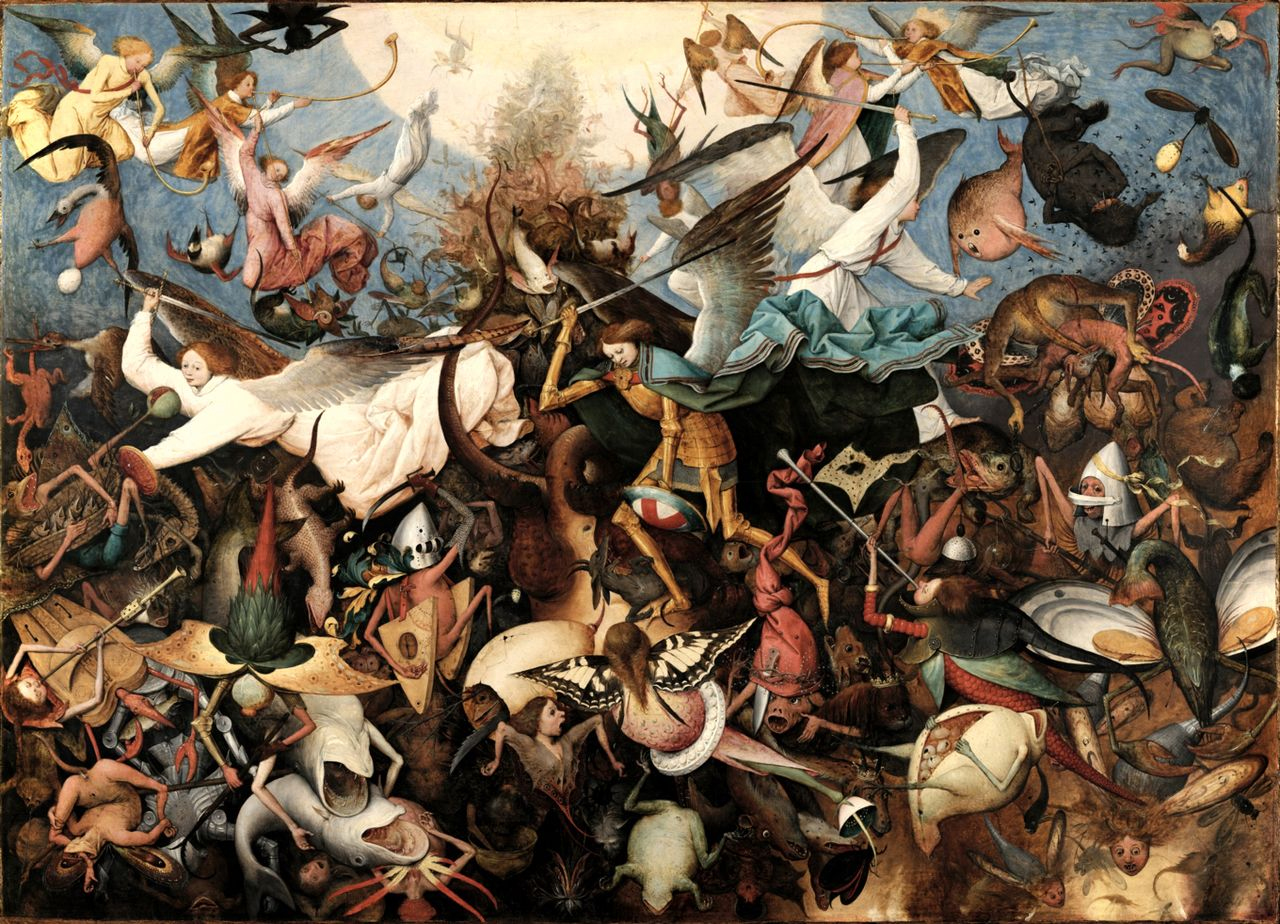
Pieter Bruegel the Elder is best known for scenes of
everyday life and he can be regarded as the first well-known exponent of genre
painting. The Fall of the Rebel Angels shows a quite different topic:
the expulsion of Lucifer from Heaven by St Michael and a group of angels loyal
to God. Bruegel shows us St Michael (with his shield bearing the cross of the
resurrection), but it is difficult to make out Lucifer in his many-headed form.
Heavenly light shines from the top of the picture, through the blue sky, and we
then move down to the darkness of the abyss of Hell. Some animals are present
in the sky, together with angels, and most are descending into Hell, which is not
fiery, as it is described in The Holy Bible and as it is usually shown in paintings.
The only hint of fire in Bruegel’s work turns out to be a feathery headdress.
An excellent commentary on the painting has been provided by
the Royal Museums of Fine Art in Brussels, where the painting is exhibited [1].
As mentioned in this commentary, several of the animals shown are based on
those from collections of curiosities, which were becoming popular as sources
of wonder at the unfamiliar.
I would like to make some additional comments on some of the
animals shown in the painting.
The puffer fish
Bruegel shows a puffer fish with the body distended. One
defence mechanism used by these fish is to rapidly take water into the stomach
to “inflate” the body and make spines stand out: the same mechanism is used
when the fish gulp air should they be caught out of the water. In this state,
puffer fish have been preserved by drying and it is likely that Bruegel saw a
preserved specimen displayed in a collection of curiosities. While the eyes
look unnatural, he shows the fused teeth that are used by the living fish to bite
into their prey [2].
Interestingly, some puffer fish have another defence mechanism
in the production of chemicals within the liver that are highly toxic to
humans. So much so, that raw fugu – a delicacy in some parts of the world –
requires preparation by specially-trained chefs. It tempts us to think that the
inflation of the body, and the production of toxins, evolved to prevent
predation by humans, but both must have existed long before the evolution of humans.
Two dead fish and bloated frogs
The fish are shown with their mouths open as if gasping, an
indication of distress that Bruegel clearly wished to convey. The same
intention of providing images that cause us to become frightened comes in the
bloated frog, whether bloating was caused by decomposition or, should the frog
be female, by being filled with eggs that will now not be laid. A second frog-like
creature is shown with the abdomen split open to show what appears to be spawn,
but this animal is different to Bruegel’s frog (having what looks like the “parson’s
nose” of a chicken at the end of the abdomen). I have no idea what Bruegel was
trying to show here.
Mussels + a crustacean
In this image we see two open mussel shells containing the
body of each mollusc. The two mussels, each shown inside one of their shell
valves, have clearly been cooked as, in life, the mantle (the pink/yellow fold)
is closely applied to the shell for almost all of its length. Lying between the
two mussels is what appears to be a crustacean, blue in colour like a lobster
when alive, and the whole reminds us of a flying creature, with the mussel shells forming
“wings”.
The stenogastrine wasp
Although stylised, the stenogastrine wasp is probably included
as a threat and also as a bizarre creature that would also have occurred in a collection
of curiosities. These wasps, like other social insects, are likely to be female
and possessed of a mild sting. However, they are not usually aggressive and
their appearance more frightening than reality, especially when shown at such a
large size relative to other recognisable animals in the painting.
The falling birds
Two birds are shown falling into the abyss. One appears to be laying an egg, but it is impossible to identify what type of bird
it might be: the other resembles a great auk, now extinct.
Interestingly, Ole Worm (1588-1654), the Danish natural historian and physician,
kept a great auk as a pet and, after its death and preservation, it might have
found its way into his splendid cabinet of curiosities [3].
We can spend much time in speculating on what Bruegel intended
in his use of images of animals, both real and imaginary. His view of the expulsion
of Lucifer is certainly unique and is based on his imagination, with no attempt
made to show the realistic scale of the different components. Dead terrestrial
and aquatic animals are present in all parts of the painting, together with images
that are supernatural and were likely to have been strongly influenced by the
earlier works of Hieronymus Bosch (as mentioned in the commentary).
The reality TV show I’m a Celebrity Get Me Out of Here
is justifiably popular in the UK. Set in Australia, the contestants live in a
basic camp and we viewers see edited versions of their conversations and other
interactions. To boost their diet of rice and beans, selected individuals compete
in “Bushtucker Trials” that involve something very unpleasant, like having
large numbers of cockroaches, mealworms etc. thrown over them in a confined
space (see below). Until the last series, the trials most popular with the
viewing public were those involving the eating of animal body parts and also
live insects. The latter torture has now been banned as it is perceived by some
as being cruel; yet eating live animals is encouraged elsewhere – take the case
of oysters.
Oysters are bivalve molluscs that produce a feeding current
using enormous numbers of tiny hairs, or cilia, that are present on the gills.
This current has a dual function as it evolved from the respiratory current, particles
trapped on the surface of the gill then being transferred to the mouth by other
tracts of cilia. To aid retention, oysters, like other bivalves, produce mucus,
or slime, on the gills and particles captured are thus bundled up into packages
from which nutritious material can be selected by an ingenious sorting mechanism
using the lips (labial palps) around the mouth.
The two shell valves are joined by a hinge and a muscle runs
from one shell valve to the other and this serves to close the oyster if it is
exposed to the atmosphere, when attacked, or not feeling. Sea water is trapped when
the shell valves are closed and this prevents damage to the soft body tissues.
When we buy oysters, they have frequently been out of water for hours, so the content
of the water is changed by the addition of mucus and excreta, although not at
levels that poison the mollusc.
The classic way to open oysters is to shuck them and this is
shown in the video [1]. Note that both the hinge and adductor muscle (between
the shell valves) are cut, but no reference is made to the oyster being alive and
that the water + excreta are referred to as the liquor. The flavour of the
liquor is an important part of eating oysters and there are debates over whether
one should chew the animals or crush them against the palate using the tongue.
Fortunately, the molluscs are often served on a bed of ice so, at least, their
metabolism is reduced, even if they are sometimes sprayed with dilute acid
(lemon juice).
For those who do not like the idea of eating live animals,
there are many recipes for cooking, and preserving, oysters and that is not a surprise,
when they were such a common food, and not the luxuries that they have become
today. Cooking also serves to kill bacteria that might otherwise cause intestinal
disorders in those eating them: something that may have been common when
oysters were collected from areas where there was a high level of pollution.
Lovell [2] gives many recipes for cooking oysters and they
can be listed. Some involved rapid killing of the molluscs, others did not:
Oyster soup (7 recipes)
Oyster sauce (4 recipes)
Oyster atlets – with sweetbreads
Curried oyster atlets
Curried oysters
Stewed ousters (6 recipes)
Dutch oysters – coated in breadcrumbs
and fried
Fried oysters (6 recipes)
Oyster ragout (2 recipes)
Grilled oysters
Oysters broiled the Dutch way
Roast oysters (3 recipes)
Ostras á la Pollada
Boiled oysters
Oyster sausages (2 recipes)
Minced oysters
Oyster forcemeat
Oysters and chestnuts
Oyster steak
Scalloped oysters (3 recipes)
Oyster fritters
Oyster loaf
Oysters and macaroni
Oyster pie (3 recipes)
Oyster and eel pie
Oyster and parsnip pie
Pickled oysters (4 recipes)
Oyster powder (2 recipes)
Oysters on toast (2 recipes)
Oyster ketchup
Oysters au gratin
An impressive list, and gourmets among you should refer to
Lovell [2] for descriptions of how to prepare oysters for each dish. Its length is a
reflection on the importance of these molluscs in the diet of many European nations
(and beyond) in earlier centuries.
Arguably, the most interesting way of preparing oysters is
described thus by Lovell [2]:
The oldest way of cooking an
oyster, of which we have any mention, is that recorded by Evelyn, who, in the
year 1672, saw Richardson, “the famous fire-eater”, perform wondrous feats, one
of which was, “taking a live coal on his tongue, he put on it a raw oyster; the
coal was blown on with bellows, till it flam’d and sparkl’d in his mouth, and
so remained till the oyster gaped, and was quite boil’d.” Who ate the oyster
thus cooked, we are not informed.
Many arguments can be put forward against the continued existence of Public Schools in the UK, especially their encouragement of a sense of entitlement. Having said that, the
facilities that the top schools provide are often excellent and so is the standard
of teaching. Many schools also select students for their academic ability and this results in
classes where there is a strong sense of curiosity, contributing to
a good atmosphere for learning.
I have given talks in Public Schools and among the most memorable
was a visit to Winchester College. The Times had taken up an article
that I had written about The Great Plagues of Egypt [1,2] and I was asked to
give a lecture on the subject. Not only that, I was also entertained to dinner
by the scholars (an elite, elite group) and conversation was wide-ranging and
interesting. Earlier, I noticed that there was a display outside the lecture theatre
and this consisted of a description of the platypus genome that had just
been published in the journal Nature and there was also a stuffed
platypus and much general information about the animal. All very impressive, given that the
paper was so recent and one felt that the students of Biology were lucky to
have this stimulating input.
The most impressive example of the good fortune that
students in the major Public Schools receive comes from a school that I have
not visited, but which has an excellent website. The web page for Biology at Sevenoaks
School [3] gives a brief description of teaching in the subject and ends with
this quote from Robert Preston:
In Biology, nothing is clear,
everything is too complicated, everything is a mess, and just when you think
you understand something, you peel off a layer and find deeper complications
beneath. Nature is anything but simple.
It comes from Preston’s book The Hot Zone, The Terrifying
True Story of the Origins of the Ebola Virus and his sentiments have a wide
application in Biology. In my own research, I rapidly became aware that the
more I found out about life in water the less I understood how aquatic
ecosystems worked. I gave up practical research, as there
were far too many questions and I ceased to have the energy, or ability, to
pursue them. That was not depressing, but liberating, as I could then read widely and venture into other fields, while retaining a sense of wonder about Nature, something that all students of Biology develop. For some, this wonder finds
an answer in religious beliefs; for others in a deep respect for the world around
us and thus a sense that humans are just a small part of something much bigger.
I’m sure that Biology students at Sevenoaks School, in
addition to achieving excellent results in examinations (that we all know are important),
will leave with a much broader understanding than the content of a syllabus provides. Whether
they become lawyers, bankers, politicians, etc., their sense of wonder when
thinking about the natural world will be invaluable in the roles they play in planning
for the future. Do all schools encourage this approach?
The great artist J.M.W.Turner travelled widely throughout
Great Britain, making sketches as he went. Two pages from his notebook of 1811
show Brixham harbour on the southern coast of Torbay, with its two piers and a
number of boats, for this was a busy fishing port (see above). It was a time
when the northern shores of Torbay were becoming fashionable, leading to the construction
of many villas in Torquay in the middle of the nineteenth century. New
residents were reminded of the French Riviera, enjoyed the favourable climate
that was thought to be good for the health, and many were fascinated by the
Natural History of the shoreline.
Philip Henry Gosse had this to say in 1853 about a visit he
made to Brixham (he became a Torquay resident in 1857) [1]:
The little town of Brixham, pretty
as it appears when viewed from Torquay, is but a sordid affair when you see it
at hand. The lower town particularly is close, mean, and dirty; indeed, truth
to tell, I saw refinements in filth here, which I had never the fortune to see paralleled
in all my wanderings..
..The scenery on either hand, when
once clear of the harbour, is bold and magnificent. The coast is rocky and
precipitous, (the town itself appears strangely stuck upon precipices, reaching
from top to bottom) and is indented with little coves, the most picturesque
imaginable. Berry Head, a noble promontory of compact limestone, rears its
lofty head abruptly out of the sea not far from the town, and forms a commanding
boundary of the prospect, conspicuous all around..
..I did not obtain much in the way
of natural history on the shore, except what I was already familiar with at
Petit Tor [his favourite collecting spot north of Torbay]..
..I came home with little desire
to see Brixham again.
Not kind words. It was the busy fishing harbour and the
surrounding cottages that appalled Gosse and one surmises that he was complaining
about the remains of fish and a lack of regard for surroundings that characterised
fishing villages of the time. They were not genteel. In addition, decomposition
of anything marine produces a very strong smell and that must also have
affected his senses
Brixham is very different now. The two piers that Turner
drew are still in place (see above), but the outer pier has been extended. Beyond
that on the western shore is the modern fish market complex and to the east the
breakwater that was begun after Turner’s time and completed in the early 20th
Century. Also noticeable is the marina and that has promoted marinafication – an
influx of wealth also found in other local ports, such as Salcombe and Dartmouth.
Brixham seems “on the up” and I’m sure that Gosse would not find it as unpleasant should he visit today, although he may have something to say about the
tourist attractions and tourist shops that also bring money into the town.
As to Natural History, visitors and residents like to see
seals and occasional cetaceans, but there is a lack of awareness of most marine
life. That is also quite a contrast to earlier times.
[1] Philip Henry Gosse (1853) A Naturalist’s Rambles on
the Devonshire Coast. London, John Van Voorst.
Turner’s sketches are from the tate.org.uk website
The aerial view of Brixham is from englishriviera.co.uk website
“Don’t judge a book by its cover” is a phrase that
originated in the mid-Nineteenth Century and we have all been surprised when the content
of books bears little relation to the illustrations that appear on their
covers. A good example is provided by the illustrations for Father and Son
[1], an autobiography by Edmund Gosse that leaves readers with a feeling of
empathy for its author, as he faced the challenges of a strict religious upbringing
in Torquay in the 1850s and 1860s. Among these readers is Sarah Perry who wrote
an article in The Daily Telegraph [2] drawing parallels between Edmund’s
experience of the constraints of a religious straitjacket with her own upbringing
as a Baptist. She acknowledges the power of his writing in describing his
father, the great Natural Historian Philip Henry Gosse, a creationist and member
of the Brethren.
Father and Son had a long gestation. Edmund published
the first biography of his father in 1890, two years after Henry died, and it is
a largely factual account that also includes an appreciation by Eliza Gosse,
Henry’s second wife and Edmund’s stepmother. Ann Thwaite remarks [3] that the
biography was “extremely well received” and various of Edmund’s friends, such
as John Addington Symonds and George Moore, saw another book in the story of
Henry and Edmund, to be told from Edmund’s side. That book was Father and
Son, and the germ of the idea took years to grow.
Like Ann Thwaite, Sarah Perry recognises that Edmund was not
renowned for accuracy and Father and Son, published anonymously, and
with the names of some key characters altered, may contain some exaggerated
stories. However, it is a powerful work of literature and has done much to colour
the reputation of Henry Gosse that we have today. Almost everyone comes to the
Gosse family through reading works by Edmund (including Ann Thwaite, who
followed up her biography of Edmund with her delightful biography of Henry, Glimpses
of the Wonderful [4]). In contrast, I came to Edmund through reading Henry’s books and
scientific writings and he was a fascinating and warm man. However, my
admiration does not extend to his religious beliefs and this is recounted in Walking
with Gosse [5] and numerous posts on this blog [6].
Considering the the way we select books set
me thinking about how many people first chose to read Father and Son from
the art work on the cover. But how true is the illustration to the content? Let’s
look at some of the covers that have adorned Edmund Gosse’s book.
The first I show (above) has the famous picture of Henry and Edmund that was
used as the frontispiece for the first edition of Father and Son. The photograph
was taken in Torquay in 1857; the year when they had moved to St Marychurch
after the death of Henry’s first wife Emily. It is touching and clearly meant
much to Edmund.
The next cover features the wonderfully sensitive portrait
of Edmund by John Singer Sargent (above).
We then go on to see covers from various editions (above) that
show the shore where Henry and Edmund collected specimens or the countryside
through which they walked. They provide a general background, but they are not recognisable
as being from Torbay.
The final series of cover illustrations (above) appear to have been
created by artists who had little inkling of the content of the book and some of
them are decidedly strange. As stated earlier, “Don’t judge a book by its cover”.
[1] Edmund Gosse (1907) Father and Son: A Study of Two
Temperaments. London, William Heinemann.
[2] Sarah Perry (2018) Like meeting the gaze of a friend in
a room of strangers. The Daily Telegraph 24th November pp. 14-16.
[3] Ann Thwaite (1984) Edmund Gosse: A Literary Landscape.
London, Martin Secker and Warburg.
[4] Ann Thwaite (2002) Glimpses of the Wonderful: The
Life of Philip Henry Gosse 1810-1888. London, Faber and Faber.
[5] Roger S Wotton (2020) Walking with Gosse: Natural
History, Creation and Religious Conflicts. e-book.
In one of the most popular scenes in the BBC adaptation of Jane
Austen’s Pride and Prejudice [1], Mr Darcy (Colin Firth) dived into the
lake at Pemberley and then encountered Elizabeth Bennet (Jennifer Ehle) while
walking back to the house. His swim was an invention, although the meeting at Pemberley
does take place in the book, as does the introduction to Mr and Mrs Gardiner (Tim
Wylton and Joanna David). In that dialogue, there is further invention when Mr Darcy
relates that he used to run from Pemberley into Lambton (more than four miles!) as
a boy to collect horse chestnuts from the tree on the green. It did seem an odd
thing to do, but maybe there were no suitable horse chestnut trees on the
Pemberley estate, despite its many acres of “some of the finest woods in the
country” [1]?
The dialogue brought fond memories of playing conkers to all
of us who watched the programme: collecting the conkers; making a hole through
the “best” ones with a meat skewer; and threading through a piece of strong and
knotting its end. Then heading for the playground to try and demolish someone else’s
conker by swiping at it with one’s own prized weapon, while avoiding, as much
as possible, sore knuckles from an opponent’s misguided shot. During these
contests there was much chat of how to prepare the best conkers (with vinegar
and baking), although the ones we used were not treated.
I was reminded of those times earlier this week as I walked
across Boxmoor in Hertfordshire, that has a splendid avenue of horse chestnut (Aeschylus
hippocastanum) trees (see above). It had been raining and there was a
moderate breeze, with the result that conkers were falling constantly and I was
grateful that my bald head was covered by a cloth cap (although none of them fell
on me). There were conkers all over the path and the freshly-fallen ones had
that lovely lustre of polished veneers that soon dies on exposure to the air.
Each conker is different in shape and patterning and they are beautiful: they
provide yet another aspect of the “mellow fruitfulness” of autumn and one which
brings, for me, a child-like appreciation of the natural world.
Christian believers might suggest that this is something that
God intended at the time of the Creation, but atheists are more likely to point
to the evolution of the horse chestnut, that began many millions of years ago,
way before the creatures that led to H. sapiens first appeared. Conkers
are, of course the means of dispersal of future generations of trees and we
probably all remember planting some in pots and watching shoots appear at the
surface of the soil.
Earlier this year, an interesting paper on the horse chestnut
appeared in the Journal of Ecology [2]. It is a comprehensive account,
well worth reading for those who love these trees, and it includes the following information:
Aeschylus hippocastanum is
native to the Balkan Peninsula in south-east Europe but has been widely planted
in temperate areas from the 17th Century onwards..
..Horse chestnut is best known as
a tree planted for ornamentation and shade in parks and streets, particularly by
the Victorians, since little else can rival the sight of a horse-chestnut in
full flower. Indeed, it was voted the UK’s favourite tree in 2017 in a poll run
by the Royal Society of Biology. The British population is an estimated 470,000
trees.
Like many other trees, horse chestnuts are attacked by insects
and by disease organisms [2]. Those having the greatest aesthetic impact are larvae
of a leaf-mining moth, Cameraria ohridella, that first appeared in the
late 1970s in Macedonia. They feed on the tissue inside the leaf and produce
unsightly brown blotches that have the effect of colouring the whole tree through the summer months and into autumn. While
these attacks reduce the ability of the tree to photosynthesise, and thus produce
energy, the trees still produce conkers (if smaller and in lower numbers than
in unaffected areas). It would be so sad if future generations were prevented
from enjoying the appearance of these wonderful fruits, then gathering them for
a game of conkers. Or is that the sentiment of an old man, out of touch with
the modern age?
[1] Jane Austen (1813) Pride and Prejudice. London,
T.Egerton.
[2] Peter A. Thomas, Omar Alhamd, Grzegorz Iszkulo, Monika Dering
and Tarek A. Mukassabi (2019) Biological Flora of the British Isles: Aeschylus
hippocastanum. Journal of Ecology 107:992-1030.