Showing posts with label Torquay. Show all posts

Friday, 25 November 2022

A seaside hotel with literary and natural history links

I left Paignton, my home town, for university in 1965 and, more permanently, in 1968, after my father died and our house was sold. I made few return visits to Torbay until 2008, when I was gathering information for a book on the famous marine natural historian Philip Henry Gosse, and his son Edmund, who lived in St Marychurch, Torquay: I needed to make visits to his old home, to Torquay Museum, and to places along the coast where he had collected. 

Since then, nostalgia for my childhood haunts took hold and I try and make an annual visit, although COVID-19 put paid to that for a while. It means that I have sampled a number of hotels in Torquay: The Imperial (that was not particularly impressive); The Livermead Cliff (that has a wonderful location as its best feature); and the Premier Inn (that I knew from childhood as the Belgrave Hotel, and which I now prefer, as it offers a very good standard package, being part of a large group). Unfortunately, none compare with some of the hotels that I have stayed in elsewhere.

During the years I spent researching the book, I stayed at the Livermead House Hotel and enjoyed its retro style – what I have called 1950s seaside chic – complete with Mr Rew, and his deputy, appearing in full “white-tie and tails” evening dress. Breakfast was accompanied by a selection of Everly Brothers hits and dinner by a pianist who played various showtime hits, etc. During the times when I was there, most of my fellow residents were from coach parties and they were given a guard of honour by staff as they left the hotel to board their coach for the journey home. I also remember visiting the Livermead House Hotel at the time boisterous Young Farmers were holding their annual conference in Torquay, with some young farmers staying with us. All these memories were triggered as I was completing a jigsaw puzzle by Susan Holbeche, where the Livermead House Hotel is seen on the left [1].


It wasn’t the 1950s ambience that drew me to the hotel, it was its association with Charles Kingsley and Henry Gosse, and I have written about their friendship [2], and the connection of the former with the original Livermead House (a picture of which is given on the hotel website [3]). Although the hotel bears a blue plaque to celebrate Kingsley’s stay, few people probably know of how he came to be there and the significance of his friendship with Henry Gosse. It’s a story worth telling.


[1] https://www.jigsawplanet.com/?rc=play&pid=28acb15f861b

[2] http://www.rwotton.blogspot.com/2016/05/charles-kingsley-creation-and-evolution.html

[3] https://www.livermead.com/torbay-hotel/about-us


Friday, 8 July 2022

Seaside resorts: seasons, decades and geological time

We have all visited seaside resorts and some of us are fortunate enough to have been brought up in one: I lived in Paignton in South Devon and went to school in Torquay more than 50 years ago, so knew both towns well. I expect that they are rather different now to the way that I remember them, while both resorts have an interesting history. 

In his foreword to John Pike’s Iron Horse to the Sea, Crispin Gill writes [1]: 

The turnpike roads to Exmouth and Torquay first created the resorts of South Devon, but it was the coming of the railway.. ..that really saw these places grow. In the early days it was the aristocracy and the upper middle class who could afford holidays when these resorts were frequented mainly in the winter. Since the First World War, with the growth of holidays with pay, these resorts have become accessible to all and are now among the most popular in Britain. 

Initially, the railway terminated at Torquay (at what is now Torre) and Pike [1] describes the onward extension (including quotes from private papers supporting the proposal to build the railway): 

The route of the proposed railway was 11 miles in length and approached quite near to Brixham which was then becoming an important fishing port. Equally of interest is the prophecy of a future for Paignton ‘in climate of equal salubrity with Torquay, it possesses, in addition, a hard sandy beach nearly two miles in length, admirably adapted for bathing. Being in the centre of the Bay, it also embraces, within easy drives, all points of beauty … [it] annually draws to it numerous visitors for health as well as recreation.’ 

In Bradshaw’s Descriptive Railway Handbook [2], originally published in 1863 shortly after the extension had been completed, we have a fulsome account of the pleasures of Torquay, while Paignton is described thus: 

The situation of this place is really beautiful, commanding a central aspect of Torbay. Its picturesque church and the sand rounding from it to the fine woods of Tor Abbey, and the town and pier below it, form a pleasing coup d’œil. 

No mention of the swampy land between the railway and the sea and, by the relative size of the two entries, readers of Bradshaw’s will gain the impression that Paignton was regarded as a poor neighbour of Torquay, although there were wealthy residents. This may well have been the attitude of many outsiders, and some Paignton residents would not disagree with that perception, despite our pride in the town. 

The importance of winter visitors has been emphasised by StJohn Thomas and Smith [3]: 

As late as the 1890s, when following the abandonment of Brunel’s broad gauge, the first through trains ran from the North to Torbay, the resorts were still busier in winter than in summer, when many of their facilities closed down. Sea bathing (of course dependent on the bathing machine) was however growing rapidly in popularity and certainly local traffic was heavier in summer; Exeter in particular has a strong tradition of sending its people to the sea on day trips.. ..and by 1914 the upper middle class family by the sea was more usually a summer affair. 

By my time, in the 1950s, Paignton was a popular family resort and any wealthy visitors coming down in winter for their health were not apparent to us residents. In the opening of Walking with Gosse, I describe what I remembered [4]: 

After the summer holiday season, Paignton in the 1950s was typical of many seaside towns in the UK, being quiet and left to its residents. A small theatre put on rather good amateur pantomimes at Christmas and, at other times, hosted school music festivals, elocution contests, and the occasional Billy Graham-style Christian “Crusade”. Bakers, butchers, grocers, newsagents, chemists, banks and other high street shops supported the local community; while pubs, churches and clubs, associated with organisations like the British Legion, provided social life. In almost all homes, meals were prepared from basic ingredients and, as a treat, fish and chip shops dotted through the town were a source of takeaway meals: the fish being cod, plaice, haddock, bream or rock salmon (dogfish), all caught locally. 

Nothing much seemed to change in the pattern of life during the week, with Saturdays a time for relaxation and, perhaps, watching, or playing, sport. Sundays were for dressing in one’s “best” clothes, with very few shops, or places of entertainment, open. It was a day for gentle walks, going to church or Sunday School, and having a roast lunch (called dinner), followed by tea with tinned fruit and fancy cakes. If the routine of the week was broken by illness, support came from General Practitioners and a small hospital; while several dentists looked after teeth and dentures (that were much commoner then than now). 

That is one person’s view of winter in a summer-resort where all the shops selling rock, “kiss-me-quick hats”, saucy postcards, etc.. were boarded up, as were the stalls selling candyfloss, seafood, chips and the like. Some cafes remained open, but winter provided a bleaker outlook that was such a contrast to the summer, when train after train brought holidaymakers on Saturdays (changeover day), with similar numbers of trains taking them home after a week. I have tried to capture Paignton in winter in photographs (see below), as, to quote a 1918 advertisement, “one picture is worth a thousand words”.


Clearly, I have little skill as a photographer, but Rob Ball is highly skilled and also has the eye of an artist. He produced a wonderful photograph in his recent collection entitled Silent Coast [5] that was referenced by the Financial Times Magazine of 4th June 2022 (see below – the associated text is worth reading).


This image is not from Paignton, of course, but Rob’s photograph conjures up the ghostly feeling that seaside resorts can create out of season. There is no-one to be seen, yet everything that provides entertainment is still there, but locked up. In looking at the image, one remembers the noise of excited children running around in bathing costumes, the warmth of the balmy air, the thrill of slides (especially water slides), etc.. 

There are not only changes in types of visitors and their means of getting to the resorts of Torbay at different times of the year as there are also changes in topography. For example, the magnificent view of the coast from Babbacombe has been altered by the cliff fall at Oddicombe (see images below), where saturated sandstones fractured at weak points and then slid down. A different form of erosion comes in the effect of tides and waves that attack coastal defences and have severed some coastal paths that linked adjacent coves. Storms and tidal surges have also affected the railway lines that run to Torquay and Paignton through Dawlish, where landslips and breaches are familiar to both contemporary residents and those that are interests in transport history. These are decadal, rather than seasonal, changes, but what of Paignton in earlier times?


Before it became a resort, the town was renowned for its production of vegetables and it was a centre for cider making. There were also “Paignton cockles” and other shellfish, and fish, to collect and that reminds us of the other, non-human, residents of the shores of Torbay, well-known to those residents and holidaymakers that enjoy rock pooling and similar activities. There are many types of seaweeds, snails and barnacles and these show different levels of tolerance to drying, with some found higher up the shore than others and some never uncovered by the sea, even at low spring tides that occur every two weeks or so. Of course, tides are familiar to holidaymakers, as the sea creeps up the beach as the tide comes in twice each day, reducing the available space on the sand and creating a Canute-style adventure for children who have defences around their sand castles. Very few visitors and residents think of the effect of tides on other shore life. 

The presence of the beach for sunbathing and swimming is something we take for granted and, apart from the various erosional events, is little changed within our lifetime. However, if we go back tens of thousands of years to the time of the last Ice Age, the coast was way to the east of where it is now and Torbay was part of a lowland forest. We would recognise some features, like headlands and hilly peaks, but we would certainly not recognise the coast as it was then; increase in sea level at the time of the melting of the northern ice cap giving us the outline of the shore that we have today. If we look into the future, it seems certain that sea level rise resulting from global warming will cause local inundations and, without increased sea defences, the coastline will be inland of its current position. I wonder what it will be like and what kinds of visitors it will attract? 


[1] John Pike (1987) Iron Horse to the Sea: Railways in South Devon. Bradford on Aven. Ex-Libris Press. 

[2] Anon (1863) Bradshaw’s Descriptive Railway Hand-book of Great Britain and Ireland. London, W.J.Adams. 

[3] David StJohn Thomas and Simon Rocksborough Smith (1973) Summer Saturdays in the West. Newton Abbot, David & Charles. 

[4] Roger S Wotton (2020) Walking with Gosse: Natural History, Creation and Religious Conflicts. e-book. 

[5] https://www.robball.co.uk/


Wednesday, 22 June 2022

Evangelical Christianity: reflections on the views of George Eliot, George Henry Lewes and Philip Henry Gosse

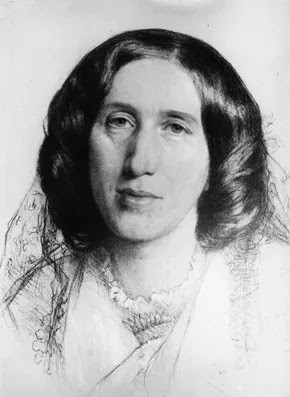
Evangelical Christians play important roles in George Eliot’s first two novels: Scenes of Clerical Life (really three separate novellas in one volume) and Adam Bede. As is well known, George Eliot (see above) was the pen name of Marian (earlier Mary Ann, or Mary Anne) Evans and her interest in evangelical Christianity came from when she attended schools in Nuneaton and Coventry. In her Introduction to the Oxford World’s Classics edition of Scenes of Clerical Life, Josie Billington writes [1]: 

As an adolescent, coming of age in just the period – the 1830s – she writes of in Scenes, Mary Anne Evans was swept up in the religious current of Evangelicalism.. ..If the Oxford Movement sought to turn back the legacy of the Reformation, Evangelicalism sought to complete what the Reformation had begun, expunging the ceremony and sacrament which were the remaining formal vestiges of Roman Catholicism and rediscovering the vital puritan impulses of original Protestantism.. ..Evangelicalism offered a belief that was hard and uncompromising, yet passionately earnest and totalizing, which in the first half of the nineteenth century had a profound impact not just on the rural towns of England, but on the nation’s cultural and intellectual life in general. 

Never fully committed to evangelical Christianity, Marian went on to reject it, while retaining sympathies for the “good side” of some of those who believed wholeheartedly in this approach. Her views are discussed in an essay by Donald C. Masters [2]: 

While George Eliot (1819-1880) came to dislike the Evangelical viewpoint, her treatment of Evangelicals, particularly in her early novels, was much more sympathetic than that of other Victorian novelists.. ..Like many other disillusioned Christians she retained her belief in the Christian ethic. She liked the Evangelicals in spite of their doctrines and what she regarded as their naïveté and narrowness, because they made people better.. 

..Her early letters.. ..suggest that her acceptance of Evangelical principles was merely an intellectual process. She never made the complete personal commitment that is the secret and core of the Evangelical position.. ..She had lost faith in the Bible, the essential basis of the Evangelical tradition and described it.. ..as “histories consisting of mangled truth and fiction.” 

Many of us who have encountered evangelical Christianity, and subsequently turned away from it without making “the commitment”, can recognise George Eliot’s feelings. I have described my own experience [3]: 

My last contact with formal Christianity came at Torquay Boys’ Grammar School, where I went to meetings of the Christian Union, in which my elder brother was a leader. We sat around a table and listened to speakers, or to tapes of Billy Graham preaching. We also had prayer meetings when we all had to take part. Prayers were for the usual things connected with our salvation but, being a school, we also prayed for masters who were Christian, to boost their religious, as well as their educational, mission. I always dreaded prayer meetings and was not comfortable at any of the other meetings either. Unlike some of those present, I found Billy Graham strange and rather too energetic, and neither could I summon up much enthusiasm for a guest speaker who spent many minutes propounding the correct pronunciation of Bethphage. 

There were tracts for us to hand out in the school, delivered in bulk from the Evangelical Tract Society.. ..I couldn’t hand out such things and had quite a collection by the time I stopped attending the Christian Union. 

It is not difficult, then, to see how personal experience of religious groups affects one’s reading of George Eliot’s novels. Like Marian, I rejected the thinking of evangelical Christians (on many grounds) and, like her, try to see their good human qualities, although I worry about their tendency to proselytise to those going through hard times. 
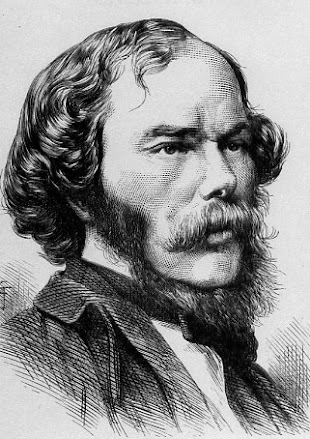

In addition to Evangelicals, another feature of George Eliot’s novels is the presence of young children, often described in detail and forming important threads to the various storylines. Marian loved children, but she was unable to have any of her own. The reason was not biological, as far as I know, more that she didn’t marry until she was in her sixties and spent most of her adult life living with George Henry Lewes (see above), who was already married and had children. If “living in sin” was bad enough in the eyes of many in Victorian society, having children while in such a relationship would be viewed very severely indeed. Certainly, Marian’s cohabitation with Lewes caused much pain to her upright family and this, in turn, was the source of much sadness to her. 

The couple had a very close relationship, with Marian depending on George for reassurance and advice. He was from a theatrical family and both acted in, and wrote, plays: he also wrote novels, was an expert on Goethe, published an outstanding review of philosophy through the ages, contributed to many leading artistic journals, and was also what we would now call a networker [4]. Although unprepossessing in appearance (some called him ugly), he was popular for his conversation and energy and he knew many of the movers and shakers in Victorian literary society. He was one himself. 

Lewes met Marian through John Chapman, the publisher of the Westminster Review [5]. Chapman was a “free-thinker” and Marian lived in his household, where relationships between Mr and Mrs Chapman, their governess, and Marian were complicated. In Ashton’s account [5] we read that Chapman “visited Marian Evans’ room, where she played the piano for him and taught him German.” It was all too much for Mrs Chapman and Marian left the household, but returned in 1851 when Chapman asked her back to help him as part of the editorial team on the Review, where her “sharp brain, wide knowledge, willing labour, and ability to deal tactfully yet firmly with touchy contributors” [5] was invaluable. 

During 1852, Marian was spending much time with Herbert Spencer, the philosopher and biologist to whom she had been introduced by Chapman, and they “were so often in one another’s company that ‘all the world is setting us down as engaged’, Marian would have liked nothing better, but Spencer was less keen.” [5] The result was that, in 1853, Lewes replaced Spencer in her affections and this was the start of a deep relationship that only ended with Lewes’ death. He was a great support to Marian and advised her during her first, tentative steps as a novelist and he played the same role after she had become famous and was being hailed as a very significant writer. Marian had come a long way from those evangelical Christian schooldays in Warwickshire and Lewes had also progressed in his interests. Like his hero Goethe, he then became interested in practical science. 

In the early years of his relationship with Marian, Lewes had been chided by T.H.Huxley as a “’mere’ book scientist ‘without the discipline and knowledge which result from being a worker also’”. This came after a review that Lewes had written and it perhaps inspired him to join the Victorian craze for the study of marine natural history. The leading figure in popularising this interest was Philip Henry Gosse, who had written A Naturalist’s Rambles on the Devonshire Coast (1853, centred on Torquay and Ilfracombe), The Aquarium (1854) and Tenby (published in March 1856, centred on the Welsh seaside town). Lewes read all these books and, in the summer of 1856, he and Marian left for Ilfracombe (where they befriended another enthusiast, Mr Tugwell, the curate of Ilfracombe) and then Tenby; following this with visits to the Scilly Isles and Jersey in spring and early summer of 1857. It was during the first section of this marine shore adventure that the pair discussed the possibility of Marian’s writing a novel. The Sad Fortunes of the Rev Amos Barton was commenced in the autumn of 1856 and became the first part of Scenes of Clerical Life published, anonymously, in instalments in Blackwood’s Magazine through 1857 and as a book in two volumes in 1858. She was not an enthusiast for studying shore life, so Lewes’ avid work on the coast allowed Marian time to think about the content of her embryo novel. 

Lewes’ work was published in instalments in Blackwood’s Magazine through 1856/7 and came out in book form, published by Blackwood and Sons and dedicated to Richard Owen, as Sea-side Studies in 1858. In the preface, Lewes pays homage to Huxley (perhaps the latter’s comment stung?) and there are frequent references to Gosse throughout the book. Both men showed a particular interest in sea anemones and, indeed they had a dispute over one aspect of the biology of some of these animals [6]. It is interesting to make a comparison of the two men. 


Whereas Lewes was a free-thinking agnostic (if he must be classified), Philip Henry Gosse (above) was a strict believer in the literal truth of the Bible [3] and an evangelical Christian. In 1857 he moved to St Marychurch in Torquay after the death of his wife Emily, who had accompanied him to Torquay, Ilfracombe and Tenby on the collecting trips that resulted in his earlier books. Emily was a writer of religious tracts (like those I failed to hand out during my school days) and as deeply committed as her husband to evangelical Christianity. Her painful death, leaving Henry Gosse with his young son Edmund (later Sir Edmund), was the main reason that he decided to move. 

At the time of the move to Torquay, he was expecting high sales of his book Omphalos, that was to be published in late autumn 1857, and he was looking forward to the attention that it would bring. Although there are many references to God and Creation in Henry’s books, Omphalos saw him tackle head-on the conflict between the Biblical Creation and the idea of geological time scales, that were becoming accepted by the mid-1850s. It is subtitled “an attempt to untie the geological knot” and it was Henry’s attempt to ease an obvious conflict: his idea being that rock strata and fossils were all created over the short period of the Biblical Creation. In Omphalos, he showed a thorough knowledge of geology and palaeontology and knew that large time periods were involved, but clung to his odd theory, for which he was duly mocked. Through all the difficulties of 1857, Henry didn’t question his beliefs; rather he became even more ensconced in evangelical Christianity. He reduced his attendance at meetings of the learned societies and didn’t have much personal contact with members the scientific community, although he had correspondence with many people, including Darwin. 

There are many that still adhere to the Creationist views shown by Henry Gosse, although they make little attempt to provide a rational explanation to account for the differences between their views and those of the scientific community. At least Henry made an attempt, even if his explanation was unacceptable to both scientists and believers; Charles Kingsley, for example, chastised Gosse for suggesting the God appears to be telling lies [3]. It seems that evangelical Christians who believe in the literal truth of the Bible have the opinion that there can be no opposition to their view and cannot tolerate any other explanations. 

Lewes took a very different approach, as described by David Williams [4]: 

He thinks, or at any rate he wishes, that the scientific explorers and the religious no-compromise men.. .. can be brought together to ‘sit round a table’, as we put it, that Huxley and Darwin can amicably confer with the tractarians and the Evangelicals and come out of the room with a formula acceptable to both sides. 

There has been movement among some evangelical Christians and we are all familiar with the little car badge of a fish with limbs, bearing the word “Darwin” at its centre. Perhaps the only major difference for many is whether there was a Creator, or whether all that we see around us is the result of chance events. 

After the adverse comments about Omphalos, Henry Gosse spent much time collecting marine creatures from the shores of South Devon [3]. He was in the throes of producing his major monograph on sea anemones, that was to be a standard work on these animals for many years and is still consulted today. It contains brilliant illustrations, as Gosse was a very capable artist in watercolours [7]. 

In a letter sent to Tugwell in November 1856, Lewes writes [8]: 

It would be a pleasant thing for you to write the monograph on Actinae with W. Thompson; & as to the money, you can’t expect much from such labour, but may consider yourself lucky to be free of expense. At the same time you have a formidable rival in Gosse, who is I believe engaged on a monograph. 

This shows Lewes’ respect for Gosse as an expert in sea anemones, but in a later letter to Hutton on 5th May 1859 we read [8]: 

Gosse’s book is too poor for a review; & I have long been making notes of the history I shall sketch which will I hope be far more entertaining than a review. 

I assume that Lewes is referring here to Omphalos, as Actinologica Britannica appeared in book form in 1860, having previously been published in twelve parts from 1858-1860 [9]. Despite their disagreement over some points [6], Lewes clearly respected Gosse as a natural historian. 

We know that Lewes and Marian visited Torquay in 1868 and, while the former continued with dissections for a future publication, Marian was preparing ideas for Middlemarch and it is possible that there were some indirect references to Torquay in that book [10]. We also learn that Marian and Lewes enjoyed walks at Babbacombe, adjacent to St Marychurch [10], and one wonders whether they called on Gosse, or encountered him while walking. I cannot find reference to a meeting and would be intrigued to know how it might have gone and what Marian would have made of this evangelical Christian and a man who was not afraid of proselytising. The urge to spread the Gospel came through in many of Henry Gosse’s books, but rarely with the intensity of the extraordinary conclusion of A Year at the Shore, published in 1865, three years before George and Marian arrived in Torquay [11]: 

I cannot conclude this volume without recording my solemn and deliberate protest against the infidelity with which, to a very painful extent, modern physical science is associated. I allude not only to the ground which the conclusions of modern geologists take, in opposition to the veracity of the “God which cannot lie,” though the distinct statements which He has made to us concerning Creation are now, as if by common consent, put aside, with silent contempt, as effete fables, unworthy of a moment’s thought, and this too before vast assemblages of persons, not one of whom lifts his voice for the truth of God. These assaults are at least open and unmasked. But there is in our scientific literature, and specially in that which takes a popular form, a tone equally dangerous and more insidious. It altogether ignores the awful truths of God’s revelation, that all mankind are guilty and condemned and spiritually dead in Adam; that we are by nature children of wrath; that the whole world lieth in the wicked one; and that the wrath of God abideth on it: it ignores the glorious facts of atonement by the precious blood of Christ, and of acceptance in Him. It substitutes for these a mere sentimental admiration of nature, and teaches that the love of the beautiful makes man acceptable to God, and secures His favour. How often do we see quoted and be-praised, as if it were an indisputable axiom, the sentiment of a poet who ought to have known better,–


“He prayeth best who loveth best

All things, both great and small;” –


a sentiment as silly as it is unscriptural; for what connexion can there be between the love of the inferior creatures, and the acceptableness of a sinner praying to the Holy God? It is the intervention of Christ Jesus, the anointed Priest, which alone gives prayer acceptance… There is no sentimental or scientific road to heaven. There is absolutely nothing in the study of created things, however single, however intense, which will admit sinful man into the presence of God, or fit him to enjoy it. If there were, what need was there that the glorious Son, the everlasting Word, should be made flesh, and give His life a ransom for many? … If I have come to God as a guilty sinner, and have found acceptance, and reconciliation, and sonship, in the blood of His only-begotten Son, then I may come down from that elevation, and study creation with advantage and profit; but to attempt to scale heaven with the ladder of natural history, is nothing else than Cain's religion; it is the presentation of the fruit of the earth, instead of the blood of the Lamb … This will be, in all probability, the last occasion of my coming in literary guise before the public: how can I better take my leave than with the solemn testimony of the Spirit of God, which I affectionately commend to my readers, – … THERE IS NO WAY INTO THE HOLIEST BUT BY THE BLOOD OF JESUS. FINIS. 

Henry Gosse was not only a proselytising evangelical Christian, but the leader of his group of Brethren in St Marychurch. He thus retreated into his own support group and this made it increasingly difficult for him to accept any religious views other than those he supported. It was religious differences, and the views of Henry on who one should have as friends, that was the basis of the conflict with his son, Edmund, described (with some elaboration?) in the latter’s famous book Father and Son [12]. This volume, more than any other work, has shaped our view of Henry [3], a pity as, if one could find a way of negotiating the religious hurdle, with all its side effects, he was a very nice man and would certainly be good company on rambles or on the shore. 

As we have seen, Marian Evans and Geoge Lewes were more accepting of those with religious differences and the former certainly recognised these human sides of evangelical Christians, although she was aware of their dogmatism and inflexibility. I think they would have enjoyed meeting Gosse, but what would Henry make of them? He would balk at their lack of faith in his version of Christianity and he would also strongly disapprove of their relationship. Henry did re-marry after the tragic death of Emily and his second wife, Eliza, while also being a member of the Brethren appeared to be a little more flexible in her approach to Edmund’s “sinfulness” than was his father. Edmund was also helped in his relationship with his father by his wife, the painter Nellie Epps, whom I have described as a “Nineteenth Century Wonder Woman” [13]. Nellie’s sister, Laura Alma-Tadema drew a profile of Marian in 1877 [14] and it would be amusing to know what the artist felt about her sitter and what views she shared with the Gosse family. 


[1] Josie Billington (1988) Introduction to George Eliot’s Scenes of Clerical Life. Oxford, Oxford University Press World’s Classics. 

[2] Donald C. Masters (1962) George Eliot and the Evangelicals. The Dalhousie Review 41: 505-512. 

[3] Roger S Wotton (2020) Walking with Gosse: Natural History, Creation and Religious Conflicts. e-book. 

[4] David Williams (1983) Mr George Eliot: A Biography of George Henry Lewes. London, Hodder and Stoughton. 

[5] Rosemary Ashton (2008) Lewes, George Henry (1817-1878). https://doi.org/10.1093/ref:odnb/16562 

[6] https://rwotton.blogspot.com/2016/11/the-human-side-of-science.html 

[7] https://rwotton.blogspot.com/2017/04/stunning-biological-illustrations.html 

[8] William Baker (ed.) (1995) The Letters of George Henry Lewes Volume 1. Victoria, Canada, ELS Editions. 

[9] R.B.Freeman and Douglas Wetheimer (1980) Philip Henry Gosse: A Bibliography. Folkestone, Wm. Dawon & Sons. 

[10] Kathleen McCormack (2005) George Eliot’s English Travels: Composite characters and coded communications. Abingdon, Routledge. 

[11] Philip Henry Gosse (1865) A Year at the Shore. London, Alexander Strahan. 

[12] Edmund Gosse (1907) Father and Son: A Study of Two Temperaments. London, William Heinemann Ltd. 

[13] https://rwotton.blogspot.com/2017/08/nellie-epps-nineteenth-century-wonder.html 

[14] https://www.npg.org.uk/collections/search/portrait/mw01628 


Friday, 22 April 2022

Homage to the Torbay Express

Growing up in South Devon, I appreciated how lucky I was to be able to walk around the coast and through country lanes, lined by deep hedges, to woods and meadows with abundant wild flowers. Solitary walks were a source of solace from unhappy times and they also enabled me to recognise the importance of the natural world; something that has stayed with me ever since. It influenced my choice of subjects to study in the Sixth Form at school and then at university, and, although I could be called a scientist, I prefer to think of myself as a natural historian, as physical sciences are still a bit of a mystery to me and the study of biosciences is now dominated by one animal, rather than the wide range of animals, plants and micro-organisms that make up most of the natural world.

My other passion as a boy was trainspotting [1] and we were lucky in having a large number of trains bringing visitors to Torbay, especially on summer Saturdays. One train stood out: this was the Torbay Express that ran daily from Paddington to Kingswear and I looked on it with both admiration and envy; the former coming from the condition of whichever Castle Class locomotive pulled the train in the 1950s, and envy because I felt that there was no chance of me travelling on anything so prestigious. The Torbay Express was second only to the Cornish Riviera Express (called the Reveera by us) that didn’t come along our line and, as its name suggests, went to Plymouth and then on to Cornwall. Like “The Torbay”, it was not a train used much by holidaymakers; more by those in business and similar occupations, or by those who preferred smart, and rapid, travel.

The Torbay Express was originally called the Torbay Limited and ran on the GWR’s direct line through Berkshire, Wiltshire and Somerset, rather than on the earlier main line through Bristol. After Taunton, the line climbed to Whiteball tunnel and then entered Devonshire (an image of the express at this point is shown below, together with one of the train entering Exeter, where it made its first stop in the 1950s).


O.S.Nock [2] describes the journey on to Torbay: 

Emerging from the western end of Parsons Tunnel [see image below] the coastwise prospect is completely changed and extends to the rocky islets at the entrance to Tor Bay that we shall see at closer range later. The red cliffs are higher than ever here though less dramatic in their formation, but the sea wall, an invaluable protection for the railway in winter, is a favourite promenade for the holiday-makers of Teignmouth, whether they are railway enthusiasts or not.. 

..The line runs through the back of Teignmouth town between high retaining walls, in Dartmoor granite, but quickly enough on the left hand side there come delightful glimpses across the harbour, boat yards, and the estuary of the River Teign, with the beautiful little town of Shaldon beneath the high red cliff of the Ness.


The description by Nock continues after the Torbay Express has run through Newton Abbot (see image above) and then on through Kingskerswell and Torre to its next stop in Torquay: 

The present main station, by Livermead Sands, is near enough to the beach for some enticing glimpses of the waters of Tor Bay, and as the train starts away for the south, and negotiates some sharp though short gradients the line comes right out above the beach [at Hollicombe] and the full beauty of Torquay’s situation and its superb and rugged coastline is displayed. At this stage in the journey the prospect is soon cut off, by the houses of Paignton.. 

..On leaving Paignton, and climbing on to the cliff edge beyond Goodrington Sands (see image below) the wide panorama over the entire sweep of Tor Bay reveals some of its interesting and complex geological features. The red sandstone cliffs of Dawlish and Teignmouth recur at Paignton, in an even deeper shade of red, but at each end of the bay, on the north side extending outwards from Torquay to Hope’s Nose, and at the south beyond Brixham to Berry Head, the tattered and splintered rock formations from “London Bridge” to the outlying Thatcher and Oar Stones, and Berry Head itself are examples of carboniferous limestone, and provide such striking and spectacular cliff structure as to cause at least one eminent geographer to compare it with those of the Mediterranean Riviera resorts.


Passing over the summit at Churston the express then ran down to the beautiful Dart valley, skirting along the river bank to the terminus at the small town of Kingswear at the mouth of the river. Remaining passengers could then travel over to Dartmouth by ferry, the town having a railway station but no railway lines (there were never any!). What a contrast it must have seemed to London and its suburbs, and what a pleasure to be able to study the landscape from a railway carriage as it passes down the line.

All this was for the passengers. Trainspotters could either find a location where the express sped past or see it at Exeter, Torquay or Paignton. There, the polished locomotive could be admired and one could take in its metallic, oily and smoky smells after the rapid, and hard-working, journey down from London. All very special memories and, as Nock points out in his descriptions of the section of line through South Devon, a link between the wonders of steam locomotives and the geology of the terrain through which the Torbay Express passed at the end of its journey. Geology is part of natural history after all, but my main interest in that subject did not involve distant views, rather in what plants and animals could be seen first-hand on shores, or in hedgerows, and what could be seen with a simple microscope.

I still like steam locomotives and, as my career has shown, I have an abiding love of natural history. Both started when I was in a boy in Torbay and I’m pleased that, in this regard at least, I have failed to grow up.


[1] https://rwotton.blogspot.com/2021/07/memories-of-privet-in-torbay.html

[2] O.S.Nock (1985) Great British Trains: An evocation of a memorable age in travel. London, Pelham Books.

Photograph credits (in sequence) R.J.Blenkinsop; S.Creer; Ben Brooksbank;  R.J.Blenkinsop; and Derek Cross.


Wednesday, 13 November 2019

Brixham, Turner and Gosse


The great artist J.M.W.Turner travelled widely throughout Great Britain, making sketches as he went. Two pages from his notebook of 1811 show Brixham harbour on the southern coast of Torbay, with its two piers and a number of boats, for this was a busy fishing port (see above). It was a time when the northern shores of Torbay were becoming fashionable, leading to the construction of many villas in Torquay in the middle of the nineteenth century. New residents were reminded of the French Riviera, enjoyed the favourable climate that was thought to be good for the health, and many were fascinated by the Natural History of the shoreline.

Philip Henry Gosse had this to say in 1853 about a visit he made to Brixham (he became a Torquay resident in 1857) [1]:

The little town of Brixham, pretty as it appears when viewed from Torquay, is but a sordid affair when you see it at hand. The lower town particularly is close, mean, and dirty; indeed, truth to tell, I saw refinements in filth here, which I had never the fortune to see paralleled in all my wanderings..

..The scenery on either hand, when once clear of the harbour, is bold and magnificent. The coast is rocky and precipitous, (the town itself appears strangely stuck upon precipices, reaching from top to bottom) and is indented with little coves, the most picturesque imaginable. Berry Head, a noble promontory of compact limestone, rears its lofty head abruptly out of the sea not far from the town, and forms a commanding boundary of the prospect, conspicuous all around..

..I did not obtain much in the way of natural history on the shore, except what I was already familiar with at Petit Tor [his favourite collecting spot north of Torbay]..

..I came home with little desire to see Brixham again.


Not kind words. It was the busy fishing harbour and the surrounding cottages that appalled Gosse and one surmises that he was complaining about the remains of fish and a lack of regard for surroundings that characterised fishing villages of the time. They were not genteel. In addition, decomposition of anything marine produces a very strong smell and that must also have affected his senses


Brixham is very different now. The two piers that Turner drew are still in place (see above), but the outer pier has been extended. Beyond that on the western shore is the modern fish market complex and to the east the breakwater that was begun after Turner’s time and completed in the early 20th Century. Also noticeable is the marina and that has promoted marinafication – an influx of wealth also found in other local ports, such as Salcombe and Dartmouth. Brixham seems “on the up” and I’m sure that Gosse would not find it as unpleasant should he visit today, although he may have something to say about the tourist attractions and tourist shops that also bring money into the town.

As to Natural History, visitors and residents like to see seals and occasional cetaceans, but there is a lack of awareness of most marine life. That is also quite a contrast to earlier times.


[1] Philip Henry Gosse (1853) A Naturalist’s Rambles on the Devonshire Coast. London, John Van Voorst.


Turner’s sketches are from the tate.org.uk website
The aerial view of Brixham is from englishriviera.co.uk website

Thursday, 24 October 2019

“Don’t judge a book by its cover”


“Don’t judge a book by its cover” is a phrase that originated in the mid-Nineteenth Century and we have all been surprised when the content of books bears little relation to the illustrations that appear on their covers. A good example is provided by the illustrations for Father and Son [1], an autobiography by Edmund Gosse that leaves readers with a feeling of empathy for its author, as he faced the challenges of a strict religious upbringing in Torquay in the 1850s and 1860s. Among these readers is Sarah Perry who wrote an article in The Daily Telegraph [2] drawing parallels between Edmund’s experience of the constraints of a religious straitjacket with her own upbringing as a Baptist. She acknowledges the power of his writing in describing his father, the great Natural Historian Philip Henry Gosse, a creationist and member of the Brethren.

Father and Son had a long gestation. Edmund published the first biography of his father in 1890, two years after Henry died, and it is a largely factual account that also includes an appreciation by Eliza Gosse, Henry’s second wife and Edmund’s stepmother. Ann Thwaite remarks [3] that the biography was “extremely well received” and various of Edmund’s friends, such as John Addington Symonds and George Moore, saw another book in the story of Henry and Edmund, to be told from Edmund’s side. That book was Father and Son, and the germ of the idea took years to grow.

Like Ann Thwaite, Sarah Perry recognises that Edmund was not renowned for accuracy and Father and Son, published anonymously, and with the names of some key characters altered, may contain some exaggerated stories. However, it is a powerful work of literature and has done much to colour the reputation of Henry Gosse that we have today. Almost everyone comes to the Gosse family through reading works by Edmund (including Ann Thwaite, who followed up her biography of Edmund with her delightful biography of Henry, Glimpses of the Wonderful [4]). In contrast, I came to Edmund through reading Henry’s books and scientific writings and he was a fascinating and warm man. However, my admiration does not extend to his religious beliefs and this is recounted in Walking with Gosse [5] and numerous posts on this blog [6].


Considering the the way we select books set me thinking about how many people first chose to read Father and Son from the art work on the cover. But how true is the illustration to the content? Let’s look at some of the covers that have adorned Edmund Gosse’s book. The first I show (above) has the famous picture of Henry and Edmund that was used as the frontispiece for the first edition of Father and Son. The photograph was taken in Torquay in 1857; the year when they had moved to St Marychurch after the death of Henry’s first wife Emily. It is touching and clearly meant much to Edmund.


The next cover features the wonderfully sensitive portrait of Edmund by John Singer Sargent (above).


We then go on to see covers from various editions (above) that show the shore where Henry and Edmund collected specimens or the countryside through which they walked. They provide a general background, but they are not recognisable as being from Torbay.


The final series of cover illustrations (above) appear to have been created by artists who had little inkling of the content of the book and some of them are decidedly strange. As stated earlier, “Don’t judge a book by its cover”.


[1] Edmund Gosse (1907) Father and Son: A Study of Two Temperaments. London, William Heinemann.

[2] Sarah Perry (2018) Like meeting the gaze of a friend in a room of strangers. The Daily Telegraph 24th November pp. 14-16.

[3] Ann Thwaite (1984) Edmund Gosse: A Literary Landscape. London, Martin Secker and Warburg.

[4] Ann Thwaite (2002) Glimpses of the Wonderful: The Life of Philip Henry Gosse 1810-1888. London, Faber and Faber.

[5] Roger S Wotton (2020) Walking with Gosse: Natural History, Creation and Religious Conflicts. e-book.

[6] http://www.rwotton.blogspot.com (numerous entries).


It should also be stated that various editions of Father and Son have covers based on designs (see below).


I am grateful to Greg Peakin for pointing out the article by Sarah Perry.

Wednesday, 4 September 2019

Pufflets, pimplets and muzzlets – Gosse and the common names of sea anemones


Philip Henry Gosse (above), together with his young son Edmund, moved to a new house in St Marychurch, Torquay in 1857. It was a tough year for him, as his wife, Emily, died of breast cancer and Omphalos, his book that attempted to resolve the conflict between Creation and the contemporary view of the geological record, was published to a hostile reception from all quarters. Against this background, Henry busied himself with collecting on the shore and working on describing the British sea anemones and corals. He published what was to become Actinologia Brittanica in 12 parts from 1858 to 1860 and the parts were gathered into a book that was published in 1860 [1,2]. I am fortunate to own a first edition of the book and I have also seen many of the original paintings by Gosse on which its illustrations are based [3].

To many, sea anemones and corals may seem an odd subject for study, yet these primitive animals fascinated many Victorian collectors and they gain their name because of their bright colours and the way they superficially resemble flowers. While those of scientific bent used a Latin binomial classification, others used the common names that are found in the book and which provide a splendid example of the richness of the English language. Gosse himself was aware of the colour provided by these names and, in the Preface of The Romance of Natural History [4], he wrote:  

In my many years’ wanderings through the wide field of natural history, I have always felt towards it something of a poet’s heart, though destitute of a poet’s genius.

That’s not to suggest that Gosse was not a good scientist (he was a Fellow of the Royal Society), but he recognised the value of popularising the subject. Here is a list of the common names of most British sea anemones and corals, as given by Gosse (the definite article has been omitted in each case) [1]:

Plumose anemone *
Daisy anemone *
Scarlet-fringed anemone *
Rosy anemone *
Ornate anemone
Fish-mouth anemone (*)
Orange-disked anemone *
Snowy anemone *
Sandalled anemone
Pallid anemone
Translucent anemone
Eyed anemone
Cave-dwelling anemone *
Snake-locked anemone *
Parasitic anemone *
Gold-spangled anemone
Cloak anemone *
Walled corklet *
Warted corklet
Painted corklet
Eyelet
Trumplet
Opelet *
Beadlet *
Deeplet
Gem pimplet *
Glaucous pimplet
Red-specked pimplet *
Diadem pimplet *
Marigold wartlet
Dahlia wartlet
Necklet
Gapelet
Scottish pearlet
Scarlet pearlet
Arrow muzzlet *
Waved muzzlet
Trefoil muzzlet
Sand pintlet
Rock pintlet *
Painted pufflet
Crimson pufflet *
Sprawlet
Vestlet
Crock
Crimson Imperial
Yellow Imperial
Globehorn *
Sandy creeplet
Furrowed creeplet *
Wrinkled creeplet
Devonshire cup-coral *
Moray cup-coral
Shetland cup-coral
Winged cup-coral
Smooth-ribbed wedge-coral
Knotted wedge-coral
Scarlet crisp-coral
Tuft-coral
Weymouth carpet-coral
Scarlet and gold star-coral

* = collected by Gosse from the shores around Torquay
(*) = sent to Gosse, having been collected by others from the shores around Torquay

Of the 61 types of sea anemone and coral in this list, 22 (36%) were collected by Gosse from the coast around Torquay. Although an excellent area for discovering these fascinating creatures, the high number reflects Gosse’s industry rather than this coast being a mecca for the animals. As an example of his industry, he remarks that the area shown in the image below was an especially good one for sea anemones, if one ventured by small boat to explore the cracks and fissures during low spring tides.


Anyone reading the list, and who wishes to escape the superficiality of the modern world, will be struck by the beauty of the names. My favourites are the red-specked pimplet, the dahlia wartlet, and the crimson pufflet: Gosse’s illustrations of these sea anemones, scanned from my copy of Actinologia Britannica, are shown below (in order).


I’m sure you will have your own favourites and, like Gosse, be stimulated to find examples during visits to the British coast.


[1] Philip Henry Gosse (1860) Actinologia Britannica: a history of the British sea-anemones and corals. London, John Van Voorst.

[2] R.B.Freeman and Douglas Wertheimer (1980) Philip Henry Gosse: A bibliography. Folkestone, Wm. Dawson & Sons Ltd..


[4] Philip Henry Gosse (1860) The Romance of Natural History. London, J.Nisbet & Co.

Wednesday, 18 April 2018

Torbay and a passion for collecting on the shore


Many British seaside towns are currently fighting a reputation for being run down, having many residents suffering financial hardship, having an influx of homeless people with all their problems, and also for open drug use. This is, of course, a generalisation, as there are many “bijou resorts” with many (un)occupied second homes and even the major resorts have marinas filled with craft owned by wealthy residents or by visitors who own apartments where they spend a few weeks, or week-ends, each year.

The influx of visitors to UK resorts has always been at its height during summer and in the 1950s and 1960s tourists poured in by train, coach and, latterly, by private car. “No Vacancy” signs were everywhere: on large and small hotels and also on guest houses, often converted from large Victorian properties built for a quite different type of visitor. I was brought up in Torbay and, as a year-round resident, was aware of the huge differences in the numbers of people in Paignton and Torquay in the summer months compared to the population in winter, when so many businesses that catered for holidaymakers shut down. All this was obvious, but I was not as curious as I should have been about the origins of the handsome villas and large houses that had been converted to accommodate visitors (and are now more widely used as holiday apartments). The young rarely are curious about history: it is something which comes with age and a sense of time passing.

Torquay was especially lucky in having a building boom in the mid-Nineteenth Century, with villas in an Italianate style being common, mirroring the Riviera feeling that the location of the town provided. Some of the villas were permanent residences and some were for shorter-term stays for those who wanted to own property in this fashionable resort. Then there were hotels that catered for First Class passengers and for members of the burgeoning middle classes who were attracted by the climate, beautiful setting and social cachet of the town. It was a time when visitors enjoyed a gentle walk, or a carriage ride, through the beautiful countryside and many also joined in the passion for Marine Natural History that was at its height at this time.

We get an idea of just how important a visit to the shore could be from the writings of Philip Henry Gosse, who lived in St Marychurch in Torquay, venturing round the coast and out to sea [1]. He was one of the great popularisers of Natural History and part of the fascination for visitors to the shores of Torbay was down to him [2]. In his book Land and Sea [3], Henry Gosse describes the local coastal scenery and the book is illustrated by woodcuts in a highly Romantic style that must have encouraged readers to visit Torbay (some are shown below).


Another woodcut from the book (see below) shows a man and woman on the shore, dressed appropriately for collecting and making observations [4]. This is what Henry Gosse writes about the effects of collectors, especially of sea anemones, that would be added to their parlour aquaria, a popular form of “entertainment” at the time:

Ah! gentle reader, I’ll whisper a secret in your ear; but don’t tell that I said so for ‘tis high treason against the ladies. Since the opening of sea-science to the million, such has been the invasion of the shore by crinoline and collecting jars, that you may search all the likely and promising rocks within reach of Torquay, which a few years ago were like gardens with full-blossomed anemones and antheas, and come home with an empty jar and an aching heart, all now being swept as clean as the palm of your hand! Yet let me do the fair students and their officious beaux justice: the work is not altogether done by such hands as theirs; but there is a host of professional collectors, small tradesmen whom you must search-up in back alleys, and whose houses you will easily recognize by the sea-weedy odour, even before you see the array of pans and dishes in front of the door all crowded with full-blown specimens. These collect for the trade, and are indefatigable. Only think of the effect produced on the marine population by three or four men in a town, one of whom will take ten dozen anemones in a single tide!

A reflection then of the popularity of the pursuit of collecting marine animals. It is not something that we recognise today, although families still venture on the shore to examine rock pools.

Later in Land and Sea, Gosse describes travelling to parts of Torbay that were less popular for collectors [3]:

Therefore it was that we ran some miles away from home, and pursued a pleasant road, partly through green lanes, rank with the glossy young leaves of the arum, and the arching fronds of the hart’s-tongue fern, scarcely embrowned by the late arctic winter; and partly sweeping along the shore-line and over the cliffs that make the base of this beautiful bay; till, Paignton being some distance behind us, we turned off to the left down a little lane, and drew up at the margin of the broad flat beach called the Goodrington Sands.

Far away is the edge of the sea, for the tide is wonderfully low, though we have yet a full hour and a half before it will be at its lowest point, and an immense breadth of soft, wet sand lies exposed. We pause for a moment to gaze on the boundary to the right. It is Berry Head, a noble headland that projects like a long wall far out into the sea, and presents its bluff termination, crowned with fortifications, to the impact of the waves that drive in with impotent fury from the wide Atlantic.

Berry Head is mentioned in the label to the woodcut of collectors shown above and, in Land and Sea, Gosse goes on to describe his methods of collecting, although contemporary Natural Historians would frown at his use of chisels and hammers to remove specimens together with the rocks to which they are attached.


Above are two contemporary images of Goodrington Sands and I wonder how many visitors today are aware of the activities of the passionate collectors of the mid-Nineteenth Century? The rocks in the lower picture were one of the collecting sites used by Henry Gosse and it is good to see young children in the picture following his example, but presumably without chisels and hammers. If only they knew about their enthusiastic predecessors.


[1] Edmund Gosse (1896) The Naturalist of the Sea-shore: The Life of Philip Henry Gosse. London, William Heinemann.

[2] Charles Kingsley (1855) Glaucus; or, The Wonders of the Shore. London, Macmillan and Co.

[3] Philip Henry Gosse (1865) Land and Sea. London, James Nisbet & Co.