Showing posts with label Cabinets of Curiosities. Show all posts

Wednesday, 11 March 2020

The zoology of Bruegel’s The Fall of the Rebel Angels


Pieter Bruegel the Elder is best known for scenes of everyday life and he can be regarded as the first well-known exponent of genre painting. The Fall of the Rebel Angels shows a quite different topic: the expulsion of Lucifer from Heaven by St Michael and a group of angels loyal to God. Bruegel shows us St Michael (with his shield bearing the cross of the resurrection), but it is difficult to make out Lucifer in his many-headed form. Heavenly light shines from the top of the picture, through the blue sky, and we then move down to the darkness of the abyss of Hell. Some animals are present in the sky, together with angels, and most are descending into Hell, which is not fiery, as it is described in The Holy Bible and as it is usually shown in paintings. The only hint of fire in Bruegel’s work turns out to be a feathery headdress.
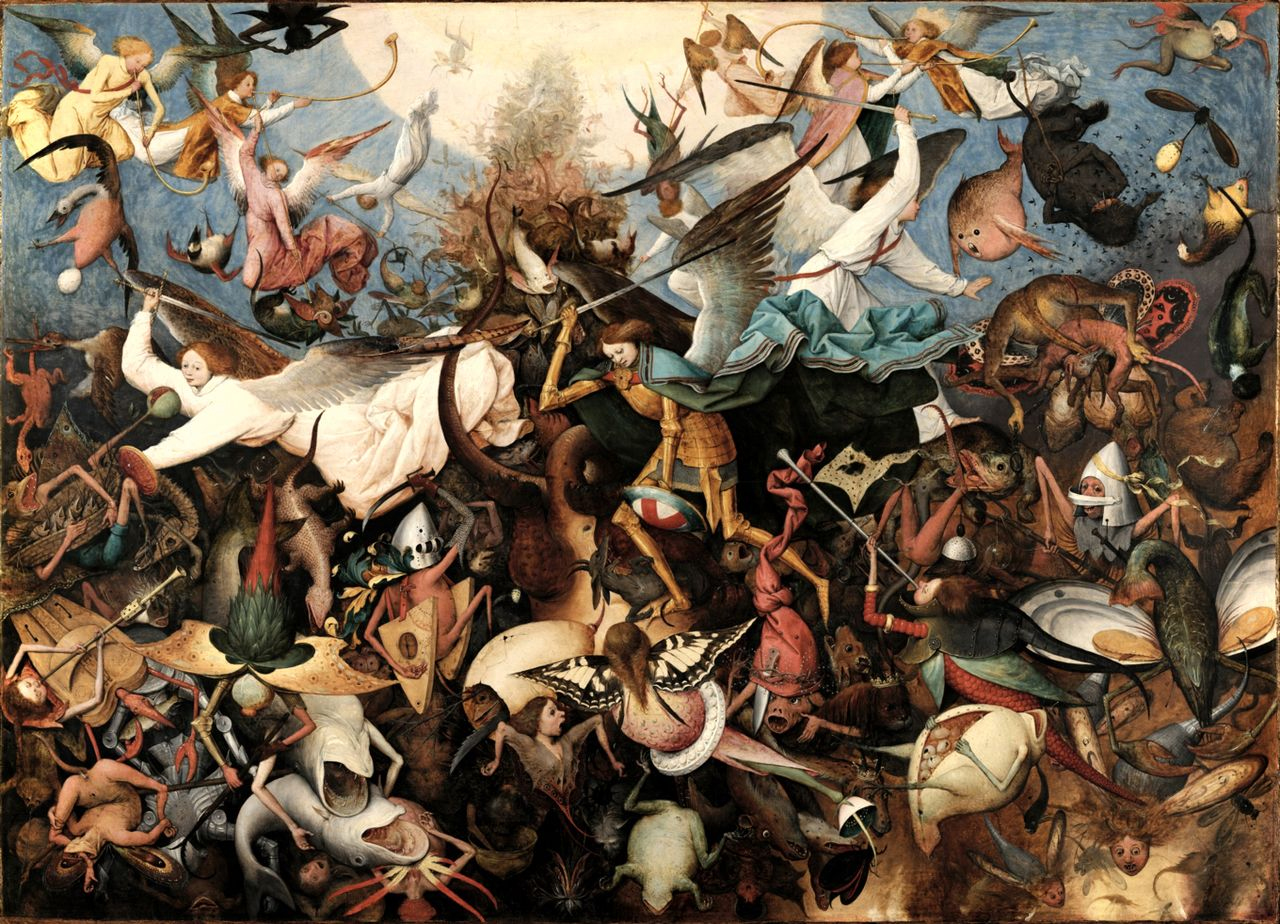

An excellent commentary on the painting has been provided by the Royal Museums of Fine Art in Brussels, where the painting is exhibited [1]. As mentioned in this commentary, several of the animals shown are based on those from collections of curiosities, which were becoming popular as sources of wonder at the unfamiliar.

I would like to make some additional comments on some of the animals shown in the painting.

The puffer fish

Bruegel shows a puffer fish with the body distended. One defence mechanism used by these fish is to rapidly take water into the stomach to “inflate” the body and make spines stand out: the same mechanism is used when the fish gulp air should they be caught out of the water. In this state, puffer fish have been preserved by drying and it is likely that Bruegel saw a preserved specimen displayed in a collection of curiosities. While the eyes look unnatural, he shows the fused teeth that are used by the living fish to bite into their prey [2].

Interestingly, some puffer fish have another defence mechanism in the production of chemicals within the liver that are highly toxic to humans. So much so, that raw fugu – a delicacy in some parts of the world – requires preparation by specially-trained chefs. It tempts us to think that the inflation of the body, and the production of toxins, evolved to prevent predation by humans, but both must have existed long before the evolution of humans.


Two dead fish and bloated frogs

The fish are shown with their mouths open as if gasping, an indication of distress that Bruegel clearly wished to convey. The same intention of providing images that cause us to become frightened comes in the bloated frog, whether bloating was caused by decomposition or, should the frog be female, by being filled with eggs that will now not be laid. A second frog-like creature is shown with the abdomen split open to show what appears to be spawn, but this animal is different to Bruegel’s frog (having what looks like the “parson’s nose” of a chicken at the end of the abdomen). I have no idea what Bruegel was trying to show here.


Mussels + a crustacean

In this image we see two open mussel shells containing the body of each mollusc. The two mussels, each shown inside one of their shell valves, have clearly been cooked as, in life, the mantle (the pink/yellow fold) is closely applied to the shell for almost all of its length. Lying between the two mussels is what appears to be a crustacean, blue in colour like a lobster when alive, and the whole reminds us of a flying creature, with the mussel shells forming “wings”.


The stenogastrine wasp

Although stylised, the stenogastrine wasp is probably included as a threat and also as a bizarre creature that would also have occurred in a collection of curiosities. These wasps, like other social insects, are likely to be female and possessed of a mild sting. However, they are not usually aggressive and their appearance more frightening than reality, especially when shown at such a large size relative to other recognisable animals in the painting.


The falling birds

Two birds are shown falling into the abyss. One appears to be laying an egg, but it is impossible to identify what type of bird it might be: the other resembles a great auk, now extinct. Interestingly, Ole Worm (1588-1654), the Danish natural historian and physician, kept a great auk as a pet and, after its death and preservation, it might have found its way into his splendid cabinet of curiosities [3].


We can spend much time in speculating on what Bruegel intended in his use of images of animals, both real and imaginary. His view of the expulsion of Lucifer is certainly unique and is based on his imagination, with no attempt made to show the realistic scale of the different components. Dead terrestrial and aquatic animals are present in all parts of the painting, together with images that are supernatural and were likely to have been strongly influenced by the earlier works of Hieronymus Bosch (as mentioned in the commentary).

It is an extraordinary painting.


Monday, 30 December 2013

Women on the shore


The growing appeal of marine Natural History in the Nineteenth Century was shared by both men and women, sometimes jointly and sometimes in groups of one sex.


Philip Henry Gosse gives an account of an excursion by small boat:

Let us then scramble down to the beautiful Anstey’s Cove [above].. ..Yonder on the shingle lies a boat, newly painted in white and green, for the attraction of young ladies of maritime aspirations.. ..”Jump aboard , please, Sir [P.H.Gosse]! Jump in, ladies! jump in, little master [Edmund Gosse]!” And now, as we take our seats on the clean canvas cushions astern, the boat’s bottom scrapes along with a harsh grating noise over the white shingle-pebbles, and we are afloat.. 1

There follows a description of all the seaweeds and animals visible from the boat as it moves around the coast and also visits islands close by. I’m sure that the women enjoyed the expertise of such a knowledgeable enthusiast as Henry Gosse, just as other women had done on an amusing occasion on the shore in Torbay, described by Henry Gosse’s son Edmund:

..we came across a party of ladies, who were cackling so joyously over a rarity they had secured that our curiosity overcame our shyness, and we asked them what they had found. They named a very scarce species, and held it up to us to examine. My father, at once, civilly set them right; it was so-and-so, something much more commonplace. The ladies drew themselves up with dignity, and sarcastically remarked that they could only repeat that it was the rarity, and that “Gosse is our authority”.  2

In addition to observing, and identifying, living algae and animals, women also made collections for their “cabinets of curiosity”. Fossilised specimens were common in these cabinets and Gosse describes one site in South Devon, well-known to collectors:

The beach of white shingle at Oddicombe, whither ladies so often repair to search for pebbles containing fossil madrepores, washed up by the tide... 3

Henry Gosse was at the forefront of the Victorian interest in marine biology and in the development of aquaria. His first wife, Emily, accompanied him on some collecting trips and also on the field courses that he led in Devonshire and South Wales. Tragically, Emily died, and her support in the typical female role of the day - silent companionship while Henry worked, and help with translation from other languages - was lost. Henry re-married after meeting Eliza through a shared enthusiasm for both Natural History and Christian views that centred on belief in the literal truth of The Bible. 4 

In the chapter on “The Naturalist of the Boudoir” in her book The Heyday of Natural History 1820-1870, 5 Lynn Barber makes interesting observations on the ways women took part in the great enthusiasm for the natural world that developed during the Nineteenth Century:

Women read about natural history, wrote about it, drew it, collected it, and generally enthused about it as much as men did..

Victorian women rarely translated their genuine enthusiasm for natural history into any purposeful form of research.. ..Illustration was the only form of natural history in which women really excelled.. .. Women were trained to draw well: it was one of the few things they practised and studied consistently from infancy through to adulthood.. ..Women also tended to make punctilious collectors.

The most scientific woman collector of the age was not a fossilist but an algologist, Mrs A.W.Griffiths of Torquay.. .. One genus and several species of seaweed were named after her, and she is mentioned with respect - almost with awe - by every Victorian writer on seaweeds, but she published nothing in her own name, and now survives only as an acknowledgement in other people’s prefaces.

Amelia Griffiths (1768-1858) was one of several well-known seaweed collectors and experts and it is surprising that she is barely mentioned by Henry Gosse, especially as both lived for much of their lives in the same town, although Henry only became a permanent resident in 1857, one year before Amelia died at the grand age of 90. He must also have known of Mary Wyatt (1789-1871), who was also a collector and who kept a shop in Torquay that dealt in pressed plants and sea shells. Mary became Amelia’s servant and, although illiterate, 6 she joined Amelia in jointly publishing Algae Danmonienses, consisting of four volumes of dried seaweeds collected largely from Torbay. In contrast to Henry Gosse, William Pengelly FRS, the distinguished explorer of cave faunas, and another Torquay resident, does refer to Amelia, as he was responsible for making arrangements in 1862 that her “beautiful and valuable collection of sea-weeds” 7 was transferred to Kew and her collection of shells to the Natural History section of the British Museum. That the collections went to such internationally recognised centres is testament to their significance.

Although the contributions of Amelia Griffiths and Mary Wyatt were recognised widely, the doyenne of 19th century women algologists was Margaret Gatty (1809-1873 - see below). She was the daughter of a clergyman (Dr Alexander John Scott, famous for being the chaplain who cradled the dying Nelson in his arms at the Battle of Trafalgar) and her uncle held the living in Ecclesfield, near Sheffield  in Yorkshire. 8 Mrs Scott died when Margaret and her elder sister, Horatia, were small, with Margaret being the dominant of the pair, having a strong drive to advance herself. Unlike Amelia Griffiths, she always had a passion for writing and took it seriously, showing her poems to family friends connected to the world of literature.


In 1839, Margaret married the Reverend Alfred Gatty and, as fortune would have it, the living at Ecclesfield became vacant after the death of Margaret’s uncle, so Rev. Gatty was able to replace him in the post. Margaret thus settled to the life of a cleric’s wife, working in the parish and also being a dutiful companion and, of course, mother to numerous children. In 1848, the burdens of the parish, child rearing and pregnancies became too great even for her energy and drive and she left the family for a break in Hastings to convalesce and regain her strength. By chance, a doctor whom she was consulting, gave her a copy of Harvey’s Phycologica Britannica (a standard work on seaweeds and zoophytes - “plant-like animals”) and Sheffield writes: 8


Why should this catalogue of plants and life-forms suddenly have captured her interest and imagination? Perhaps it was a buoy in a sea of endless empty days and perhaps Gatty, exiled at the sea-side, became infected by the mid-century ‘craze’ for natural history, for gathering, collecting, naming and labelling specimens that many men, women and children of all social classes were taking up. Marine botany was no exception as the rise of interest in seaside recreation included the scouring of beaches and tide-pools and the dredging of the sea itself for the ultimate specimen. At this time Phillip [sic] Henry Gosse (1810-1888) had already published The Ocean (1845), and would go on to publish other popular scientific works in quick succession..

Interestingly, Margaret made little reference to seaweeds in her diary entries while she was in Hastings, but she now set out on serious study and her home in Yorkshire “became her laboratory.. ..[and] her family found themselves knee-deep in seaweeds, seaweed books and seaweed correspondence.” 8 She had always loved the sea and now had an added reason to make visits to the shore. Her work culminated in the publication in 1863 (as Mrs Alfred Gatty) of British Seaweeds, drawn from Professor Harvey’s “Phycologica Britannica”. These volumes (available today as free Google e-books) served to simplify the scientific descriptions used by Harvey and thus make his work more accessible to a general audience, Margaret being in communication with Harvey throughout the production of the book. It wasn’t her only publication, as she wrote many other popular books linking Natural History and religious themes. Probably the best known are her five volumes of Parables from Nature published from 1855-1871 and her writing was popular and profitable. 


Margaret Gatty’s algal herbarium, with seaweeds prepared using the techniques of Miss Cutler of Sidmouth, another renowned woman algologist of the times, was donated to the University of St Andrews by her daughter Horatia. It is pleasing to know that it is still used in research, 9 just as Amelia Griffiths’ herbarium is likely to be at Kew. Their work made important contributions to science and demonstrates that women Natural Historians in the Nineteenth Century were not just collectors (although that was certainly the majority case), but much respected by the male-dominated scientific Establishment.
 

1 Philip Henry Gosse (1865) A Year at the Shore. London, Alexander Strahan.

2 Edmund Gosse (1890) The Naturalist of the Sea-Shore: The Life of Philip Henry Gosse. London, William Heinemann.

3 Philip Henry Gosse (1853) A Naturalist’s Rambles on the Devonshire Coast. London, John Van Voorst.

4 Roger S Wotton (2012) Walking with Gosse: Natural History, Creation and Religious Conflicts. Southampton, Clio Publishing.

5 Lynn Barber (1980) The Heyday of Natural History 1820-1870. London, Jonathan Cape.

6 David Charles Raiment (2007) Mary Wyatt (1989-1871): The Princess of Seaweeds. The Phycologist 73: 4-5.

7 Hester Pengelly (ed.) (1897) A Memoir of William Pengelly, of Torquay, F.R.S., Geologist, with a selection from his correspondence. London, John Murray.

8 Suzanne Le-May Sheffield (2001) Revealing New Worlds: Three Victorian Women Naturalists. London, Routledge.