Showing posts with label Recipes. Show all posts

Tuesday, 18 February 2020

Eating live animals


The reality TV show I’m a Celebrity Get Me Out of Here is justifiably popular in the UK. Set in Australia, the contestants live in a basic camp and we viewers see edited versions of their conversations and other interactions. To boost their diet of rice and beans, selected individuals compete in “Bushtucker Trials” that involve something very unpleasant, like having large numbers of cockroaches, mealworms etc. thrown over them in a confined space (see below). Until the last series, the trials most popular with the viewing public were those involving the eating of animal body parts and also live insects. The latter torture has now been banned as it is perceived by some as being cruel; yet eating live animals is encouraged elsewhere – take the case of oysters.


Oysters are bivalve molluscs that produce a feeding current using enormous numbers of tiny hairs, or cilia, that are present on the gills. This current has a dual function as it evolved from the respiratory current, particles trapped on the surface of the gill then being transferred to the mouth by other tracts of cilia. To aid retention, oysters, like other bivalves, produce mucus, or slime, on the gills and particles captured are thus bundled up into packages from which nutritious material can be selected by an ingenious sorting mechanism using the lips (labial palps) around the mouth.

The two shell valves are joined by a hinge and a muscle runs from one shell valve to the other and this serves to close the oyster if it is exposed to the atmosphere, when attacked, or not feeling. Sea water is trapped when the shell valves are closed and this prevents damage to the soft body tissues. When we buy oysters, they have frequently been out of water for hours, so the content of the water is changed by the addition of mucus and excreta, although not at levels that poison the mollusc.

The classic way to open oysters is to shuck them and this is shown in the video [1]. Note that both the hinge and adductor muscle (between the shell valves) are cut, but no reference is made to the oyster being alive and that the water + excreta are referred to as the liquor. The flavour of the liquor is an important part of eating oysters and there are debates over whether one should chew the animals or crush them against the palate using the tongue. Fortunately, the molluscs are often served on a bed of ice so, at least, their metabolism is reduced, even if they are sometimes sprayed with dilute acid (lemon juice).


For those who do not like the idea of eating live animals, there are many recipes for cooking, and preserving, oysters and that is not a surprise, when they were such a common food, and not the luxuries that they have become today. Cooking also serves to kill bacteria that might otherwise cause intestinal disorders in those eating them: something that may have been common when oysters were collected from areas where there was a high level of pollution.

Lovell [2] gives many recipes for cooking oysters and they can be listed. Some involved rapid killing of the molluscs, others did not:

Oyster soup (7 recipes)
Oyster sauce (4 recipes)
Oyster atlets – with sweetbreads
Curried oyster atlets
Curried oysters
Stewed ousters (6 recipes)
Dutch oysters – coated in breadcrumbs and fried
Fried oysters (6 recipes)
Oyster ragout (2 recipes)
Grilled oysters
Oysters broiled the Dutch way
Roast oysters (3 recipes)
Ostras á la Pollada
Boiled oysters
Oyster sausages (2 recipes)
Minced oysters
Oyster forcemeat
Oysters and chestnuts
Oyster steak
Scalloped oysters (3 recipes)
Oyster fritters
Oyster loaf
Oysters and macaroni
Oyster pie (3 recipes)
Oyster and eel pie
Oyster and parsnip pie
Pickled oysters (4 recipes)
Oyster powder (2 recipes)
Oysters on toast (2 recipes)
Oyster ketchup
Oysters au gratin

An impressive list, and gourmets among you should refer to Lovell [2] for descriptions of how to prepare oysters for each dish. Its length is a reflection on the importance of these molluscs in the diet of many European nations (and beyond) in earlier centuries.

Arguably, the most interesting way of preparing oysters is described thus by Lovell [2]:

The oldest way of cooking an oyster, of which we have any mention, is that recorded by Evelyn, who, in the year 1672, saw Richardson, “the famous fire-eater”, perform wondrous feats, one of which was, “taking a live coal on his tongue, he put on it a raw oyster; the coal was blown on with bellows, till it flam’d and sparkl’d in his mouth, and so remained till the oyster gaped, and was quite boil’d.” Who ate the oyster thus cooked, we are not informed.


Anyone fancy trying that?


[2] M.S.Lovell (1884) The Edible Mollusca of Great Britain and Ireland, with Recipes for Cooking them (Second Edition). London, L.Reeve & Co.

Tuesday, 7 November 2017

The legendary Paignton cockles (and some recipes…)


I grew up in Paignton in South Devon and was always attracted to the sea, although only occasionally went swimming as I was more interested in walking along the beach to look at what had been washed up by the waves and tides. After the severe winter of 1962/63, I remember that the first storms brought masses of shells ashore, after the very low temperatures had killed a large number of molluscs (the sea froze in a few places). Although there were many common cockles, there were also some more unusual cockle shells, including those of the red-nosed cockle (below, upper) and the spiny cockle (below, lower). These species made Paignton Beach (shown above) famous in Victorian times, as their distribution around the coast of Great Britain is very local, the spiny cockle being largely confined to the shallow sandy sediments of the western part of Torbay.


Lovell wrote this about the red-nosed cockle (as Cardium rusticum) and spiny cockle (as Cardium aculeatum) in 1867 [1]:

[The red-nosed cockle].. ..is rare and local in England. It is found on the Devonshire coast, at Paignton, and occasionally at Dawlish, and at certain times of the year, especially in the spring after a gale from the east, numbers may be gathered. On paying a visit to the Paignton sands, for the purpose of shell collecting, in the spring of 1862, the beach was quite strewn with broken single valves of this cockle, and there had evidently been quantities of live specimens washed up as well, as we met many persons returning home with their baskets heavily laden with them..

.. There is another cockle found also at Paignton, which is even more scarce than Cardium rusticum, viz. Cardium aculeatum; it is larger and not so solid, with long spines on each rib, and is of a pale brownish-pink or flesh colour. It is very good to eat.

Lovell then describes the “Paignton method of cooking the red-nosed cockle” by frying them in a batter of breadcrumbs after they have been kept in clean water for a few hours to remove sand and other unwanted particles. We’ll come to more recipes later, but first a quote from Philp Henry Gosse, who lived in Torquay and knew the Torbay coast well. In his book A Year at the Shore (1865) Gosse writes [2]:

What is that object that lies on yonder stretch of sand, over which the shallow water ripples, washing the sand around it and presently leaving it to dry? It looks like a stone; but there is a fine scarlet knob on it; which all of a sudden has disappeared. Let us watch the moment of the receding wave, and run out to it.

It is a fine example of the great spinous cockle, for which all these sandy beaches that form the bottom of the great sea-bend of Torbay are celebrated. Indeed the species is scarcely known elsewhere; so that it is often designated in books as the Paignton cockle.. ..The creatures have not changed their habits nor their habitats, for they are still to be seen in the old spots just as they were a century ago: nor have they lost their reputation; they are indeed promoted to the gratification of more refined palates now, for the [Paignton] cottagers, knowing on which side their bread is buttered, collect the sapid cockles for the fashionables of Torquay, and content themselves with the humbler and smaller species.

For those who do not have access to the red-nosed, or spiny, cockles that the “fashionables of Torquay” were able to enjoy, the common cockle (Cardium edule) is still excellent to eat. They can be obtained from cockle “fisheries” in several estuaries, among the best being those from Penclawdd in Wales, where the shellfish are collected using hand rakes, rather than by more aggressive approaches. Cockles are gathered into sieves, washed to clean as much mud as possible from the shells, and then tipped into sacks for easy transport. There is much less occasional foraging than in Victorian times, although John Wright encourages us in his book Edible Seashore [3], in which he describes many edible plants and animals from both the landward and seaward parts of the shore. He recommends that cockles should not be collected during the summer months as this is when they spawn, but they are at their best through September and October.


Wright gives an excellent recipe for cooking cockles with chorizo, although they can be cooked using many of the recipes for clams [3]. Cockles with chorizo is easy to prepare: make sure that the cockles have had a chance to “clean themselves” in sea water overnight and then add them to a pot in which small pieces of chorizo have been sautéed to release their oil, with the addition of a little olive oil and a squeeze of lemon juice. Cover and cook until the shells open, garnish with parsley and then serve like mussels, with crusty bread to mop up the juices. If you are interested, further recipes are given below [4,5].

Should there be an excess of cleaned cockles, they can be prepared by placing them in a hot pan and then teasing the cockles away from their shells and placing them in a jar with just enough malt vinegar to cover. Pickled cockles will keep much longer than fresh cockles and they make a delightful snack at any dinner party (but make sure that they have had a chance to clean themselves of sand and silt…).

Do any readers out there, and especially those from Paignton, want to collect and cook cockles, or are you somehow put off by the thought?


[1] M. S. Lovell (1867) The Edible Mollusks of Great Britain and Ireland with recipes for cooking them. London, Reeve & Co.

[2] Philip Henry Gosse (1865) A Year at the Shore. London, Alexander Strahan.

[3] John Wright (2009) Edible Seashore: River Cottage Handbook No.5. London, Bloomsbury Publishing.


Friday, 16 December 2016

Parasol mushrooms, recipes and a great sadness


Parasol mushrooms (Lepiota procera – see above in an illustration by Mrs Hussey [1]) are striking and also delicious to eat. Although they are locally abundant, and easily collected, most of us buy mushrooms from supermarkets, or market stalls, as we know that some fungi are lethal to humans and we prefer to err on the side of caution.

In his book British Edible Fungi [2], Mordecai Cubitt Cooke is scathing about those who might confuse parasols with poisonous types:

The Parasol mushroom is known and appreciated throughout Europe, and is doubtless one of the first class for the table, with the great advantage that only dense stupidity could confound it with any suspicious species.

Cooke suggests that the Shaggy Parasol (Lepiota rhacodes), rather similar in appearance to L. procera, is also worth collecting and "there is no difference in their edible qualities". A few years back, I knew of some excellent patches of L. rhacodes and, accompanied by my son, Alex, we would collect enough for a good lunch on Sundays in October and November. We always cooked them sliced into hot butter, but Cooke gives several excellent recipes, many of which will have been familiar to cooks in the Nineteenth Century. At that time, collecting wild mushrooms was more popular than it is today, although Fungal Forays with an expert mycologist still attract good audiences.

Cooke's recipes [2] include the following:

Broiled Parasol Mushroom. - Remove the scales and stalks, and broil lightly over a clear fire on both sides for a few minutes; arrange them on a dish, over fresh made well-divided toast; sprinkle with pepper and salt, and put a small piece of butter on each; set before a brisk fire to melt the butter, and serve quickly.

Baked Parasol Mushroom. - Remove the scales and stalks, and place the caps in layers in a dish; put a little butter on each, and season with pepper and salt. Cover lightly and bake for twenty minutes or half an hour, according to the number in the dish. Put them on hot toast in a hot dish. Pour the hot sauce over them and serve quickly.

Stewed Parasol Mushroom. - Remove the stalks and scales from young specimens, and throw each one as you do so into a basin of fresh water, slightly acidulated with the juice of a lemon or a little good vinegar. When all are prepared remove them from the water, and put them into a stewpan with a very small piece of fresh butter, sprinkle with white pepper and salt, and add a little lemon juice. Cover up closely, and stew for half-an-hour. Then add a spoonful of flour with sufficient cream, or cream and milk, until the same has the thickness of cream. Season to taste, and stew again gently until all are perfectly tender. Remove all the butter from the surface and serve in a hot dish, garnished with slices of lemon. A little mace, nutmeg, or catsup may be added, if preferred, but some think the spice spoils the flavour.

Scalloped Parasol Mushroom. - Mince young fresh agarics, season with pepper, salt, and a little lemon juice, add a little butter, and stew in a warm oven for ten minutes, then put them in the scallop tin, layer by layer, with fresh bread crumbs moistened with milk, cream, or good gravy; bake for five minutes, and brown well before a quick fire.

Procerus Pie. - Cut the fresh agarics in small pieces, and cover the bottom of a pie dish. Pepper, salt, and place on them small shreds of fresh bacon, then put a layer of mashed potatoes, and so fill the dish layer by layer, with a cover of mashed potatoes for the crust. Bake well for half-an-hour, and brown before a quick fire.

Procerus Omelette. - Mince some young fresh agarics; season with pepper and salt; add butter and set them in the oven whilst you whisk well the whites and yolks of half a dozen eggs; then put two ounces of butter into the frying pan, and heat until it begins to brown; having again well whisked up the eggs, with three tablespoonfuls of the prepared agarics and a little milk, pour it lightly into the boiling butter; stir one way, and fry on one side only for five or six minutes; drain it from the fat; roll it up and serve quickly on a hot well covered dish.

In addition to these six, which you are no doubt very keen to try, there are also recipes for Parasol Sauce, Potted Procerus, Essence of Procerus and Procerus Ketchup, the latter two allowing Parasols to be enjoyed during the winter months.

We can imagine Cooke tucking into many feasts of these delectable mushrooms. However, we learn from his daughter, Leila [3], that he suffered badly from indigestion, something that he attributed to having eaten Norfolk dumplings when growing up (these dumplings were made from bread dough and were cooked in stews to add bulk). Leila relates that Cooke took a glass of ale and two Abernethy biscuits (advertised as being suitable for those with indigestion, and devised by a Dr John Abernethy) at 8 o'clock in the evening as he could not eat much [3].

Cooke was a renowned authority on fungi and worked at Kew for three days each week, otherwise identifying many specimens that were sent to him at home [3]. He also wrote more widely in Botany and was an illustrator, although he found it difficult to make money as a Botanist. He had a small pension from the India Office and, in his late eighties, moved to Southsea to be near his grand-daughters. Leila concludes her notes with this paragraph:

Arrived at Southsea, he could go and sit in the sun on the sea front, but in August 1914 war was declared; a bomb from the sea knocked down the garden wall. He could no longer go out. All around was the bustle of war. His grand-daughters were called up. He was a very lonely old man. On 12th November 1914 he died. He was buried in Finchley cemetery. Nobody came. The war was on.

This is so sad after the achievements of Mordecai Cooke and his splendid works on fungi, including his enthusiastic inclusion of recipes. His story becomes even sadder when one learns from Leila [3] that his collections of first editions, poems that he had written, an autobiography, and many other treasures were all destroyed during the Second World War, after an incendiary bomb attack on the repository where they were stored. Sad isn't a strong enough word – thank goodness we have British Edible Fungi to remember him by.


[1] Mrs T. J. Hussey (1847) Illustrations of British Mycology, containing Figures and Descriptions of the Funguses of Interest and Novelty Indigenous to Britain. London, Reeve Brothers.

[2] M. C. Cooke (1891) British Edible Fungi: how to distinguish and how to cook them. London, Kegan Paul, Trench, Trübner and Co.

[3] Mary P. English (2001) Leila Cooke's notes on the life of her father, M.C.Cooke. Mycologist 15: 91-93.

Wednesday, 4 March 2015

Eating limpets


In my last blog post, I wrote an appreciation of limpets and the extraordinary adaptations that they show for life on rocky marine shores [1]. As I pointed out, that should not prevent us from using these molluscs as a source of food and that is something that fits with contemporary debates about sustainability and the need for animal protein. We are now much less resourceful than our ancestors, and are dependent on what is available in stores or on market stalls, with the latter often showing a more local approach than the former.

To gain an historical perspective on eating limpets, I read Lovell's The Edible Molluscs of Great Britain and Ireland with Recipes for cooking them [2] and he describes their consumption by some communities:

"In many places limpets are used for food, especially on the Continent, where they are oftener eaten than the periwinkle. At Naples they make them into soup, and I am told it is an excellent dish.. ..The poorer classes at Eastbourne eat them constantly.. ..At Plymouth they gather great numbers of them, especially from the breakwater, as well as in the Isle of Man, where they are known by the name of "flitters"; and in Scotland the juice of these shellfishes is mixed with oatmeal.."

In addition to this background information, Lovell also gives recipes [2]:

"Limpet Soup – Wash them, and free the shells from seaweeds etc.; put them into a saucepan and parboil them. Take them out of the shells; chop up some parsley, and put it, with a tablespoonful of oil, or an ounce of lard or butter, into a saucepan, and fry until it becomes brown. Add a pint of water, and, when boiling, throw in the limpets, with a teaspoonful of anchovy sauce, some pepper, and boil again for half an hour; or, if preferred, stew them before putting them into the soup.

Limpet sauce – Choose clean-shelled limpets, not covered with barnacles, steep them in fresh water, and then heat them in a close covered saucepan until they part easily from the shells. They yield a rich brown liquor, in which, after being shelled, they may be stewed for half an hour. Thicken the liquor with butter and flour; strain and season with pepper, cayenne, and salt, and a slight flavouring of lemon-juice or vinegar. The limpets, being tough and indigestible, are not returned into the sauce."

The latter comment reminds us of the common failing of over-cooking seafood of all kinds, something that one learns by trial and error.

Lovell [2] also gives a more rustic approach to cooking limpets, originating from the island of Herm in the Channel Islands, and reported by Jeffreys in Volume 3 of his British Conchology:

"Roasted limpets - The limpets were placed on the ground, and laid in their usual position, and cooked by being covered with a heap of straw, which had been set on fire, about twenty minutes before dinner."

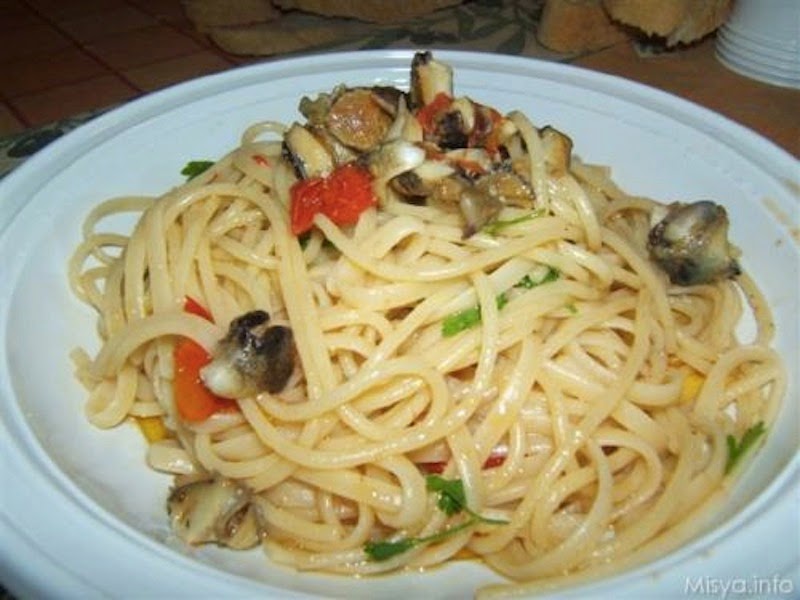
To these recipes can be added others from different parts of the World (illustrations of each dish are given, with the URL to the web page for each recipe):


It is only possible to eat limpets as a regular part of the diet if one lives at, or near, the coast. For those who are landlocked, Lovell guides us to Garden Snails, together with their close relatives, including the Roman, or Vine, Snail (and who doesn't like Escargots à la Bourguinonne?). Limpets and land snails are both sustainable foods and provide good sources of animal protein. Although I don't feel comfortable about roasting them alive, placing the molluscs in boiling water kills them rapidly and they can also be kept in a deep freeze for a short time to reduce their metabolism severely before they are cooked.

Mark Zuckerberg became famous not only for Facebook, but also for his statement that killing animals oneself is better than willingly being ignorant of how we obtain the meat we buy from butchers or supermarkets [3]. For those that would like to follow Mr Zuckerberg's example, but cannot face the prospect of cutting the throat of a pig or a goat, killing snails of various kinds provides rather less of a challenge.   


[2] M. S. Lovell (1867) The Edible Molluscs of Great Britain and Ireland with Recipes for cooking them. London, Reeve & Co.