Showing posts with label Slugs. Show all posts

Wednesday, 15 July 2015

Eating slugs – and a fascinating defence mechanism


Mention slugs to people and you are likely to get "Ugh!" as a response - and from gardeners a more hostile reaction. This is because slugs are slimy and they also eat plants, often in competition with humans when we are growing plants for food or decoration.


To a Natural Historian, slugs are fascinating, as they are gastropod molluscs that have lost their shell during evolution. Adult gastropods, with few exceptions, move using muscular contractions and expansions of the foot, sliding over a film of secreted slimy mucus. Production of mucus is also important in providing a body covering to prevent desiccation and as a deterrent to predators. Nevertheless, many slugs are predated and gardeners are encouraged to provide areas for hedgehogs or predatory birds. One solution to the pest problem that is rarely mentioned is the collection of slugs for food, just as we gather some types of snails (Roman snails, winkles, whelks, etc.). Here is a recipe adapted from one posted on the "eattheweeds" website [1]:

Allow slugs to feed on salad leaves and then kill them in a vinegar-water mixture before boiling them in water, repeating this three times. The prepared slugs can now be used to make patties.

Beat 3 eggs with 3 tablespoons of double cream and add the mixture to 3 tablespoons of flour, the same quantity of cornmeal, and 10 slugs (chopped into bite-sized pieces). Whisk, form into patties, and then fry in butter. Serve with bread and salad.

Some of you may find this low on your list of recipes to try, but slugs are attracting the interest of at least one celebrity chef [2] and they are a source of protein that is readily available. Hugh Fearnley-Whittingstall recommends slugs cooked in a tomato sauce [2].

Less familiar to us than terrestrial slugs are those that live in the sea and these are not easily gathered in quantity, so are unlikely to be utilised widely as food. There are reports of sea slugs being eaten by humans, but these accounts arise from confusion with sea cucumbers (holothurian echinoderms) that are eaten in many parts of the World. Holothurians formed part of the famous dinner of the Acclimatization Society in 1862 where views on flavour and consistency were mixed [3]. However, true sea slugs are now finding their way on to speciality restaurant menus [4] – and note that the article refers to them as "trash from the sea". It is an unfortunate term for remarkable and beautiful animals.


It was a sea slug, Marionia sp, that I "adopted" at the UCL Grant Museum of Zoology [5]. It is mounted with the foot facing the viewer and this was done to allow students, and other observers, to see the dimensions of the foot and thus the area in contact with the substratum (see above left).  Unfortunately, preservation in spirit removes pigment and the living specimen would have been light orange in colour, providing camouflage (see above right). Reference to the Sea Slug Forum [6] shows the range of sea slugs and some of their extraordinary adaptations and beautiful colours. These colours are not for our appreciation, of course, although a Creationist might disagree, but to provide warning or camouflage. Warning of what? I'll come to that question, but first we need to know a bit more about the body plan of sea slugs and how they are different to snails.


During evolution, some of the internal organs of gastropods underwent torsion, with the gut opening forward into the mantle cavity at the shell entrance. Slugs, including sea slugs, have undergone de-torsion, with the anus being towards the rear, nearer to their ancestral positions. The anterior end of the gut of snails and slugs features a rasping tongue, or radula, and this is used to remove food from the surface of stones or vegetation, or for scraping away the tissue of living plants and animals. Marionia feeds on corals [7] and the Grant Museum specimen, labelled Marionaria quadrilatera (but actually Marionaria blainvillea) would have fed on these colonial animals while living in the Mediterranean Sea.

A characteristic of corals is the ability of individual polyps to retract and to use stinging cells as a means of catching food, just like their relatives the jellyfish (many corals also generate their own food by harbouring algal cells within their tissues). The stinging cells, or nematocysts (see below), have a trigger that releases a thread through which toxins are injected to immobilise prey, a series of small barbs holding the thread into the tissue. They also serve in defence and a grazing sea slug will be at risk of being attacked by these stinging threads as they eat the coral tissue, even when polyps are retracted. The evolution of stinging cells in coelenterates is an amazing adaptation, but there are some sea slugs that eat coral tissue without the nematocysts discharging. Not only that, intact cells can be moved to extensions of the body, called cerata, on the back of the sea slug through branches of the gut that extend into the projections. Any animals attacking these sea slugs now receive stings from coral nematocysts and the bright colour of the molluscs probably acts as a warning.


Slugs may not appeal to everyone, but we should all be amazed at some of their adaptations. How these evolved can only be speculated upon, but there are few examples in nature as extraordinary as the evolution of nematocysts by coelenterates, followed by their hijacking by some sea slugs. It's worth thinking about if you feel tempted to eat some.


[3] G.H.O.Burgess (1967) The Eccentric Ark: The Curious World Of Frank Buckland. New York, The Horizon Press.


The UCL Grant Museum of Zoology gave permission for me  to use the photograph of the preserved Marionaria specimen.


Friday, 23 May 2014

Slugs that glide, use “smoke screens” - and can swim


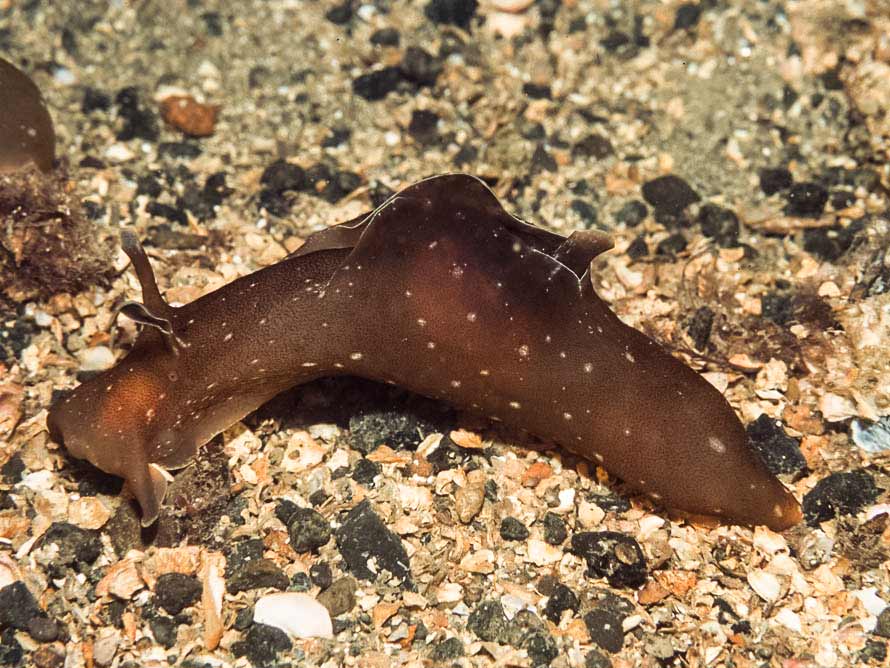
Few people like slugs. While I consider them to be pests for eating too many of our garden plants, I rather like the forms that live in water and, especially Aplysia, the “sea hare”. 


Philip Henry Gosse, the great Nineteenth Century Natural Historian and populariser, encouraged readers of his books to discover the animals of the coast and he wrote, in Tenby, 1 that specimens of Aplysia..

..crawled, or rather glided, along over the stones upon a fat fleshy disk or foot, and up the slender stems of Sea-weeds by bringing the edges of the same muscular foot to meet around the stem, grasping it thus, as if enclosed in a tube. The fore part, as the animal progressed, was poked forward as a narrow neck, furnished with two pairs of tentacles; one pair of which, standing erect, and being formed of thin laminae, bent round so as to bring the edges nearly into contact, looked like the long ears of a beast; whence this creature is called by the vulgar the Sea-hare (by naturalists, Aplysia punctata). On each side of the body, which is large and semi-oval, rises up a great fold of flesh (the mantle), which, arching over the back, is itself overlapped by its fellow on the opposite side. These wings are sometimes carried apart, exposing the back, and are said to be used as swimming fins; but this I cannot confirm from my own observation. 


Nine years later, in A Year at the Shore, 2 Gosse is more dismissive about descriptions of swimming by Aplysia, writing:

It is reported that these mantle-lobes are capable of being used as swimming-fins, by their undulations; but I doubt the correctness of the observation.


As can be seen from the clip above, he was mistaken.  

Another feature of this slug, described by Gosse, 1 is its ability to exude clouds of purple “fluid”:

Sometimes on being disturbed, and sometimes quite spontaneously, or at least without any visible cause, they would pour out from beneath the mantle-lobes a copious fluid of the richest purple hue, which stained the stones, the sands, and the water, of the same gorgeous tinge.. ..a few hours sufficed to remove all trace of it.


In both Tenby and A Year at the Shore, Gosse also describes the complex gut found in Aplysia, with chambers modified for holding food, milling it and then digesting the milled contents. He concludes the descriptions of the mollusc by saying:

..the whole organization affords us an instructive example of the Divine resources, and of the adaptation of organs to their requirements which an enlightened research is continually finding in Creation.

The sense of wonder is no less in those of us who consider that all the adaptations result from the selection of genetic mutations. Whether we believe in The Creation or in evolution, we can all agree that these slugs crawl by means of muscular waves passing over the foot; they can swim; they produce a dye to act as a diversion when disturbed; and they have a gut structure that is well adapted to their diet of strengthened seaweeds. The interesting question for an evolutionist is how did all these adaptations come about? What were the precursors, if precursors were present, or were there sudden mutations producing changes in the form and function we observe? It is easy to see how the gut structure enabled more efficient digestion of an abundant source of food, but how important was predation pressure in selecting for genetic changes that resulted in swimming and dye production? We do not know the answers, but pondering the possibilities is fascinating, although such thoughts would have been inconceivable to Gosse the Creationist.

I am an old-fashioned Zoologist, a Natural Historian, so looking at the wide diversity of animals and considering their adaptations and way of life comes as second nature to me. This approach, driven by a child-like curiosity, is now much less common in learned circles, as we move to a strongly anthropocentric and more “useful” Zoology. A contemporary student is unlikely to learn about the Natural History of Aplysia as described by Gosse, but be more familiar with the role the slug plays in applied research:

The marine mollusk Aplysia californica is an important animal for experiments in cellular, molecular and behavioral neuroscience because of the distinctive organization of its nervous system, which makes it appropriate for cellular analysis of a variety of behaviors, learning and memory. Aplysia presents a one-of-a-kind model for developmental and neurophysiological studies. 3

It is interesting that this quote is given under the title “Scientific Importance” and it represents a growing trend in using organisms as models. 4

I am sure that these investigations are of value but they say little about the animal in its natural environment and that is the main interest of a Natural Historian. It could be suggested that contemporary Biologists spend too much time dwelling on humans, and models for humans, without looking at the extraordinary natural world of which we are a part. That’s a bit preachy, but I’m sure that Henry Gosse would feel the same way. No doubt, critics of this view would suggest that I am looking backward, not forward, in suggesting that all organisms should be viewed in the context of their natural environment. However, we wreck environments in the cause of human advancement, and Modern Biology does little to address that issue. Rather, it encourages us to be concerned with all aspects of human health and wellbeing without being involved in the wider context of the health of the Earth. Is that wise?


1 Philip Henry Gosse (1856) Tenby: a sea-side holiday. London, John Van Voorst.
2 Philip Henry Gosse (1865) A Year at the Shore. London, Alexander Strahan.

Thursday, 11 April 2013

Why not eat sea anemones?


Vincent M Holt published “Why Not Eat Insects?” in 1885 and the book was given a new lease of life when it was reprinted in 1988 by the British Museum (Natural History). Holt raises a good question and, arguably, it applies even more today than it did in Victorian times. In addition to recommending a range of insects that are good to eat, Holt includes molluscs and, while recommending slugs of various species, it is cooked snails which he favours, giving two recipes from a book by M. S. Lovell, “The Edible Mollusks of Great Britain and Ireland with recipes for cooking them”, published in 1867. This is the Preface of that book:

“In these days, when attention has been so much directed towards the cultivation of the common kinds of eatable shell-fish, it is surprising that the importance of certain others for food has been hitherto almost entirely overlooked. We understand the good qualities of oysters, cockles, and a few other kinds; but some equally nutritious (which are universally eaten on the Continent) are seldom, if ever, seen in our markets, or are only used locally as food, and the proper modes of cooking them are scarcely known. I have therefore endeavoured to call attention to all the eatable species common on our coasts, and also to those which, though not found here in abundance, might be cultivated as easily as oysters, and form valuable articles of food.”

This comment from Lovell applies to both marine snails and bivalves, but the great Victorian Natural Historian Philip Henry Gosse provides us with another addition to gastronomy. In “A Naturalist’s Rambles on the Devonshire Coast”, published in 1853, he writes of one of his own experiments in cooking sea anemones. He collected Actinia crassicornis (now named Urticina crassicornis) and, after washing them in sea water, began to cook:

“Some I put into the water (sea-water) cold, and allowed to boil gradually. As soon as the water boiled, I tried one: it was tough and evidently undone. The next I took out after three minutes’ boiling: this was better; and one at five minutes’ was better still; but not so good as one which had boiled ten. I then put the remaining ones into the boiling water, and let them remain over the fire boiling fast for ten minutes, and these were the best of all, being more tender, as well as of a more inviting appearance.. .. In truth the flavour and taste are agreeable, somewhat like those of the soft parts of crab; I ate them hot, with the usual crab-condiments of salt, pepper, mustard, and vinegar, mixed into a sauce.. ..I wonder that they are not commonly brought to table, for they are easily procured, and are certainly far superior to cockles, periwinkles, and mussels. After a very little use, I am persuaded anyone would get very fond of boiled Actinias.”


We know that Henry Gosse was a strong influence on the wonderful glass modelling of the Blaschkas (see my earlier Blog post) but could he also be an inspiration for other artists - the top experimental chefs of today? How splendid Anémone de mer a la Gosse would look on the menu of a Michelin-starred restaurant. It would be as big a talking point as snail porridge.