Showing posts with label Swimming. Show all posts

Wednesday, 21 September 2022

School sport – or how I failed to become an athlete

While watching the Commonwealth Games cycling from the velodrome in London, I noticed a sign that read “Sport is just the beginning”. For some reason, that set me thinking about my sporting career.


As I child, I enjoyed the freedom of living a few hundred yards from Victoria Park (see above), in the Polsham area of Paignton, where I could sail my yacht in the circular pond and play on swings and the slide in the children’s playground (located beyond the trees in the distance). There was also a large field in the park where friends and I played cricket in the summer and kickaround football (soccer) in the winter. Cricket was my favourite sport and I joined Paignton Cricket Club so that I could watch games and also operate the scoreboard (being reminded frequently by the official scorer that I had it wrong and therefore the players out on the pitch were being misinformed). Stan Cray (below) was the professional (succeeded by Jack Kelly and Harold “Dickie” Bird, of later umpiring fame) and they were early sporting heroes.

There was no coaching and I had no idea of the technique of the fast bowling I enjoyed, other than to run in off about 30 paces and try and launch the ball somewhere near the batsman. As for batting, all I knew was to hammer the ball as hard as possible: I had no defence and no shots on the off side. Although enthusiastic, I realised that I was never going to be a good player and there was no hope of getting any coaching at Oldway Primary School, as all the teachers, bar one, were women and they concentrated on netball with the girls: Mr Mitchell, the sole male teacher, didn’t seem interested in sport. We had games that involved running around the playground (coloured sashes and equipment like beanbags, and balls of various sizes, being kept in the shelter at the “Oldway Mansion end”) and we played in inter-school games [1]. There was also Music and Movement in the Hall, with all of us following the instructions from a radio, with its speaker contained in an enormous wooden box. The programme was from a different age, as you can hear in a clip [2].

It was left to Torquay Boys’ Grammar School to introduce me to other sports and to get me fit through gymnastics. In winter, it was cross-country running, football, rugby and swimming: in summer it was athletics, cricket, and swimming. Gymnastics was all year round and consisted of learning how to vault (both gate vaults and vaulting horses), walk on a balance beam, hang off wall bars, and do somersaults and stretches while on a mat. It was never explained that these were components of gymnastics competitions, they were just things we were made to do by Mr Stokes and Mr Morrall, the former being serious about getting things right and the latter just being deeply unpleasant. Both had a slightly disconcerting habit of sticking their chests out, but that might have been a requirement for gym teachers. Just as I left the school, another master came along (I think his name was Mr Goulder) and he was quite different, being encouraging rather than taking enjoyment from putting down the less able. I shall always remember Mr Morrall, though.

For swimming, we walked through the town to the Marine Spa baths (see above in an image from the Devon Live web site) and my first lesson involved jumping in to the shallow end. As a non-swimmer who was terrified of putting my head under water, this was a challenge that I avoided by hiding in the showers and, fortunately, Mr Betteridge didn’t notice when a wet RSW climbed down the steps into the pool. All further lessons were with Mr Roberts and even his more encouraging approach did not succeed and I spent my time holding on to the side rail and thrashing about with my legs to give the impression that I was trying. I certainly was trying, but remained a non-swimmer until much later in life.

In cross-country (actually road running) we ran through country lanes, setting out from the sports hut that was located near to the Girls’ Grammar School (it would have been to the right of the far-right corner in the image above – this is a recent view of “our” playing field site, now laid out rather differently [3]). We would walk from the Barton Road TBGS site up to Shiphay, get changed, and then run on a specified route that had staff members located at intervals to see that we completed the course. Some masters, who had no involvement with sport, must have used this as a means of getting away from the staff room early and I remember Mr Evans (“Mole”) scowling at me as I went past in the last few “runners”, as I had delayed him from jumping into his blue MG Midget to get home early.

We were given some coaching in soccer, but knew the basics from the times when we played together with friends. Rugby was different, as many of us knew little about the game. We were taught to tackle, how to pass backwards not forwards, and how to form a scrum – not helped when Mr Stokes hollered “go hard” to encourage us… I had no idea about the rules of the game and this was apparent when I volunteered to play rugby for Dobson House against Clifford House. Our captain, Malcolm Baker, was a very good player who also captained the school side, so knew the game well. I played in the scrum and was so good at jumping for the ball in line-outs that Mr Gillham (“Fritz”), who was refereeing, commented on my prowess after the game. Malcolm was less impressed, as he felt I wasn’t getting the ball to the backs fast enough and, when he called for a short line-out, I felt him forcibly grabbing my collar and yanking me back, as I had no idea what he meant. During the same game, I remembered all that I had been taught about tackling and stood my ground when a large opponent raced toward me and then handed me off, the smack in my face nearly knocking me out. I had no idea that sort of thing was allowed.

In the summer term, I enjoyed it when cricket was the sport of the week, but athletics was more challenging, although it had a lot of variety: discus, shot putt, javelin, sprinting, long jump, and high jump. We knew about the position needed to throw the discus from the image of the statue of the Discobolus of Myron (see below) that was the subject of the badge on Mr Stokes’ CCPR blazer. The other athletic events were easy enough, but high jump was not. We had to jump into a sand pit, invariably damp, and there was a choice between straddle or western roll (this was before the “Fosbury Flop”, and that would have been dangerous, anyway). I used a kind of bunny hop and crashed through the bar, but it was the best I could do. It didn’t garner much praise.

So, my training in sports wasn’t the beginning mentioned in the opening paragraph, but the end. Much later, I took swimming lessons and became a reasonably good swimmer. Surprisingly, I also took up jogging and enjoyed running around set routes; usually not needing to stop for rests, as in my school cross-country days. 

My main “sporting” activity remains walking alone through country lanes and footpaths [4] and it has been since I was a teenager. Now, the distance covered by each walk is a bit shorter, but I can still do 15 miles without a break and at a reasonable pace of over 3 mph, too. I should be grateful that all the attempts of gymnastics, and sports, masters failed to make me an athlete, so that I haven’t needed to look back on past achievements that I know I could never repeat. Ironically, given that the sign mentioned in the opening paragraph was in the velodrome, I never learned to ride a bike. Who knows, I may have found that as pleasurable as walking.

[1] Roger S Wotton (2020) Walking with Gosse. e-book.

[2] https://www.youtube.com/watch?v=2Ve-93G9h10&ab_channel=BenMorris

[3] https://www.kayelliott.co.uk/portfolio/project/torquay-girls-grammar-school/

[4] https://rwotton.blogspot.com/2022/08/a-walk-in-countryside-is-not-always.html


Tuesday, 28 October 2014

Mackerel: easy to catch, good to eat - and beautifully designed


On the rare occasions when I visit the coast from land-locked Hertfordshire, I like to go out mackerel fishing, in company with other holidaymakers. Boat owners run these trips alongside those for sightseeing, and the necessary tackle is provided. Local knowledge of where shoals of fish are likely to be found is invaluable and, after chugging out to a suitable location, the boat’s engine is turned off and instruction given on how to lower the weighted line to the sea bed, raise it a little, let it drop, raise it again, etc. No bait is used, but hooks (at least three) are held out on traces that have brightly coloured feathers attached. In no time, the tug of fish is felt and the line is reeled in, sometimes with a mackerel on each hook, and everyone seems to have success. Occasionally, other fish are caught, but it is mackerel that make up almost all the catch and, on good days, they begin to pile up in trays, or buckets, on deck.


For many people on the trip, catching mackerel is pleasure enough but, for others, the freshly-caught fish make a splendid supper. Whereas meat, and especially game, improves with hanging, fish are best eaten as fresh as possible. There are a number of ways in which mackerel can be enjoyed and they are both delicious and good for one’s health. The simplest approach is to barbecue, or they might be eaten as a ceviche of raw fish, and they can also be smoked to allow preservation for several days, or even weeks. [1] My own favourite recipe comes from childhood when we were given freshly-caught mackerel by Mr Revell, who lived along our road and always seemed to have an excess when he went fishing from the end of Paignton Pier. We had them soused in vinegar, [2] with bay leaves placed into slashes in the flesh, and I can remember the taste well.

Everyone catching Atlantic mackerel (Scomber scombrus), whether to eat or not, is impressed by the appearance and muscularity of the fish. The muscles used for swimming are arranged in blocks and run along the body, from just behind the head to the tail, and they drive the caudal fins (tail). If we looked closely, we would see that three types of muscle are present. Running along the sides of the fish are red muscles, while ca. 90% of the bulk of the flesh consists of white muscles, or intermediate pink muscles. [3] Red muscles are very different in structure and function to the other types. They are well supplied with oxygen and do not tire easily and this contrasts with the white muscles, which show the opposite qualities, with the pink muscles (lying within the white muscle mass) having a slightly longer endurance. Red muscles are thus used in cruising, while the white and pink muscles are used for bursts of acceleration, such as are needed when avoiding prey or in predation.

In addition to powering the caudal fins, the muscles also provide the outline of the fish. Mackerel have an “idealised streamlined shape”; one where the widest part of the body is about one third from the front and where the length is about four times the width. This shape is shown in the diagram below and one needs to visualise it in 3-D. The mackerel makes a good fit and, to understand why this is advantageous, we need to imagine that water is arranged into sheets and that turbulence results when these sheets are disrupted. At some point along the body, the sheets of water passing over the mackerel peel away from close contact with the surface and this is referred to as the separation point (SP, see arrows in the diagram below). Beyond the SP, the sheets of water stop flowing smoothly and this results in drag, but the streamlined shape means that the water layers hold to the body for longer, resulting in a smaller turbulent wake behind the fish. Its shape thus results in less drag, so less power is then needed by the fish in both slow, and fast, swimming


Scales that are sunk into the skin cause micro-turbulence in the water flowing just over the surface of the fish and this provides a “lubricant” over which the fast-moving sheets just a little further away from the body can slide, further diminishing the risk of separation. Of course, this is only one function of the scales, as they also serve for protection. More obvious features of the surface are the fins and these are rigid and can be held out into the smooth flow of water passing over the fish when they are needed most during rapid swimming. They function like the flights of arrows, or darts, in counteracting pitch, roll and yaw and, like the body profile and the musculature, are elegant designs.


However, mackerel did not have a designer and all the structures that we see evolved over time. So, too, did other features of these fish, such as their good eyesight (that enabled them to spot the feathers on my fishing line); the swim bladder (an extension of the gut) that allows them to float without expending energy; their efficient means of acquiring oxygen through the gills; and many other modifications, including their extraordinary musculature (which is so good to eat). All evolved and we can only speculate how: were there dramatic mutations, or more gradual changes in anatomy, morphology and physiology? Sometimes, belief in a Creator seems like an easier way to get answers.


[3] J.J.Videler (1993) Fish Swimming. London, Chapman & Hall

Friday, 23 May 2014

Slugs that glide, use “smoke screens” - and can swim


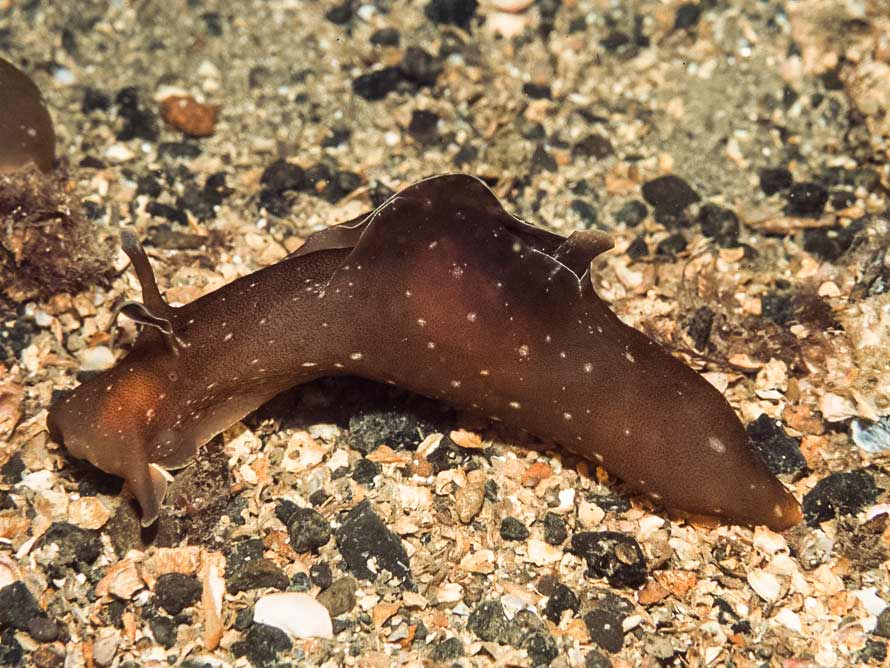
Few people like slugs. While I consider them to be pests for eating too many of our garden plants, I rather like the forms that live in water and, especially Aplysia, the “sea hare”. 


Philip Henry Gosse, the great Nineteenth Century Natural Historian and populariser, encouraged readers of his books to discover the animals of the coast and he wrote, in Tenby, 1 that specimens of Aplysia..

..crawled, or rather glided, along over the stones upon a fat fleshy disk or foot, and up the slender stems of Sea-weeds by bringing the edges of the same muscular foot to meet around the stem, grasping it thus, as if enclosed in a tube. The fore part, as the animal progressed, was poked forward as a narrow neck, furnished with two pairs of tentacles; one pair of which, standing erect, and being formed of thin laminae, bent round so as to bring the edges nearly into contact, looked like the long ears of a beast; whence this creature is called by the vulgar the Sea-hare (by naturalists, Aplysia punctata). On each side of the body, which is large and semi-oval, rises up a great fold of flesh (the mantle), which, arching over the back, is itself overlapped by its fellow on the opposite side. These wings are sometimes carried apart, exposing the back, and are said to be used as swimming fins; but this I cannot confirm from my own observation. 


Nine years later, in A Year at the Shore, 2 Gosse is more dismissive about descriptions of swimming by Aplysia, writing:

It is reported that these mantle-lobes are capable of being used as swimming-fins, by their undulations; but I doubt the correctness of the observation.


As can be seen from the clip above, he was mistaken.  

Another feature of this slug, described by Gosse, 1 is its ability to exude clouds of purple “fluid”:

Sometimes on being disturbed, and sometimes quite spontaneously, or at least without any visible cause, they would pour out from beneath the mantle-lobes a copious fluid of the richest purple hue, which stained the stones, the sands, and the water, of the same gorgeous tinge.. ..a few hours sufficed to remove all trace of it.


In both Tenby and A Year at the Shore, Gosse also describes the complex gut found in Aplysia, with chambers modified for holding food, milling it and then digesting the milled contents. He concludes the descriptions of the mollusc by saying:

..the whole organization affords us an instructive example of the Divine resources, and of the adaptation of organs to their requirements which an enlightened research is continually finding in Creation.

The sense of wonder is no less in those of us who consider that all the adaptations result from the selection of genetic mutations. Whether we believe in The Creation or in evolution, we can all agree that these slugs crawl by means of muscular waves passing over the foot; they can swim; they produce a dye to act as a diversion when disturbed; and they have a gut structure that is well adapted to their diet of strengthened seaweeds. The interesting question for an evolutionist is how did all these adaptations come about? What were the precursors, if precursors were present, or were there sudden mutations producing changes in the form and function we observe? It is easy to see how the gut structure enabled more efficient digestion of an abundant source of food, but how important was predation pressure in selecting for genetic changes that resulted in swimming and dye production? We do not know the answers, but pondering the possibilities is fascinating, although such thoughts would have been inconceivable to Gosse the Creationist.

I am an old-fashioned Zoologist, a Natural Historian, so looking at the wide diversity of animals and considering their adaptations and way of life comes as second nature to me. This approach, driven by a child-like curiosity, is now much less common in learned circles, as we move to a strongly anthropocentric and more “useful” Zoology. A contemporary student is unlikely to learn about the Natural History of Aplysia as described by Gosse, but be more familiar with the role the slug plays in applied research:

The marine mollusk Aplysia californica is an important animal for experiments in cellular, molecular and behavioral neuroscience because of the distinctive organization of its nervous system, which makes it appropriate for cellular analysis of a variety of behaviors, learning and memory. Aplysia presents a one-of-a-kind model for developmental and neurophysiological studies. 3

It is interesting that this quote is given under the title “Scientific Importance” and it represents a growing trend in using organisms as models. 4

I am sure that these investigations are of value but they say little about the animal in its natural environment and that is the main interest of a Natural Historian. It could be suggested that contemporary Biologists spend too much time dwelling on humans, and models for humans, without looking at the extraordinary natural world of which we are a part. That’s a bit preachy, but I’m sure that Henry Gosse would feel the same way. No doubt, critics of this view would suggest that I am looking backward, not forward, in suggesting that all organisms should be viewed in the context of their natural environment. However, we wreck environments in the cause of human advancement, and Modern Biology does little to address that issue. Rather, it encourages us to be concerned with all aspects of human health and wellbeing without being involved in the wider context of the health of the Earth. Is that wise?


1 Philip Henry Gosse (1856) Tenby: a sea-side holiday. London, John Van Voorst.
2 Philip Henry Gosse (1865) A Year at the Shore. London, Alexander Strahan.