Showing posts with label Seaweeds. Show all posts

Friday, 14 May 2021

The awesome cyanotypes of Anna Atkins


The digital age has made it easy for us to identify plants and animals using selections from the millions of illustrations that are available on the Web. Accessing images of specimens was a much greater challenge in the Nineteenth Century, just when more and more people were becoming interested in Natural History and wanting to identify plants and animals they collected from the countryside or the shore.

One solution to the need for illustration was the used of line drawings, or watercolours, that could be made into plates and thus appear in books. A good example comes in the work of Philip Henry Gosse who was both a scientist and an able artist, so knew exactly which features to portray. Other approaches used real specimens preserved in spirit or by the use of taxidermy, but these were only readily available in Museums and similar collections. Freshly collected plants could be compared with those in herbaria, labelled collections of pressed and dried specimens, but these were not widely available, although many amateurs made their own. However, they were dependent on the herbaria, and illustrations, of experts to ensure accurate identification. Mary Wyatt used herbarium specimens of seaweeds to allow the publication of a necessarily limited number of books to aid identification, while Bradbury and others extended this approach by pressing plants on to lead plates to make an impression. Each of the plates was then coated with copper and could be used to print many copies, some in monochrome and some using colour for even garter realism [1]. Like illustrations made from engravings of other art work, these become available widely [2,3].

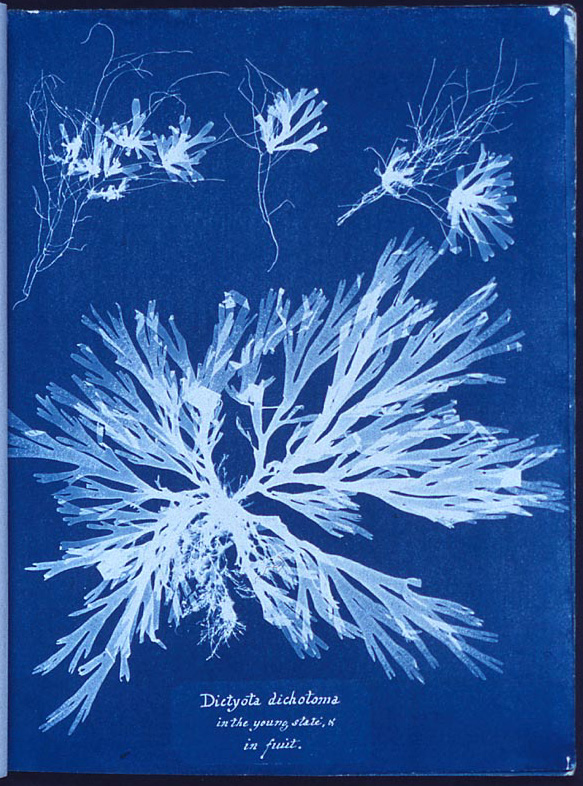
Of the many examples of Nature Printing, among the best known are the cyanotypes of Anna Atkins, the daughter of John George Children FRS, for whom she had earlier prepared 250 woodcuts of shells for his translation of a work by Lamarck, the original not being illustrated [4]. Through her father, she had contacts with Herschel and thus the early development of cyanotypes in which chemicals are transformed by light to give a wonderful blue image, with the subject blocking the effect of light and appearing white. With her keen interest in illustration, Anna Atkins made cyanotypes of seaweeds that were then bound into a small number of volumes.

Complete collections of Anna Atkins cyanotypes have become justly famous – and very valuable. I was privileged to look through the large collection that was owned by Frederick John Horniman and now held by the Horniman Museum in London. Each is printed on watermarked Whatman paper, mostly of 1846 and 1849 in the volumes that I saw, and all have a wonderful quality. As aids to identification, they give dimension and the arrangement of fronds of the seaweeds but no natural colour. One would be hard pressed to identify fresh specimens from some illustrations, especially of small algae, or those that are toughened with natural strengthening (see the images below for examples). Mounting specimens that were translucent meant that some surface and internal detail became visible and these cyanotypes are especially impressive. 


Anna Atkins labelled each sheet with their Latin binomial and this would have been written in ink on strips of paper that were then cleared, most probably using highly refined oil. The labels could then be mounted with each alga and their outline is seen clearly in the prints at the Horniman Museum. Whatever their practical use, these images are beautiful works of art from Nature and it was a privilege to see them. Soon to be superseded by photography, they mark an exciting step in the Art – and Science - of Biological Illustration [3].


[1] Roderick Cave (2010) Impressions of Nature: A History of Nature Printing. London, The British Library.


[2] http://www.rwotton.blogspot.com/2013/08/nature-printing.html


[3] http://www.rwotton.blogspot.com/2014/1/where-science-meets-art-usefulness-and.html


[4] A. E. Gunther (1978) John George Children, F.R.S. (1777-1852) of the British Museum. Mineralogist and reluctant Keeper of Zoology. Bulletin of the British Museum (Natural History) 6: 75-108


I am grateful to Helen Williamson and the Horniman Museum for letting me see these valuable works and for allowing me to reproduce pictures of them in this blog post.


For those wanting to make cyanotypes of their own, a video explaining the technique can be found at: https://www.youtube.com/watch?v=gvvVUfdqDaM and I recommend Roderick Cave's brilliant book (reference [1] above) as an introduction to all aspects of Nature Printing.


Friday, 19 January 2018

Amelia Griffiths, Mary Wyatt and a curious phenomenon in Torbay


Mary Wyatt was a dealer in shells and minerals from her shop in Torquay [1]. During the boom in exploring seashores that occurred during the early Nineteenth Century, such shops supplied visitors with important specimens to add to their cabinets of curiosities. Mary Wyatt’s shop was as well known in Torquay as Mary Anning’s shop in Lyme Regis, where fossils could be obtained, as well as other mementoes; the passion for Natural History including rocks and minerals as well as living organisms.

In addition to running, and supplying, her shop, Mary Wyatt collected algae that were dried and pressed, with some of her collections made up into volumes published as Algae Danmonienses - illustration by dried specimens resulted necessarily in a very limited number of copies being produced [2]. None of this would have been possible without the close co-operation of another famous resident of Torquay, Amelia Griffiths (1768-1858) [3], the subject of an essay by Philip Strange and a biographical note by Ann Shteir. From their articles [4,5], we learn that Amelia Griffiths was born Amelia Warren Rogers on 14th January 1768 and married a vicar, William Griffiths, in 1794. He died in 1802 and she then raised her five children on her own, eventually settling in Torquay in 1829, where Mary Wyatt was one of her servants. By this time, Amelia was already well known for her knowledge of algae, their locations and their biology, and she corresponded with many of the leading authorities of the day.

Philip Strange concludes his article [4] by writing:

The more I investigated the story of Amelia Griffiths, the more I found similarities with Mary Anning. Both were systematic collectors, acquiring immense expertise in their fields and passing on samples to male scientists who furthered their own careers as a result. Both were strong women who pursued their interests whether or not these conformed to norms of society. Griffiths is known to have collected at Lyme Regis so perhaps she encountered Anning on the beach; it is an interesting thought. Anning is now better known, partly because her discoveries were much more significant for science and partly because of the well developed Mary Anning-industry in her home town.

Algae Danmonienses, with its limited number of copies was unlikely to spread the fame of Amelia and Mary and, while Amelia corresponded with many botanists, she produced few articles – Shteir [5] mentioning only two notes to The Phytologist and a list of Natural History specimens in Blewitt’s The Panorama of Torquay [6].

She was certainly well-known and respected in Torbay and Blewitt wrote:

The article on Natural History will be acceptable to all, containing, as it does, the most recent of Mrs. Griffiths’s truly beautiful discoveries in the difficult department of marine botany..

Blewitt also describes an interesting phenomenon at Elberry Cove in Torbay in which Amelia’s expertise was called upon [6]:

At a short distance from the beach, the surface of the water presents a curious phenomenon. A fresh-water spring, rising of course in some part of the chain of hills above the cove, makes its exit from the sandy bottom, about eight or ten feet below the surface of the sea at low water mark.. ..It ascends perpendicularly with considerable force and forms a smooth circle, four or five feet in diameter, on the surface of the sea. Two of these circles are occasionally seen, in consequence, perhaps, of the accumulation of sand; and their size, depth, and distance from each other vary at different times, according as they are influenced by the swell or weather. They are of course best seen at low tide and when the sea is smooth. In April of the present year, we made some experiments in conjunction with Mrs Griffiths, in order to ascertain the character of the water ejected by this spring. The result was satisfactory, and proved that it was a body of fresh water pouring out of an aperture of large size, and with such strength that the sand disturbed was forced by its power to the surface. The appearances within the circle resembled the effect of oil poured on the water.. ..[and] The volume of fresh water must be considerable as the salt taste of the sea perceptibly diminishes in the neighbourhood of the spring. This phenomenon will be visited by the natural philosopher with much pleasure..

Quite what experiments were carried out by Amelia Griffiths are not known – apart from tasting the sea water!


Having been brought up In Torbay, I made many visits to Elberry Cove (shown above at a time of far from ideal conditions) but never recall seeing the upwelling from springs that is described by Blewitt. Perhaps they no longer exist?


[1] M. Rendel (1994) Women in Torquay in the First Half of the Nineteenth Century. The Transactions of the Devonshire Association 126: 17-39


[5] Ann Shteir (2004) Griffiths [née Rogers], Amelia Warren (1768-1858). Oxford Dictionary of National Biography https://doi.org/10.1093/ref:odnb/59318

[6] Octavian Blewitt (1832) The Panorama Of Torquay, A Descriptive And Historical Sketch Of The District Comprised Between The Dart And Teign. London, Simpkin and Marshall + Torquay, Cockrem

Wednesday, 20 April 2016

The awesome cyanotypes of Anna Atkins


The digital age has made it easy for us to identify plants and animals using selections from the millions of illustrations that are available on the Web. Accessing images of specimens was a much greater challenge in the Nineteenth Century, just when more and more people were becoming interested in Natural History and wanting to identify plants and animals they collected from the countryside, or the shore.

One solution to the need for illustration was the use of line drawings, or watercolours, that could be made into plates, printed and thus appear in books. A good example comes in the work of Philip Henry Gosse, who was both a scientist and an able artist, so knew exactly which features to portray. Other approaches used real specimens preserved in spirit, or by taxidermy, but these were only readily available in Museums and similar collections. Freshly-collected plants could be compared with those in herbaria, labelled collections of pressed and dried specimens, but these also were not widely available, although many amateurs made their own. However, they were dependent on the herbaria, and illustrations, of experts to ensure accurate identification. Mary Wyatt used herbarium specimens of seaweeds to allow the publication of a necessarily limited number of books to aid identification, while Bradbury and others extended this approach by pressing plants on to lead plates to make an impression. Each of the plates was then coated with copper and could be used to print many copies, some in monochrome and some using colour for even greater realism [1]. Like illustrations made from engravings of other art work, these become available widely [2,3].

Of the many examples of Nature Printing, among the best known are the cyanotypes of Anna Atkins, the daughter of John George Children FRS, for whom she had earlier prepared 250 woodcuts of shells for his translation of a work by Lamarck, the original not being illustrated [4]. Through her father, she had contacts with Herschel and thus the early development of cyanotypes in which chemicals are transformed by light to give a blue background, with the subject blocking the effect of light and appearing white. With her keen interest in illustration, Anna Atkins made cyanotypes of seaweeds that were then bound into a small number of volumes.

Complete collections of Anna Atkins cyanotypes have become justly famous – and very valuable. I was privileged to look through the large collection that was owned by Frederick John Horniman and is now held by the Horniman Museum in London. Each is printed on watermarked Whatman paper, mostly of 1846 and 1849 in the volumes that I saw, and all have a wonderful quality. As aids to identification, they give dimension and the arrangement of fronds of the seaweeds but no natural colour. One would be hard pressed to identify fresh specimens from some illustrations, especially of small algae, or those that are toughened with natural strengthening (see the images below for examples). Mounting specimens that were translucent meant that some surface, and internal, detail became visible and these cyanotypes are especially impressive.


Anna Atkins labelled each sheet with the Latin binomial of the seaweed and this would have been written in ink on strips of paper that were then cleared, most probably using highly refined oil. The labels could then be mounted with each alga and their outline is seen clearly in the prints at the Horniman Museum. Whatever their practical use, the Anna Atkins cyanotypes are beautiful works of art from Nature and it was a privilege to see them. Soon to be superseded by photography, they mark an exciting step in the Art – and Science - of Biological Illustration [3].


[1] Roderick Cave (2010) Impressions of Nature: A History of Nature Printing. London, The British Library.


[4] A. E. Gunther (1978) John George Children, F.R.S. (1777-1852) of the British Museum. Mineralogist and reluctant Keeper of Zoology. Bulletin of the British Museum (Natural History) 6: 75-108


I am grateful to Helen Williamson and the Horniman Museum for letting me see these valuable works and for allowing me to reproduce pictures of them in this blog post.

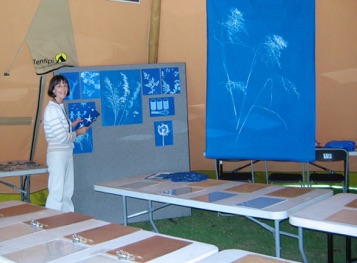
For those wanting to make cyanotypes of their own, a video explaining the technique can be found at: https://www.youtube.com/watch?v=gvvVUfdqDaM and I recommend Roderick Cave's brilliant book (reference [1] above) as an introduction to all aspects of Nature Printing.

Monday, 13 January 2014

Where science meets art - the usefulness and beauty of nature printing


Today, there are a large number of guides and web sites that help us to identify plants and animals. These may contain accurate printed illustrations, photographs, or video clips and, taken with the descriptions in the text, notes on habits etc., we can usually come up with a name. We are not always correct in our identification, as some organisms look very similar to others, but we can certainly get close.

The Victorian followers of the “craze” for Marine Biology had far fewer sources to help them. There were the beautiful illustrations in books by Philip Henry Gosse of many types of marine animals, and illustrations of seaweeds by William Henry Harvey (produced from 1846-1851) 1 and Margaret Gatty (1863), 2 largely the result of prints made from water colour paintings. Some seaweed collectors also had other sources, should they be able to obtain copies of rare books. Those fortunate to gain a copy of Algae Danmonienses by Mary Wyatt (aided by Amelia Griffiths) 3 will have had the opportunity to see mounted herbarium specimens. These have the advantage of allowing the surface of the algae to be examined, albeit in dried form, and this can be helpful when looking at diagnostic features. However, there were, of necessity, rather few copies and they would not be used by the general followers of the “craze”.

Shortly after the appearance of Algae Danmonienses, Anna Atkins produced a wonderful series of illustrations of algae in her Photographs of British Algae: Cyanotype Impressions, produced from 1843-1853. 4 The process of cyanotyping is described by Roderick Cave in his fascinating and attractive book Impressions of Nature: a History of Nature Printing. 5 Atkins’ illustrations are outlines of seaweeds, so lack the fine detail required for identification, but they are among the first biological illustrations that use photographic techniques and they have a magical quality. To make each illustration, a seaweed was placed on to paper which had been treated with iron salts (potassium ferricyanide and ferric ammonium citrate) and kept in the dark until needed. On exposure to sunlight, the iron salts darken to a deep blue colour, leaving the outline of the seaweed, with its densest parts the lightest colour as the iron salts were not transformed. Washing off the remaining salts ensured that no further colour change occurred and each illustration could then be dried and made ready for incorporation into a collection. Cave tells us “It was published in an edition consisting of at least thirteen copies, calling for a total of over 5000 prints to be made.” 5 Although Anna received help, it was a formidable achievement and must have seemed extraordinary at the time - her prints certainly retain their great beauty.


Another method of nature printing was that developed by Alois Auer, and this was applied to seaweeds by Henry Bradbury. Auer was appointed the Director of the Austrian National Printing Office in 1842 and he was an “unusual, gifted and energetic man”. 5 With a colleague, he experiment in pressing lace between two plates, one of lead and one of steel, with the result that the former received an impression from the lace that could be used in printing a copy. If the lead was coated with copper using an electrolytic process, several prints could be made from one plate, and the results were so convincing that observers believed that they were looking at lace rather than prints (two examples are shown below). This technique was then used to make impressions and prints of botanical specimens and Auer demonstrated this to a visiting Englishman, Henry Bradbury, whose father was the senior partner in the Publishing House responsible for printing Punch and The Field, as well as newspapers. 5


On return to England, Bradbury set about making nature prints and, after a series was used in Thomas Moore’s book on ferns, produced illustrations of seaweeds for The Nature Printed British Sea Weeds: Nature Printed by Henry Bradbury published by Johnston and Croall in 1858-1860 and printed by the family firm of Bradbury and Evans. 6 As the specimens used had been pressed, there was inevitably some distortion in the width of some parts, but the impressions were almost as good as herbarium specimens and certainly more useful than cyanotypes. If they were coloured effectively, it could be argued that they were even better than the illustrations produced from prints of paintings, as they conveyed the dried texture more accurately. The prints by Bradbury also had the advantage over cyanotypes and herbarium material in allowing large numbers of copies to be produced once the lead plates had been copper-coated. However, The Nature Printed British Seaweeds was not as successful as the book on ferns and Cave suggests this was because Johnston and Croall were not as well known as Moore (then, as now, names count). 5


No-one looking at the nature prints of Atkins and Bradbury will fail to be impressed by their techniques. In her review of the book Ocean Flowers: Impressions from Nature, Sandra Knapp writes: 7

The art of nature printing, using modern versions of cyanotypes or other techniques, is still very much alive. For example, the British artist Angela Easterling [see below] works with scientists from the Eden Project, The Royal Botanic gardens at Kew and the Natural History Museum to make amazing cyanotype images of threatened plants in threatened habitats. Her images.. ..are wonderful, contributing both to art and science.


I became aware of nature printing when looking at the work of Merrin in making preparations of the scales of butterfly wings (http://rwotton.blogspot.co.uk/2013/08/nature-printing.html) and was amazed at the results he achieved. Nature printing using cyanotypes and the Auer method provided me with a further eye-opener and I revel in the idea that the images are of value both to science and art. Using the expression coined by Henry Gosse in the Preface to the The Romance of Natural History, 8 I was trained to be a “Dr Dryasdust”; although I retained a child-like amazement at the beauty of animals I collected and then observed under the microscope. It’s the way we interpret our impressions of plants and animals that makes Natural History so fulfilling and something that we can all share - from the most dedicated taxonomist to those inspired by the visual arts.


1 William H. Harvey (1846-1851) Phycologia Britannica: or History of British Sea-Weeds, containing coloured figures, generic and specific characters, synonymes and descriptions of all the species of algae inhabiting the shores of the British Islands. London, Reeve Brothers.

2 Mrs Alfred Gatty (1872) British Sea-Weeds drawn from Professor Harvey’s “Phycologia Britannica”; with descriptions, an amateur’s synopsis, rules for laying out sea-weeds, an order for arranging them in the herbarium, and an Appendix of new species. London, Bell and Daldy.

3 Mary Wyatt (?1833-1840) Algae Danmoniensis, or dried specimens of marine plants, principally collected in Devonshire; carefully named according to Dr Hooker’s British Flora. Published privately.

4 Anna Atkins (1843-1853) Photographs of British Algae : Cyanotype Impressions. Published privately.

5 Roderick Cave (2010) Impressions of Nature: A History of Nature Printing. London, The British Library.

6 William Grosart Johnston and Alexander Croall (1858-1860) The Nature Printed British Sea Weeds: Nature Printed by Henry Bradbury. London, Bradbury and Evans.

7 Sandra Knapp (2004) Book review of Ocean Flowers: Impressions from Nature (eds. Carol Armstrong and Catherine de Zegher). American Scientist 92 (http://www.americanscientist.org/bookshelf/pub/seaweed-cyanotypes)

8 Philip Henry Gosse (1860) The Romance of Natural History. London, J.Nisbet and Co.


For those interested, the web site for the Nature Printing Society is: http://www.natureprintingsociety.org/


Monday, 30 December 2013

Women on the shore


The growing appeal of marine Natural History in the Nineteenth Century was shared by both men and women, sometimes jointly and sometimes in groups of one sex.


Philip Henry Gosse gives an account of an excursion by small boat:

Let us then scramble down to the beautiful Anstey’s Cove [above].. ..Yonder on the shingle lies a boat, newly painted in white and green, for the attraction of young ladies of maritime aspirations.. ..”Jump aboard , please, Sir [P.H.Gosse]! Jump in, ladies! jump in, little master [Edmund Gosse]!” And now, as we take our seats on the clean canvas cushions astern, the boat’s bottom scrapes along with a harsh grating noise over the white shingle-pebbles, and we are afloat.. 1

There follows a description of all the seaweeds and animals visible from the boat as it moves around the coast and also visits islands close by. I’m sure that the women enjoyed the expertise of such a knowledgeable enthusiast as Henry Gosse, just as other women had done on an amusing occasion on the shore in Torbay, described by Henry Gosse’s son Edmund:

..we came across a party of ladies, who were cackling so joyously over a rarity they had secured that our curiosity overcame our shyness, and we asked them what they had found. They named a very scarce species, and held it up to us to examine. My father, at once, civilly set them right; it was so-and-so, something much more commonplace. The ladies drew themselves up with dignity, and sarcastically remarked that they could only repeat that it was the rarity, and that “Gosse is our authority”.  2

In addition to observing, and identifying, living algae and animals, women also made collections for their “cabinets of curiosity”. Fossilised specimens were common in these cabinets and Gosse describes one site in South Devon, well-known to collectors:

The beach of white shingle at Oddicombe, whither ladies so often repair to search for pebbles containing fossil madrepores, washed up by the tide... 3

Henry Gosse was at the forefront of the Victorian interest in marine biology and in the development of aquaria. His first wife, Emily, accompanied him on some collecting trips and also on the field courses that he led in Devonshire and South Wales. Tragically, Emily died, and her support in the typical female role of the day - silent companionship while Henry worked, and help with translation from other languages - was lost. Henry re-married after meeting Eliza through a shared enthusiasm for both Natural History and Christian views that centred on belief in the literal truth of The Bible. 4 

In the chapter on “The Naturalist of the Boudoir” in her book The Heyday of Natural History 1820-1870, 5 Lynn Barber makes interesting observations on the ways women took part in the great enthusiasm for the natural world that developed during the Nineteenth Century:

Women read about natural history, wrote about it, drew it, collected it, and generally enthused about it as much as men did..

Victorian women rarely translated their genuine enthusiasm for natural history into any purposeful form of research.. ..Illustration was the only form of natural history in which women really excelled.. .. Women were trained to draw well: it was one of the few things they practised and studied consistently from infancy through to adulthood.. ..Women also tended to make punctilious collectors.

The most scientific woman collector of the age was not a fossilist but an algologist, Mrs A.W.Griffiths of Torquay.. .. One genus and several species of seaweed were named after her, and she is mentioned with respect - almost with awe - by every Victorian writer on seaweeds, but she published nothing in her own name, and now survives only as an acknowledgement in other people’s prefaces.

Amelia Griffiths (1768-1858) was one of several well-known seaweed collectors and experts and it is surprising that she is barely mentioned by Henry Gosse, especially as both lived for much of their lives in the same town, although Henry only became a permanent resident in 1857, one year before Amelia died at the grand age of 90. He must also have known of Mary Wyatt (1789-1871), who was also a collector and who kept a shop in Torquay that dealt in pressed plants and sea shells. Mary became Amelia’s servant and, although illiterate, 6 she joined Amelia in jointly publishing Algae Danmonienses, consisting of four volumes of dried seaweeds collected largely from Torbay. In contrast to Henry Gosse, William Pengelly FRS, the distinguished explorer of cave faunas, and another Torquay resident, does refer to Amelia, as he was responsible for making arrangements in 1862 that her “beautiful and valuable collection of sea-weeds” 7 was transferred to Kew and her collection of shells to the Natural History section of the British Museum. That the collections went to such internationally recognised centres is testament to their significance.

Although the contributions of Amelia Griffiths and Mary Wyatt were recognised widely, the doyenne of 19th century women algologists was Margaret Gatty (1809-1873 - see below). She was the daughter of a clergyman (Dr Alexander John Scott, famous for being the chaplain who cradled the dying Nelson in his arms at the Battle of Trafalgar) and her uncle held the living in Ecclesfield, near Sheffield  in Yorkshire. 8 Mrs Scott died when Margaret and her elder sister, Horatia, were small, with Margaret being the dominant of the pair, having a strong drive to advance herself. Unlike Amelia Griffiths, she always had a passion for writing and took it seriously, showing her poems to family friends connected to the world of literature.


In 1839, Margaret married the Reverend Alfred Gatty and, as fortune would have it, the living at Ecclesfield became vacant after the death of Margaret’s uncle, so Rev. Gatty was able to replace him in the post. Margaret thus settled to the life of a cleric’s wife, working in the parish and also being a dutiful companion and, of course, mother to numerous children. In 1848, the burdens of the parish, child rearing and pregnancies became too great even for her energy and drive and she left the family for a break in Hastings to convalesce and regain her strength. By chance, a doctor whom she was consulting, gave her a copy of Harvey’s Phycologica Britannica (a standard work on seaweeds and zoophytes - “plant-like animals”) and Sheffield writes: 8


Why should this catalogue of plants and life-forms suddenly have captured her interest and imagination? Perhaps it was a buoy in a sea of endless empty days and perhaps Gatty, exiled at the sea-side, became infected by the mid-century ‘craze’ for natural history, for gathering, collecting, naming and labelling specimens that many men, women and children of all social classes were taking up. Marine botany was no exception as the rise of interest in seaside recreation included the scouring of beaches and tide-pools and the dredging of the sea itself for the ultimate specimen. At this time Phillip [sic] Henry Gosse (1810-1888) had already published The Ocean (1845), and would go on to publish other popular scientific works in quick succession..

Interestingly, Margaret made little reference to seaweeds in her diary entries while she was in Hastings, but she now set out on serious study and her home in Yorkshire “became her laboratory.. ..[and] her family found themselves knee-deep in seaweeds, seaweed books and seaweed correspondence.” 8 She had always loved the sea and now had an added reason to make visits to the shore. Her work culminated in the publication in 1863 (as Mrs Alfred Gatty) of British Seaweeds, drawn from Professor Harvey’s “Phycologica Britannica”. These volumes (available today as free Google e-books) served to simplify the scientific descriptions used by Harvey and thus make his work more accessible to a general audience, Margaret being in communication with Harvey throughout the production of the book. It wasn’t her only publication, as she wrote many other popular books linking Natural History and religious themes. Probably the best known are her five volumes of Parables from Nature published from 1855-1871 and her writing was popular and profitable. 


Margaret Gatty’s algal herbarium, with seaweeds prepared using the techniques of Miss Cutler of Sidmouth, another renowned woman algologist of the times, was donated to the University of St Andrews by her daughter Horatia. It is pleasing to know that it is still used in research, 9 just as Amelia Griffiths’ herbarium is likely to be at Kew. Their work made important contributions to science and demonstrates that women Natural Historians in the Nineteenth Century were not just collectors (although that was certainly the majority case), but much respected by the male-dominated scientific Establishment.
 

1 Philip Henry Gosse (1865) A Year at the Shore. London, Alexander Strahan.

2 Edmund Gosse (1890) The Naturalist of the Sea-Shore: The Life of Philip Henry Gosse. London, William Heinemann.

3 Philip Henry Gosse (1853) A Naturalist’s Rambles on the Devonshire Coast. London, John Van Voorst.

4 Roger S Wotton (2012) Walking with Gosse: Natural History, Creation and Religious Conflicts. Southampton, Clio Publishing.

5 Lynn Barber (1980) The Heyday of Natural History 1820-1870. London, Jonathan Cape.

6 David Charles Raiment (2007) Mary Wyatt (1989-1871): The Princess of Seaweeds. The Phycologist 73: 4-5.

7 Hester Pengelly (ed.) (1897) A Memoir of William Pengelly, of Torquay, F.R.S., Geologist, with a selection from his correspondence. London, John Murray.

8 Suzanne Le-May Sheffield (2001) Revealing New Worlds: Three Victorian Women Naturalists. London, Routledge.