Showing posts with label Limpets. Show all posts

Wednesday, 3 February 2021

Looking for Torbay Bonnets


I was very lucky to have been born, and brought up, in Torbay on the Devon Riviera coast, only leaving to go to University when I was 18 [1]. Although I now live in Hertfordshire, I enjoy my return visits to South Devon for a couple of days each year, and I’m hoping that 2021 will allow me to re-connect with my roots; COVID-19 having prevented travel in 2020.

Perhaps because I live inland, I have a strong love of coasts and I am drawn, especially, to the red sandy beaches of Torbay and the rocky outcrops of sandstone and limestone that are such features of the Bay and the adjacent coast. Every visit I make includes a walk along a beach and, unlike most people, my fascination is with the strand line of material left by the retreating tide. I started beachcombing nearly seventy years ago, when there was far less plastic and other refuse on the shore, most of that being discarded by ships, or coming through sewage outlets from around the world. My discoveries then were mostly of seaweeds (from which colonising sandhoppers scurried away when the weed was turned over) and the remains of marine animals, with shells and shell fragments being abundant. Sometimes, there was something unusual – a mermaid’s purse or a comb jelly – but mostly the remains were of molluscs, their soft body parts having been decomposed long before. The commonest shells were those of cockles, clams and razor clams and, usually, there were also good numbers of limpets, slipper limpets, winkles (of several species) and top shells. They intrigued me as a child, as I had such little knowledge of the aquatic world, except that acquired by exploring rock pools.

After a storm, the amount of detritus gathered at the strand line could be impressive and the number of shells, and shell fragments, washed up after the “big freeze” of early 1963 made one wonder just what had been left behind in, and on, the substratum of the shallow bay. Although I wasn’t aware of them at the time, among the shells would have been those of “Paignton Cockles” and “Torbay Bonnets”. I have described Paignton Cockles in an earlier blog post [2], but many readers will not have heard about Torbay Bonnets (also known as Fools-cap Limpets). These are extracts from a description written by Gosse in the mid-Nineteenth Century [3]:

The Fools-cap Limpets.. ..have the shell shaped like a somewhat high cone, with the summit a little produced, and turned over backwards. The surface is commonly marked with lines (striƦ), and covered with a horny skin, which is sometimes invested with a short velvety down. The interior has no plate or partition of any kind..

..The only British species is commonly known by the appellation Torbay Bonnet; it also bears the names of Fools-cap Limpet, Cap of Liberty, and Hungarian Bonnet, all of which designations.. .. have an obvious reference to its form. It is a rather large shell, being frequently more than an inch and a half in diameter, and an inch in height. Its substance is rather thin, though strong, and somewhat translucent; its colour is a delicate pink, or flesh-white, though this is concealed, especially around the lower part, by an olive-coloured skin, covered with shaggy down. The interior of the shell is delicately smooth, and of the same roseate hue as the exterior.

The animal is usually pale yellow, with a pink mantle bordered with a fine orange-coloured fringe. The head, which is large and swollen, is tinged with brown.

Though generally distributed, The Fools-cap must be considered a rare shell. Torbay, as one of its familiar names indicates, is the locality in which it occurs in greatest abundance.


Gosse provides an illustration of the shell (above upper) that can be compared to a photographic image taken by Georges Jansoone (above lower). In the latter, note that the periostracum is missing, this being the coating of the shell that Gosse refers to. In both images, there is no animal present, just the shells that they secrete, the animals having a superficial resemblance to limpets and slipper limpets, the former being familiar to us.

Although Gosse refers to Torbay Bonnets as Fools-cap Limpets, they are very different to common limpets, although they share features with slipper limpets. Common limpets use a file-like tongue (the radula) to scrape over the surface of rocks to remove algae and biofilm and are mobile when covered by water, returning to their “home scar” should they live on rocks in the inter-tidal. Slipper limpets and Torbay Bonnets, in contrast, are sedentary and feed on tiny particles carried into the cavity of the shell by huge numbers of tiny beating hairs called cilia. The particles are then trapped on mucus and carried to the mouth for ingestion, the radula being important in this process [4].  

I began this post about Torbay Bonnets by describing my love of beachcombing in Torbay before I went off to University. There, I was taught about molluscs by Professor Alastair Graham and Dr Vera Fretter (the latter was my tutor) and they were acknowledged experts on British snails, like limpets, slipper limpets, and Torbay Bonnets. I wish that they were still alive, as I would love to chat to them to find out more about these fascinating molluscs (I didn't have so many questions when I was a student...). Their monograph on snails (see image below) remains a classic of scholarship and research and, just like Gosse, they made all the illustrations themselves. Few of us have these skills, and maybe they are not needed in the age of videography and the internet, but we can still enjoy beachcombing and the excitement of discovery along the strand line. I’m certainly looking forward to visiting South Devon in 2021 and I shall be looking out for Torbay Bonnets.


[1] Roger S Wotton (2020) Walking with Gosse. e-book.

[2] https://rwotton.blogspot.com/2017/11/the-legendary-paignton-cockles-and-some.html

[3] Philip Henry Gosse (1854) Natural history. Mollusca. London, Society for Promoting Christian Knowledge.

[4] C.M.Yonge (1938) Evolution of ciliary feeding in the Prosobranchia, with an account of feeding in Capulus ungaricus. Journal of the Marine Biological Association of the United Kingdom 22: 453-468.

[5] Vera Fretter and Alastair Graham (1962) British Prosobranch Molluscs: their functional anatomy and ecology. London, The Ray Society.


Wednesday, 4 March 2015

Eating limpets


In my last blog post, I wrote an appreciation of limpets and the extraordinary adaptations that they show for life on rocky marine shores [1]. As I pointed out, that should not prevent us from using these molluscs as a source of food and that is something that fits with contemporary debates about sustainability and the need for animal protein. We are now much less resourceful than our ancestors, and are dependent on what is available in stores or on market stalls, with the latter often showing a more local approach than the former.

To gain an historical perspective on eating limpets, I read Lovell's The Edible Molluscs of Great Britain and Ireland with Recipes for cooking them [2] and he describes their consumption by some communities:

"In many places limpets are used for food, especially on the Continent, where they are oftener eaten than the periwinkle. At Naples they make them into soup, and I am told it is an excellent dish.. ..The poorer classes at Eastbourne eat them constantly.. ..At Plymouth they gather great numbers of them, especially from the breakwater, as well as in the Isle of Man, where they are known by the name of "flitters"; and in Scotland the juice of these shellfishes is mixed with oatmeal.."

In addition to this background information, Lovell also gives recipes [2]:

"Limpet Soup – Wash them, and free the shells from seaweeds etc.; put them into a saucepan and parboil them. Take them out of the shells; chop up some parsley, and put it, with a tablespoonful of oil, or an ounce of lard or butter, into a saucepan, and fry until it becomes brown. Add a pint of water, and, when boiling, throw in the limpets, with a teaspoonful of anchovy sauce, some pepper, and boil again for half an hour; or, if preferred, stew them before putting them into the soup.

Limpet sauce – Choose clean-shelled limpets, not covered with barnacles, steep them in fresh water, and then heat them in a close covered saucepan until they part easily from the shells. They yield a rich brown liquor, in which, after being shelled, they may be stewed for half an hour. Thicken the liquor with butter and flour; strain and season with pepper, cayenne, and salt, and a slight flavouring of lemon-juice or vinegar. The limpets, being tough and indigestible, are not returned into the sauce."

The latter comment reminds us of the common failing of over-cooking seafood of all kinds, something that one learns by trial and error.

Lovell [2] also gives a more rustic approach to cooking limpets, originating from the island of Herm in the Channel Islands, and reported by Jeffreys in Volume 3 of his British Conchology:

"Roasted limpets - The limpets were placed on the ground, and laid in their usual position, and cooked by being covered with a heap of straw, which had been set on fire, about twenty minutes before dinner."

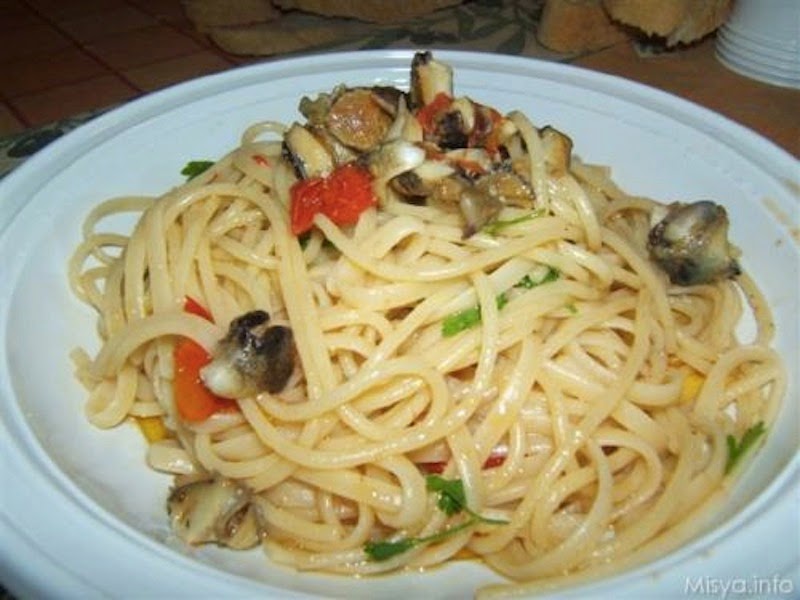
To these recipes can be added others from different parts of the World (illustrations of each dish are given, with the URL to the web page for each recipe):


It is only possible to eat limpets as a regular part of the diet if one lives at, or near, the coast. For those who are landlocked, Lovell guides us to Garden Snails, together with their close relatives, including the Roman, or Vine, Snail (and who doesn't like Escargots Ć  la Bourguinonne?). Limpets and land snails are both sustainable foods and provide good sources of animal protein. Although I don't feel comfortable about roasting them alive, placing the molluscs in boiling water kills them rapidly and they can also be kept in a deep freeze for a short time to reduce their metabolism severely before they are cooked.

Mark Zuckerberg became famous not only for Facebook, but also for his statement that killing animals oneself is better than willingly being ignorant of how we obtain the meat we buy from butchers or supermarkets [3]. For those that would like to follow Mr Zuckerberg's example, but cannot face the prospect of cutting the throat of a pig or a goat, killing snails of various kinds provides rather less of a challenge.   


[2] M. S. Lovell (1867) The Edible Molluscs of Great Britain and Ireland with Recipes for cooking them. London, Reeve & Co.


Friday, 27 February 2015

Limpets and F1 cars


An article on the Sky News web site had the headline: Does Humble Limpet Hold Key To Future F1 Cars? It referred to the findings of Asa Barber and colleagues on the strength of limpet teeth (there were many other reports of this work in the Media, most with catchy headlines). Intrigued, I read the original publication describing the detailed studies and the comparisons made by the authors between the strength of limpet teeth and strong, Man-made materials. In the paper [1], there was none of the colourful reporting that I had seen in newspapers and on the web.


The teeth of limpets are set on the radula (see above), a rasping tongue, used to scrape rock surfaces and thus acquire food from attached algal and microbial biofilms. In moving over stone surfaces, the teeth “need to be extremely strong and hard to avoid catastrophic failure” although the scraping action does cause them to become worn [1]. Strength comes from a mineral, goethite (iron oxy hydroxide), that is formed in filaments within a matrix of protein with the “mineral nanofibres typically many micrometres in length but only a few tens of nanometers in diameter” [1]. In non-technical language, the strengthening filaments are long and very thin and this provides the optimum arrangement for resilience.

Limpets are very common around shores and are certainly successful snails (members of the Class Gastropoda). As I was brought up by the sea, I became fascinated by marine organisms and their habits and, like many children, was intrigued by the ability of limpets to cling on to rocks and thus resist any amount of kicking by me. I learned that this attachment was made possible by the muscular foot and was not related to suction as I had thought. The foot has numerous minute extensions over its base and these interface with the (microscopically) rough surface to which the limpet is attached, a thin film of mucus ensuring good contact. This tight attachment serves not only to prevent limpets from being removed, but also allows a near perfect match between the shell and the rock, minimising water loss when the tide is out. The attachment is so close that the rock can become eroded into “home scars” and the margin of the shell follows contours, like those created by the barnacles in the illustration below.


Everything changes when the tide comes in. The tight hold is relaxed and the limpets now use their foot, and secreted mucus, to glide over the surface, just like other snails. It is then that they feed by movements of the radula and this leaves a characteristic trail of removed biofilm (see below - and for further, excellent pictures see https://natureinfocus.wordpress.com/category/seashore-creatures/limpets-seashore-creatures/page/2/). As some limpets are territorial, it is thought that local areas of biofilm is then “farmed” by individuals and their excretions may well act as fertiliser, as it is known that biofilm components are highly adsorptive [2]. Algae also grow on the home scars [3] and these will again be fertilised by the limpet during attachment; exposure to light allowing the algae to photosynthesise when the limpets forage away from the home scar.


The findings of Barber et al., and our knowledge of the Natural History of limpets, bring to mind many questions: “How did the structure of limpet teeth evolve?”; “How did mineral fibres become embedded in a protein matrix?”, “How did teeth become arranged on a radula?”; “How was a radula formed?”; “How did the structure of the foot develop?”; “How did limpets become territorial and develop the habit of gardening?”; etc. These questions have no easy answers.


We tend to regard animals like limpets as being mundane and lacking in interest, although they are valued as food, especially in Madeira, where an annual festival is held in their honour. This doesn’t extend to considering the welfare of the limpets, especially as they are fried alive in butter, before the addition of a little garlic and lemon juice makes them a tasty treat. Their use as food, and as examples of useful bioengineering, emphasises our anthropocentric approach and we rightly continue to have this attitude. However, we should also step back and admire how evolution has resulted in such an impressive array of adaptations to life on the rocky shore. The child in me has a sense of awe at the selection of mutations that allowed all the changes that have occurred through time to produce such wonderful creatures. I’m not suggesting that limpets should be regarded as honorary humans, in the way that we regard our pets, but these splendid snails are not just around for our purposes, whatever the sentiments of the Book of Genesis, or the impressions provided by headlines in the Media. All the adaptations referred to in the questions above were in place long before humans appeared and limpets deserve our respect.


[1] Asa H. Barber, Dun Lu and Nicola M Pugno (2015) Extreme strength observed in limpet teeth. Journal of the Royal Society Interface 12: 20141326.

[2] Roger S Wotton (2004) The essential role of exopolymers (EPS) in aquatic systems. Oceanography and Marine Biology, An Annual Review 42: 57-94.

[3] Gray A Williams and Colin Little (2001) Preliminary observations on algal growth under limpet (Patella vulgata) home scars. Journal of the Marine Biological Association of the United Kingdom 81: 175-176.