Thursday, 20 August 2015

Capital punishment and the tragedy of Edith Thompson


It is easy to kill micro-organisms, plants and invertebrates and even a pleasurable act when these cause infestations. I find it more difficult to kill many vertebrates, especially mammals and, when writing the blog post about Taking Life [1], my thoughts turned to the theoretical consideration of whether I could kill another human. The answer was a clear "No" and that extended to warfare, even when individuals are removed from their background and one has no knowledge of them, or of their family and friends. I'm not sure that I could live with the thought of having killed another human, even when my own life was threatened. It's not an assumption that I am keen to test.

As a result of my views on killing other humans, I am firmly against capital punishment, yet recognise that it is practised in many countries and has been for centuries. Indeed, one of the most famous examples of capital punishment occurred two thousand years ago with the crucifixion of Christ and the religion would not exist if Christ had not been killed and then risen from the dead. From this perspective, capital punishment is fundamental to Christianity and provides an exception to the moral code of the Judaeo-Christian tradition given by God in the Ten Commandments [2].


The crucifixion of Christ was carried out alongside that of two other "criminals" (omitted by Giotto in the fresco shown above) and it was intended as a spectacle, this being the custom of the time. Executions continued to be held in public in Western countries until recent times and they occur today in the Middle East and elsewhere, both as a warning and as a form of macabre entertainment. Of course, I refer here to state-sanctioned murder, rather than the execution by terrorists of hostages, or of citizens who are deemed to be out of line with a religious or political principle. Capital punishment is a deliberate act of killing, usually carried out weeks and months after a trial and, bizarrely, in countries like the USA, this delay can extend to decades.

Capital punishment requires an executioner (or executioners). Firing squads have traditionally involved a number of shooters, some of whom have live ammunition and others blanks. This lessens a sense of responsibility for taking life when the executioners are coerced into having to take part. In most other forms of capital punishment there is one executioner and they may be remote (as in lethal injection, gassing, or electrocution) or be involved directly (as in beheading, the use of the guillotine, and hanging). The latter executioners know only too well that they are responsible for taking the life of another human and do so legally.

Hanging remains one of the most frequently used forms of capital punishment and, while the act is usually witnessed by prison officials and some others, it is mostly carried out in private. In some high profile state killings, the execution has been recorded on film or video to serve as confirmation that the act has taken place, but this is exceptional. There is a tradition that hangmen used by the state (are there any hangwomen?) are selected for their knowledge and ability to ensure clinical dispatch and some learn these skills from within a family tradition of having the role, learning by stages until able to perform a hanging themselves. How are they affected by the experience?

The following quote is from a BBC article [3] that includes an interview with Sabir Masih, a hangman in Pakistan:

"I feel nothing. It's a family thing. My father taught me how to tie the hangman's knot, how many coils etcetera, and he took me along to witness some hangings around the time when I was being recruited."..

.."My only concern is to prepare him [the victim] at least three minutes before the time of hanging. So I remove his shoes, put a hood on his face, tie his hands and feet, put the noose around his neck, make sure the knot is placed below his left ear, and then wait for the jailer's signal to pull the lever."

There is no pre- or post-hanging psychological counselling for hangmen, and no limit to the number of hangings one executioner may perform before he is given a break.

Mr Masih says he doesn't need either.

Not all hangmen have that reaction and one the chief executioners in England, John Ellis, committed suicide because of the stress created by his job, and of one execution in particular. A reporter for The Rochdale Observer interviewed Ellis's wife shortly after his funeral and she mentioned the hanging of Edith Thompson, carried out by her husband on 9th January 1923 [4]. The execution, and its preliminaries, are described in the book Criminal Justice by René Weis [5] and the distinguished Shakespearean scholar describes the events leading up to Edith Thompson's conviction for the murder of her husband. It is a harrowing, and tragic, story and I found some sections of the book distressing to read. Despite the verdict of the court that she was guilty of murder, Weis shows us that this was a miscarriage of justice. 


Edith had brief, passionate encounters with Freddy Bywaters, a young merchant seaman, during his short return visits to England between voyages to Australia and the Far East, but it was Bywaters alone who killed her husband, Percy. In the photograph below, posed deliberately by Edith's brother, Edith is flanked by Percy on the right and by Freddy on the left - eighteen months after the photograph was taken all three would be dead. There is no dispute that Freddy killed Percy, although there has been discussion of the circumstances that led up to the assault and, to the end, Freddy maintained that Edith was innocent and had nothing to do with the final act.


Especially harrowing in Criminal Justice are the descriptions of the extreme anguish that Ethel suffered while on remand and when awaiting execution. In the weeks leading up to 9th January 1923 she was so distressed that frequent doses of strong sedative had to be administered and she was near unconscious when warders effectively carried her to the scaffold after Ellis had entered her cell to prepare her for the execution (was this his first contact with Edith after being summoned from Rochdale?). When the act took place, there were dreadful consequences, as the drop caused severe haemorrhaging and there was a lot of cleaning up to do. Ellis and the prison staff were obviously very upset by this and they may also have suspected that she was innocent of a capital offence. Several journalists took up both Edith's and Freddy's cases and argued against the verdict of the court and there was wide coverage of the case [5] and of subsequent events.
I won't dwell more on that story, but it is relevant to discussions on the use of the death penalty as a means of state punishment. If the cold-blooded nature of the act wasn't bad enough, the mental anguish of waiting for "justice", the agony of visits from family and friends as the day draws nearer, and the effect on all the staff are quite enough to convince me that capital punishment cannot be justified, even for the most heinous crimes.
 

                                                     Executed and executioner


[2] The Holy Bible Exodus chapter 20 verse 13 (King James' Version).


[5] René J. A. Weis (1990) Criminal Justice: The True Story of Edith Thompson. London, Penguin Books.


Friday, 7 August 2015

Taking Life


The headline on page 6 of The Independent on Saturday 1st August read [1]: 'What is fun about death and the killing of a beautiful creature?'. It was a quote from an interview by Jonathan Owen with the campaigner Virginia McKenna and focussed on the killing of a lion by a trophy hunter, but it set me thinking more widely about my attitude to killing organisms. I maintain that all creatures are beautiful, so, for me, the adjective is redundant.

I'll begin with two examples that only loosely fit the definition of a creature. As someone who has had a close encounter with E. coli (below, top left), I am very thankful for antibiotics and their power to kill the bacteria. However, studies in microbiology reveal not only a beautifully adapted organism, but one with tremendous powers of reproduction and the ability to fend off the defence mechanisms of the host. Killing them when they infect areas of the body other than the gut brings a great deal of relief but I wouldn't describe it as being fun. The same applies to the presence of weeds like dandelions in the garden, especially the lawn. No-one could dispute that they are beautiful plants, but we like them in the countryside and not messing up the neat arrangement of plants that we like to culture. Killing weeds never involves thoughts of regret at extinguishing the life of another creature, at least in my experience.


Having spent time in Northern Scandinavia on research visits, I know something about high densities of mosquitoes [2]: who was it who said they enjoyed the high-pitched noise of mosquito wing beats and likened it to singing? Adult females require blood before they can mature their eggs and they are both persistent at finding hosts and, despite their noisy flight, usually land unnoticed. Unfortunately, I react badly to mosquito bites and invariably get lots of itchy lumps as a result. Creams and anti-histamine sprays are of some assistance, but I try to kill the insects before attack, if at all possible. Not exactly the fun of the headline in The Independent, but certainly pleasurable. Yet I have studied larval mosquitoes in some detail, as I have the larvae of other biting flies, and I am amazed by the evolution of their feeding structures and the metamorphosis that results in such different body plans as those of the larvae and adults. I retain a sense of wonder, but this is not in my mind when I kill biting flies (and I've killed millions of their larvae). However, there are plenty left after my efforts.

Other beautiful creatures include wasps and blowflies (above, lower). All of us are amazed at the structure of wasp nests: the way they are constructed; the social behaviour of the inhabitants; and the capacity for workers to hunt and gather to bring food to bring to the nest. Wasps are brightly coloured to give a warning that they sting and we react to that, even though it evolved long before humans appeared on the Earth. Indeed, almost any insects with black and yellow striped abdomens receive the same treatment as wasps as we try to brush them away and, preferably, swat them. As I write, we have a wasp nest nearby and the workers often enter our house through open windows. Despite my admiration for the structure and lifestyle of wasps, I kill these intruders with relish and would ideally like the nest removed, wherever it might be. It's the same with blowflies and house flies and their beautifully adapted maggots [3]. I kill those with the same degree of pleasure.


All the examples thus far are of creatures which either cause harm or irritation to us, or to our immediate surroundings. What of the killing of creatures for food? Our hunter-gatherer ancestors captured animals to eat and we can still do this if collecting, fishing or shooting. However, we are now mostly dependent on buying animals that have been killed by someone else, although blue mussels are sold alive before we kill them by tipping them into a pan of boiling muscadet [4]. The food industry is geared to providing us not only with killed animals, but also gutted fish, or butchered meat, although this processing is largely hidden from us. Fish are caught at sea by lines or trawls, or gathered from large enclosures in fish farms, and they are allowed to die before being gutted and packed on ice. Meat comes mainly in the form of chickens, turkeys, sheep, cows and pigs that are farmed, with the latter three transported first to markets and then on to abattoirs for slaughter. I've visited an abattoir and it was not a pleasant experience, but not sufficiently unpleasant to stop me from being an enthusiastic omnivore.


During disease outbreaks, it is common for farm animals to be shot in situ and their carcases burned or buried. It strikes me that killing livestock on farms is preferable to the market-abattoir route, although many may prefer the killing to continue being hidden from view. At least some chickens and turkeys are killed on the farms where they are reared, but the conditions in which they live vary greatly. The intensive rearing of battery chickens for egg production is a case in point and I still remember vividly the smells, sounds and sights of a battery rearing unit that I visited forty years ago. Slaughter is just part of a brutal process, as it is with other intensively reared farm animals, and slaughter on site, or nearby, is hardly the compensation it would be for animals that are allowed a (relatively) free range. 


Shooting livestock would be little different to hunting game, something that I've enjoyed. As I do not wish to kill the animals myself, my role in rough shoots is as a beater, walking up the game and watching the dogs quartering the ground ahead of the line of guns. It is a good day out and worth it just to watch the dogs in action, and most birds on shoots I've attended are shot cleanly. In addition, there is the prospect of being paid for my pleasure in the occasional gift of a bird and I'm very fond of game of all kinds. My sole experience of hunting deer came when I accompanied a friend who is highly experienced stalker. We could see roe deer in a clearing and I was told to lie down and watch while he moved through the wood to get into a good position to shoot. After minutes, there was a loud crack and the deer dropped dead and we were quickly on to it. We immediately performed the gralloch, which was not upsetting to me as it was no different to the dissecting that I had done as part of my Zoology training. The deer was grazing one minute and dead the next and I thought that was rather good, just like the killing of pheasants that died shortly after they were put to flight.

Killing to prevent attacks, or for food, seems acceptable to me, as long as death is rapid. Killing for fun is less acceptable, although I recognise that some people get pleasure from slaughtering large numbers of fish and higher vertebrates, enjoying in this way their power over Nature. Selecting the killing of a lion, albeit in a gruesome manner, highlights our approach to the killing of all living creatures, each a remarkable example of the power of evolution.


[1] The Independent 1st August 2015 p6.


Friday, 24 July 2015

Fear of death


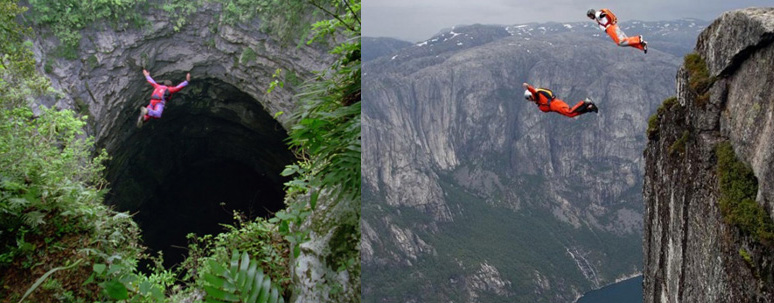
The colloquial expression of "having a death wish" is often applied to people who expose themselves to great danger, and especially to those who enjoy extreme sports.


The most dangerous extreme sport is BASE jumping (above), where an individual leaps from a cliff, bridge or a similar structure, and free falls before opening a parachute. BASE jumping carries a five to sixteen times greater risk of death than skydiving from an aeroplane or helicopter [1], and an even more risky variant of BASE jumping is proximity flying using steerable wing suits. These suits allow fliers to pass very close to terrain before moving out into a region where there is sufficient altitude to allow safe release of a parachute and return to the ground. Take a look at this video clip and you'll see what I mean:


The fliers are Jeb Corliss (in the black suit) and Jhonathan Florez (in the light suit) and one can sense their exhilaration in flying quickly and so close to the ground. However, it can go wrong. Indeed, Jhonny Florez was killed recently in Switzerland and he was a highly experienced wing suit flier who had made many jumps of the same type as the one that resulted in his death from "impact with terrain". For close proximity fliers, then, death is a real possibility, but their attitude towards it is different to that of the average person.

In a study entitled Personality Characteristics of BASE Jumpers, Monasterio et al. [1] found that, while many personality traits showed a range that was similar to that of their peers, BASE jumpers tended to have very low HA (Harm Avoidance) scores:

The finding of low HA is not surprising or counterintuitive, as individuals with low scores in this dimension are described as carefree, relaxed, daring, courageous, composed, and optimistic even in situations that worry most people. These individuals are described as outgoing, bold, and confident. Their energy levels tend to be high, and they impress others as dynamic, lively and vigorous. The advantages of low HA are confidence in the face of danger and uncertainty leading to optimistic and energetic efforts with little or no distress..

..In our study there was a high prevalence of witnessed and experienced serious trauma, and near misses among BASE jumpers; despite this participants persisted in the sport and this suggests that they are likely to possess considerable psychological resilience to the effects of trauma.

Far from being reckless, BASE jumpers are very careful in their preparation, as they are aware of the danger of things going wrong, but this awareness is exceeded by the pleasure provided in making flights and jumps. Close proximity wing suit flying can be regarded as the pinnacle of the sport when it comes to exhilaration and, in discussing a range of extreme sports, Brymer and Schweitzer [2] point out that:

Fear was intimately related to decision making in terms of decisions to engage in or not engage in activities and potential consequences of such engagement. That is, the future which involved the potential destruction of the physical self emerged in the present..

..participants live in relationship to fear. Extreme sport participants perceive the experience of fear as an essential element to their survival. Fear is spoken about as if it is a healthy, productive experience..

..they are also able to objectify fear. Fear is thus not something to be avoided, but embraced as contributing to personal survival. Fear 'keeps you alive', revealing an intimate relationship between fear and the living self.

There are shades of mindfulness in these statements and the fear faced by BASE jumpers and wing suit fliers is not unlike the paralysing fear of those suffering from severe anxiety as a mental illness. However, the jumpers and fliers look at fear as something that is felt, challenged and benefitted from and the result is a feeling of release. Further in their article, Brymer and Schweitzer [2] write:

Participation in the face of the fear offers considerable benefits as participants note how the experience changes their life..

..a BASE jumper related how BASE jumping was the 'ultimate metaphor for jumping into life rather than standing on the edge quivering'. She described an acceptance of the inevitability of death and development of an intimate connection to nature as if just 'a leaf in the wind': ' you're totally vulnerable and totally part of the environment at the same time'..

.. Working through fear in an extreme situation empowers everyday life.. ..Fear emerges as part of the experience and meaning of extreme sports. Participants are very clear about the intense feelings during the preparation and pre-activity stage. It would seem that participants consider those who do not feel fear are a danger to themselves and others.

In another paper, Brymer and Schweitzer make a telling statement [3]:

A number of participants described a sense of freedom in terms of peace or being at one as participants were immersed in the natural environment.

Immersion in the natural environment is important to mental health, whether one is a BASE jumper, wing suit flier or, like me, a Natural Historian. Perhaps the only difference comes in the scale of intensity of feeling?

A sense of fear can be so overwhelming in beginners at free-fall parachuting that they have to make a first attempt by being strapped to an experienced parachutist who makes the decision of when to jump. This sense of impending danger also affects some bungee jumpers. Take a look at this clip (turn off the sound) and put yourself in the woman's position:


Bungee jumping and free fall parachuting are extreme sports with a good safety record, but fatalities do occur (the bridge in the above clip was the scene of a recent bungee jumping fatality). Yet the exhilaration of completing a jump often makes people want to make another attempt, just to see if the buzz is the same – and it usually is. In tackling the fear on a second, and subsequent, flight, the participant knows more about fear and that they can cope with it. Imagine that multiplied in BASE jumping and further magnified in wing suit close proximity flying and one sees something powerful at work [2]:

Participants in this study also report that facing fear in extreme sports and learning to participate despite the intensity of the fear facilitates the management of fears in other aspects of life. That is by facing our greatest 'true' fears whether they be death, uncertainty or something else and taking action despite those fears we transcend our own limitations and invite new possibilities into our lives.

Should we then encourage those with low HA scores in personality tests to take up the most dangerous sports because they provide a quite different perspective on life and one which is highly beneficial to the participant? Close proximity wing suit flying provides personal fulfilment and a great deal to the individual, but it is also selfish. If death results, the flier presumably knows little about it, but others have to cope with the trauma of recovery, and of bereavement, and this is the down side of the activity.

I don't know how many wing suit and proximity fliers believe in a supernatural force, but their sense of exhilaration in the face of death could be termed a religious experience, while providing tools to conquer day-to-day sources of anxiety and the fear of death. It all seems so much more real than the conventional religious approach to death, with the need to adhere to tenets throughout one's life, and the deep fear of judgement and retribution.


[1] Erik Monasterio, Roger Mulder, Christopher Frampton and Omer Mei-Dan (2012) Personality characteristics of BASE jumpers. Journal of Applied Sport Psychology 24: 391-400.

[2] Eric Brymer and Robert Schweitzer (2012) Extreme sports are good for your health: a phenomenological understanding of fear and anxiety in extreme sport. Journal of Health Psychology 18: 477-487.

[3] Eric Brymer and Robert Schweitzer (2013) The search for freedom in extreme sports: a phenomenological exploration. Psychology of Sport and Exercise 14: 865-873.

Wednesday, 15 July 2015

Eating slugs – and a fascinating defence mechanism


Mention slugs to people and you are likely to get "Ugh!" as a response - and from gardeners a more hostile reaction. This is because slugs are slimy and they also eat plants, often in competition with humans when we are growing plants for food or decoration.


To a Natural Historian, slugs are fascinating, as they are gastropod molluscs that have lost their shell during evolution. Adult gastropods, with few exceptions, move using muscular contractions and expansions of the foot, sliding over a film of secreted slimy mucus. Production of mucus is also important in providing a body covering to prevent desiccation and as a deterrent to predators. Nevertheless, many slugs are predated and gardeners are encouraged to provide areas for hedgehogs or predatory birds. One solution to the pest problem that is rarely mentioned is the collection of slugs for food, just as we gather some types of snails (Roman snails, winkles, whelks, etc.). Here is a recipe adapted from one posted on the "eattheweeds" website [1]:

Allow slugs to feed on salad leaves and then kill them in a vinegar-water mixture before boiling them in water, repeating this three times. The prepared slugs can now be used to make patties.

Beat 3 eggs with 3 tablespoons of double cream and add the mixture to 3 tablespoons of flour, the same quantity of cornmeal, and 10 slugs (chopped into bite-sized pieces). Whisk, form into patties, and then fry in butter. Serve with bread and salad.

Some of you may find this low on your list of recipes to try, but slugs are attracting the interest of at least one celebrity chef [2] and they are a source of protein that is readily available. Hugh Fearnley-Whittingstall recommends slugs cooked in a tomato sauce [2].

Less familiar to us than terrestrial slugs are those that live in the sea and these are not easily gathered in quantity, so are unlikely to be utilised widely as food. There are reports of sea slugs being eaten by humans, but these accounts arise from confusion with sea cucumbers (holothurian echinoderms) that are eaten in many parts of the World. Holothurians formed part of the famous dinner of the Acclimatization Society in 1862 where views on flavour and consistency were mixed [3]. However, true sea slugs are now finding their way on to speciality restaurant menus [4] – and note that the article refers to them as "trash from the sea". It is an unfortunate term for remarkable and beautiful animals.


It was a sea slug, Marionia sp, that I "adopted" at the UCL Grant Museum of Zoology [5]. It is mounted with the foot facing the viewer and this was done to allow students, and other observers, to see the dimensions of the foot and thus the area in contact with the substratum (see above left).  Unfortunately, preservation in spirit removes pigment and the living specimen would have been light orange in colour, providing camouflage (see above right). Reference to the Sea Slug Forum [6] shows the range of sea slugs and some of their extraordinary adaptations and beautiful colours. These colours are not for our appreciation, of course, although a Creationist might disagree, but to provide warning or camouflage. Warning of what? I'll come to that question, but first we need to know a bit more about the body plan of sea slugs and how they are different to snails.


During evolution, some of the internal organs of gastropods underwent torsion, with the gut opening forward into the mantle cavity at the shell entrance. Slugs, including sea slugs, have undergone de-torsion, with the anus being towards the rear, nearer to their ancestral positions. The anterior end of the gut of snails and slugs features a rasping tongue, or radula, and this is used to remove food from the surface of stones or vegetation, or for scraping away the tissue of living plants and animals. Marionia feeds on corals [7] and the Grant Museum specimen, labelled Marionaria quadrilatera (but actually Marionaria blainvillea) would have fed on these colonial animals while living in the Mediterranean Sea.

A characteristic of corals is the ability of individual polyps to retract and to use stinging cells as a means of catching food, just like their relatives the jellyfish (many corals also generate their own food by harbouring algal cells within their tissues). The stinging cells, or nematocysts (see below), have a trigger that releases a thread through which toxins are injected to immobilise prey, a series of small barbs holding the thread into the tissue. They also serve in defence and a grazing sea slug will be at risk of being attacked by these stinging threads as they eat the coral tissue, even when polyps are retracted. The evolution of stinging cells in coelenterates is an amazing adaptation, but there are some sea slugs that eat coral tissue without the nematocysts discharging. Not only that, intact cells can be moved to extensions of the body, called cerata, on the back of the sea slug through branches of the gut that extend into the projections. Any animals attacking these sea slugs now receive stings from coral nematocysts and the bright colour of the molluscs probably acts as a warning.


Slugs may not appeal to everyone, but we should all be amazed at some of their adaptations. How these evolved can only be speculated upon, but there are few examples in nature as extraordinary as the evolution of nematocysts by coelenterates, followed by their hijacking by some sea slugs. It's worth thinking about if you feel tempted to eat some.


[3] G.H.O.Burgess (1967) The Eccentric Ark: The Curious World Of Frank Buckland. New York, The Horizon Press.


The UCL Grant Museum of Zoology gave permission for me  to use the photograph of the preserved Marionaria specimen.