Monday, 8 July 2013

Edmund Gosse on an “accidental portrait” of his father


Edmund Gosse wrote Father and Son as “a record of a struggle between two temperaments, two consciences and almost two epochs. It ended, as was inevitable, in disruption.” 1 It was published in 1907, nineteen years after the death of his father, Philip Henry Gosse, and describes the closeness, and then the developing tension, between them. The disruption in their relationship described by Edmund centred on Henry’s immovable and narrow religious beliefs that dominated his life and that of his son, until Edmund broke away. 2

In 1890, Edmund wrote an earlier biography of his father at the request of E. Ray Lankester, who admired Henry’s outstanding work as a Natural Historian, illustrator and populariser of aquaria, microscopes and what might be called the study of Nature (I share Lankester’s admiration). The Naturalist of the Sea-shore: the Life of Philip Henry Gosse included a letter written by Edmund to Ray Lankester in which he declared: “No one who reads this book will require to be told that there were many points of vital importance upon which your convictions and those of the subject of this biography were diametrically opposed. Yet you respected him and he admired you, and of all our friends you were the earliest to urge me to undertake this labour of love.” 3 The opposition between the parties refers to Henry’s deeply-held belief in Creation, as described in the Holy Bible.

The first biography, written when Edmund’s step-mother was still alive (Eliza Gosse contributed to the volume in writing “Reminiscences of my husband from 1860 [when they married] to 1888”) was respectful and did not contain the pent-up negative feelings that Edmund harboured and which were expressed later in Father and Son. In The Naturalist of the Sea-shore: the Life of Philip Henry Gosse, Edmund describes Henry as having a severe appearance, with his black hair brushed back from his “large and massive” face, a strong chin, “tightly compressed lips” and large hazel eyes. “His smile was rare, but when it came it was exquisite”.  The severity was partly the result of Henry’s very serious approach to life (he expected the Second Coming at any moment) and partly from his acute shyness and inability to be at ease in company. There are, of course, photographs of Henry Gosse and the cover of the Penguin edition of Father and Son shows a dual portrait of Henry and Edmund taken shortly after Edmund’s mother had died in 1857 and the little family had moved to Torquay. It was the time when they were at their closest, collecting together on the seashore and with Edmund increasingly involved in the Brethren chapel where Henry was the leader of the congregation. 2 There was much affection between the two as they shared their bereavement and started the process of recovery.


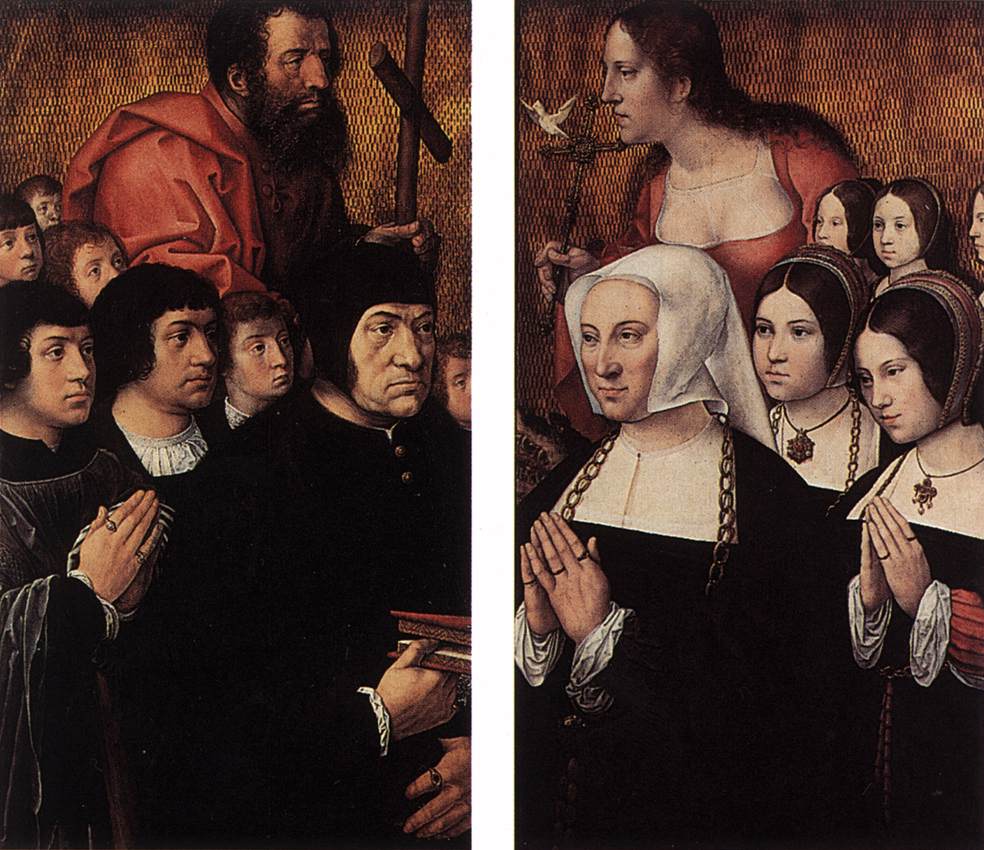
Having described Henry’s appearance in The Naturalist of the Sea-shore: the life of Philip Henry Gosse, Edmund then includes a fascinating footnote: “A very remarkable accidental portrait of my father, as he looked when he was about sixty years of age, exists in the museum at Brussels. Philip [Henry] Gosse might have sat for the man, holding a crimson missal, who kneels in the left-hand wing of the triptych, by Bernard van Orley (No. 40 in the Catalogue), except that the nose is too large and flat. The eyes and mouth, the general form of the face, and the colour of the skin are marvellously identical.” 3 The painting to which Edmund refers is The Haneton Triptych, Haneton being the figure holding the missal, with his seven sons behind him. It is a reverential and highly Catholic work, the wings being on either side of a Pietà, and Edmund would have been very aware of this. Throughout his adult life, Henry Gosse had a strong dislike of Catholicism and being likened to someone holding a missal and gazing on the Pietà would have made him very angry. Of course, we do not know whether Edmund was just drawing our attention to Henry’s likeness in the footnote (13 years after that in the earlier photograph above), or whether he was making an initial foray into the ground covered in Father and Son. I suspect it was the latter and that is why we have to find the work from the clues provided, rather than in an explicit reference.


1 Edmund Gosse (1907) Father and Son reprinted in 1989 in Penguin Twentieth Century Classics. London, Penguin.

2 Roger S. Wotton (2012) Walking with Gosse: Natural History, Creation and Religious Conflicts. Southampton, Clio Publishing.

3 Edmund Gosse (1896) The Naturalist of the Sea-Shore: The Life of Philip Henry Gosse. London, Heinemann [First published in 1890]


Thursday, 4 July 2013

Elders and brambles: foods and mythologies


It is early summer in Great Britain and many hedgerows are dominated by the creamy blossoms of the elder. Last week, I picked some, cut the flowers from the stems and steeped them, together with slices of lemon, in sugar solution to make elderflower cordial. 1 It is such a simple thing to do, but the end product is delicious, whether taken diluted with water, or with some fizzy wine. Some would argue that it is much easier to buy a bottle in a store, as elderflower cordial is now available so readily, but there is something satisfying about producing one’s own and, like all those who do, I think my cordial tastes better than commercial brands.


I’ve always liked collecting food from the countryside and there are many opportunities, especially in late summer and autumn. Elderberries then ripen and can be collected to make jellies 2 (do try it, if you’ve not already done so) and there is an abundant supply of blackberries. Indeed, it puzzles me that there are punnets of blackberries on sale in supermarkets at the time there are masses of the same fruit in hedgerows, although I admit there is a price in their collection, as one rarely escapes without a few scratches from thorns while gathering berries.


One of the reasons that few of us pick berries is that we are very far from our hunter-gatherer roots and have little knowledge of which wild foods are edible and which are not. Our ancestors, who had received this information from older people around them, collected wild fruits much more readily and they were also aware of mythologies that surround the plants on which they grow. In Great Britain, brambles and elders are both associated with superstitions and it must be borne in mind that both stain red, an association with the colour of blood. Anyone passing through a bramble arch (formed where a branch has grown out and rooted on touching the ground) was thought likely to be cured of a number of medical complaints, amongst which was whooping cough. 3 Children unfortunate enough to be infected with Bordetella pertussis (the bacterium which causes whooping cough) therefore felt miserable from all the coughing and also sore from scratches provided by the bramble. Perhaps it formed a distraction? Scratches from the arch are likely to be beneficial in the cure of other illnesses and drawing of blood has been regarded as an excellent way of treating infections in the recent past (see any description of the use of lancets, or leeches).

Elder has a much more complex role in superstition and mythology. As Steve Roud explains: 3

“Elders were everywhere connected with fairies and witches, although it was not always clear in what way. It was also reputed to be the tree on which Judas Iscariot hanged himself, and it was believed to have provided the wood for the Crucifixion. Furthermore, it must never be cut down, or the wood burned; it must never be used to make cradles; a wound inflicted with an elder spike was bound to prove fatal; and the tree would ‘bleed’ if cut.

It has proved impossible to reach an adequate synthesis of elder beliefs, because the evidence is patchy and contradictory, and all that can be said is that elder was generally agreed to be ‘uncanny’. There is a curious sense that the negative and positive feelings stemmed from the same basic notions and may have depended largely on the general disposition of the informant.”

We know that humans are imaginative in providing explanations and this shows well when we consider old superstitions. The power of our imagination is also important in affording religious explanations. For example, the abundance of berries is late summer and autumn is understood by some Creationists as being a gift from God, being a loose interpretation from the text in Genesis in The Holy Bible: 4

“And God said, Let the earth bring forth grass, the herb yielding seed, and the fruit tree yielding fruit after his kind, whose seed is in itself, upon the earth: and it was so. And the earth brought forth grass, and herb yielding seed after his kind, and the tree yielding fruit, whose seed was in itself, after his kind: and God saw that it was good.”

The implication here is that God created fruit trees and that they were “good”, meaning that fruit had been supplied for human consumption.

However, the production of fruits has been a feature of the biology of these plants long before humans appeared. Blackberries and elderberries contain the seeds that germinate to give the next generation of plants and these seeds must be dispersed. Some fruits will fall near the parent plant and be in competition with it, but others will be eaten by birds and other animals, attracted by their colour and succulence. Seeds pass through the gut of these grazers and are deposited in faecal matter, usually at some distance from the parent plant. The seeds are thus dispersed and also start to grow in a little patch of concentrated nutrients. The cost to the parent plant is the production of an excess of fruits to ensure that the process of dispersal is optimal and this strategy has developed through evolution. My picking of berries, or flower heads, is taking advantage of this natural trend. Of course, some would argue that this was all part of the Creation........


1 http://www.bbc.co.uk/food/recipes/elderflowercordial_6465

2 http://www.waitrose.com/home/recipes/recipe_directory/e/elderberry_jelly.html

3 Steve Roud (2003) The Penguin Guide to the Superstitions of Britain and Ireland. London, Penguin Books.

4 Genesis Chapter 1 verses 11-12. The Holy Bible (Standard King James’ Version).


Tuesday, 25 June 2013

Burns and basilisks


I was working at my laboratory bench in the University when I first noticed sharp pains across the inside of both forearms and, when I looked at my arms, I was a bit shocked to see several lines of what appeared to be acid burns. My first reaction was to wash my arms and then go back to the bench to see if acid, or some other chemical, had spilled and accumulated along the edge where I had been leaning. There was no evidence of any liquid, so that wasn’t the explanation.

I went to the Occupational Health Unit for their advice and they agreed with me that it looked like I had placed my arms, on several occasions, on the edge of a bench where there had been a spill of a corrosive chemical. That would result in the lines of burns which were so evident. After the consultation, they recommended that I should go to St Thomas’ Hospital, which had a Dermatology Unit and where I could get further advice. Visiting hospitals is never much fun and I was apprehensive about what they might say but, fortunately, I was seen quickly by a member of the nursing staff and she asked me a few questions and then made a rapid diagnosis. One of the questions was whether we had any rue (Ruta graveolens) growing in our garden and she also asked if I could remember having touched it. Well, that morning we had indeed cut back a large rue bush and I must have brushed my arms against the sappy stems as I gathered everything up. It was a beautifully warm and sunny morning and it was a pleasurable little job before I set off to work by train and bus. The nurse then explained what had happened.  Sap from the rue had become smeared on my arms, making several invisible lines, and these had then become exposed to the sun, causing changes to the chemistry of the sap and thus resulting in the appearance of weals after several hours. She gave me some cream and, within a week, there was no trace of my encounter with the plant. I was fortunate, as one case involving a 12-year-old who had rubbed rue on his skin as an insect repellent required a hospital stay of 5 days. 1

From ancient times, rue has been used in herbal medicine, in addition to its value as a culinary herb. It was often administered in water, oil, or wine (sometimes with the addition of other components) and Culpeper advises its use against fever, flatulence, removing intestinal worms, stopping nosebleeds, easing earache, removing warts and in curing other skin conditions. Rue also “helps the gout or pains in the joints, hands, feet or knees, applied thereto” 2 In conclusion, Culpeper writes: “It helps disorders in the head, nerves, and womb, convulsions and hysteric fits, the colic, and weakness of the stomach and bowels; it resists poison, and cures venomous bites.” 2 The role of rue as a deterrent against fleas and other pests is also well known in folklore and its properties were said to be appreciated at the time of the Great Plague. A herb of wide-ranging value it would seem, but none of the treatments with rue, or its extracts, use the burning effect created after exposure to strong sunlight.


There is an interesting mythological association between rue and burning that may have arisen from the effects of phytophotodermatitis, the condition being known (although not by that name) in the Ancient World. 1 Basilisks were snake-like creatures described by Pliny the Elder, the Roman author and Natural Historian of nearly 2000 years ago. In time, they were portrayed as reptiles with wings and with the head and legs of a cockerel. Basilisks could kill with their stare, or by breathing on organisms, causing all to shrivel and die. There were three exceptions: cockerels (whose crowing caused basilisks to flee - is that why basilisks developed cockerel-like features through time?), rue, and weasels (especially if they had eaten rue, or were wrapped in it as in the illustration below). I cannot explain the role of the cockerel, but was the resistance of rue to the burning breath of a basilisk, or in conveying protection to weasels, based in some way on the known effects of the plant on skin, after the skin is exposed to sunlight? Such an effect, delayed as it is, would provide good material for mythology and we love fanciful explanations of the unknown.


1D.J.Gawkrodger and J.A.Savin (1983) Phytophotodermatitis due to common rue (Ruta graveolens). Contact Dermatitis 9: 224.

2Nicholas Culpeper (1880) Culpeper’s complete herbal: consisting of a comprehensive description of nearly all herbs with their medicinal properties and directions for compounding the medicines extracted from them. London, Foulsham.


Friday, 21 June 2013

Gosse, Elgar and the wonders of microscopy


Philip Henry Gosse was at the forefront of popularising the use of microscopes and in his book Evenings at the microscope; or researches among the minuter forms of animal life,1 he writes: “Great and gorgeous as is the display of Divine power and wisdom in the things that are seen of all, it may safely be affirmed that a far more extensive prospect of these glories lay unheeded and unknown, till the optician’s art revealed it. Like the work of some mighty genie of Oriental fable, the brazen tube is the key which unlocks a world of wonder and beauty before invisible, which one who has once gazed upon it can never forget, and never cease to admire.” Even through this expression of the religious ardour that dominated Henry Gosse’s life, it is easy to feel his amazement at what he saw and he conveyed this both to his friends and, through the book, to a wider public.

Microscopy became a popular pastime of the Victorian middle classes, once quality microscopes became less expensive, and an industry then developed in supplying slides of mounted specimens, often having elaborate paper labels or covers.2 While Henry Gosse, as a zoologist of note, described animals and parts of animals through 21 chapters of vivid description and with 113 of his own illustrations in Evenings at the microscope, algae were also a major fascination for Victorian microscopists, and the most important of these algae were the diatoms. These single cells (which may also form colonies or filaments) live within a coat of silicates termed a frustule, having two opposed valves that are secreted by the alga. The coats have characteristics unique to each species and provide the diagnostic features used in their classification. Victorian slides of mounted diatoms show not only an interest in individual algae, but also in the arrangement of frustules into “artistic” patterns.3 This tradition continues today in the work of the brilliant Klaus Kemp.4


Looking at diatoms provided inspiration in some unusual quarters. In his article in Gramophone of June 1957, published to mark the centenary of Edward Elgar’s birth, the author and raconteur Compton Mackenzie quotes this exchange with Elgar: “'Not that I care,' he growled quickly. 'I take no more interest in music. You'll find as you grow older that you'll take no more interest in literature. The secret of happiness for an artist when he grows old is to have a passion that can take the place of his art. I have discovered the joy that diatoms [my emphasis] can give me. This miraculous world of beauty under the ocean revealed by the microscope is beyond music,' and he went on to expatiate on the exquisite patterns formed by these fossilised algae and the spiritual comfort that observation of them brought to his mind.”5 The conversation from which the quote is taken took place in 1923, when Elgar was 66 years old. Although a famous and great composer, Elgar was prone to bouts of self pity and the quote is a reflection of one of those moods, but no-one can doubt his fascination for microscopy, the same fascination that Henry Gosse had done much to popularise over sixty year earlier. (By the way, for those of you who enjoy coincidences, Elgar was brought up in High Street, Worcester, the same street in which Henry Gosse was born many years before).

In the Natural World, diatom frustules are found extensively in the sediments of water bodies, from ponds to oceans. It may be thought that the coats developed to deter predators, and some of the more spiky types may do so, yet diatoms are fed upon by zooplankton and other animals, just as are algal cells without that protection. The result is not only the sedimentation of the frustules of dead algal cells but also of the frustule-loaded faecal pellets of animals which have eaten the algae. All fall through the water and accumulate over the bed. By taking cores, we can therefore know which species have been present in the surface waters through time, just as we can record the presence of plants by the types of pollen we see in cores taken from soil profiles. The deposits of diatom frustules can be so packed that they result in “diatomaceous earth” or diatomite, familiar for its many applications in industry after it is extracted by mining, or the use of quarrying techniques. These, of course, are ancient deposits and will have lost the clear stratification which occurs over short time periods of hundreds of years and where the contents of the annual layers of sediment can be recorded. We use information from these strata to date accurately the appearance of various species of diatom that we know are indicators of certain chemical conditions, or temperature regimes. In this way, diatoms give us a means of recording changes over centuries and much research has focussed on this use frustules. For example, changes in the diatom flora occurred after the Industrial revolution in Europe, when acid precipitation became a major feature and lakes changed in water quality. They are also used to show changes which have resulted from global warming.

Such practical applications do not detract from the beauty of diatom frustules, so stunning when observed under the microscope, especially under special lighting. It is easy to comprehend Gosse’s conclusion that we are witnessing “the display of Divine power and wisdom” but, for those that do not believe in the chronology of events described in the book of Genesis, there is an equal, or perhaps greater, sense of awe. One is left with the question: How and why did diatoms evolve their many varieties? The fossil record shows that they have existed for tens of millions of years in forms that are recognisable today6 and we can only speculate on the steps that occurred in the evolution of the siliceous frustule before that. It’s the frustule that makes diatoms so popular and useful but that is only the covering of the living algae, which are so important in trapping carbon dioxide through photosynthesis and thus playing a major role in the metabolism of energy in fresh waters, marine coasts and the oceans.


1 Philip Henry Gosse (1859) Evenings at the microscope; or researches among the minuter forms of animal life. London, Society for Promoting Christian Knowledge.