Showing posts with label Religious Conflict. Show all posts

Friday, 21 July 2017

Two Creationists, Christian sects, and religious tolerance


Philip Henry Gosse (1810-1888) and Francis Orpen Morris (1810-1893) were two of the most well-known Natural Historians of the mid-Nineteenth Century. Gosse is famous as the populariser of aquaria, the use of microscopes, and the observation of marine organisms on the shore; Morris for his works on moths, butterflies and birds, and also for his campaigns against fox hunting, vivisection and much else besides. Both had biographies written by their sons [1,2] and it is from these that we know much about the two men.


Henry Gosse (above) was the son of a painter of miniatures and, as a young man, was sent to work as a clerk in Newfoundland, returning to England after travelling to Alabama where he held a teaching post. He was interested in insects as a boy and was introduced to shore life by a knowledgeable aunt. Like Gosse, Morris (below) was also very interested in Natural History as a boy, but his background was rather more privileged, being the son of a Royal Navy officer (who became an Admiral) and going on to study Classics at Oxford University. On graduation, Morris was ordained in the Church of England and progressed to be rector of Nunburnholme from 1854-1893 [3]. From this small village in the Yorkshire Wolds, Morris kept up a correspondence on many topics and he was an enthusiastic pamphleteer, best known today for attacking Darwinism and, especially, Darwin's On the origin of species [3].


Having returned from North America, Henry Gosse was a schoolmaster and also wrote books, the first being based on his experience in Canada and published by Van Voorst. This was followed by a number of other publications, most of which he illustrated, having acquired the skills and training of an artist from his father (the plates in Morris's books were by others). Eventually, Gosse became recognised and he was able to live off his work as an author and lecturer, settling in Torquay from 1857-1888. He was a devout non-conformist and he produced his book Omphalos [4] as an "attempt to untie the geological knot": the conflict between geological periods of time and the account of Creation in The Bible. Although written in London, Omphalos was published soon after Henry moved to Torquay and this was two years before the publication of Darwin's famous book. Gosse's thesis was that geological time periods, strata and fossils were all likely to be real but that they were created at the time the Earth and all organisms came into existence. Needless to say, this idea was not met with any enthusiasm by either the scientific or religious communities [5] and Gosse continued his work in Natural History, making many outstanding contributions.

Both men were Christians and Creationists, but I wonder whether they would have enjoyed each other's company if they met (I cannot find a record that they did so, and both travelled little in their mature years). Gosse was shy, but this did not stop him proselytising his views if he had the chance. He was an evangelical Christian with a profound belief that the second coming of Christ was imminent, something that strongly influenced his thinking. He was intolerant of Catholicism and always referred to the village in which he lived as Marychurch, rather than St Marychurch (its proper title), as he objected to the use of the term saint in the Catholic tradition [5]. Morris had equally strong views about the practice of religion, but these centred on the need for the traditions of the Church of England. On the organisation of religion, then, the two men are likely to have clashed – would their mutual love of Natural History and the evidence it provided constantly to them of Divine Creation have enabled them to celebrate together? Somehow, I doubt it. Yet, if there weren't religious differences to get in the way, one can imagine Gosse and Morris talking for hours about the boyhood collection of insects, their love of birds and all manner of other Natural History.

Henry Gosse's religious views provided difficulties in his relations with Edmund, his son and biographer and these led Edmund to write Father and Son, published anonymously in 1907. In contrast, Morris's son not only became ordained in the Church of England, but also followed his father as the Rector of Nunburnholme. Both "official" biographies written by the sons are factual and, in parts, affectionate, but Father and Son is rather different. It paints Henry Gosse as being intolerant of Edmund's views and he was always encouraging him to return to the values of the Brethren that Henry believed in so profoundly. The result of Henry's unshakeable beliefs was thus alienation from the scientific world and also from his only child. It all seems so unnecessary, especially as he was such a splendid enthusiast for Nature. Having asked whether Morris and Gosse would have enjoyed each other's company, I'm tempted to ask whether I would get on well with either of them. I like to think that the answer is yes, but I'm not sure. Religious belief has a way of becoming so intrusive and damaging.

It is not far-fetched to suggest that both Gosse and Morris had a Christian faith that made them isolated and narrowly focussed and which provided challenges from the scientific developments occurring in the mid-Nineteenth century. Their faith was the most important thing in their lives and they believed in all that was written in the Bible, yet their preferences in form of worship were different and neither was likely to budge from their position. As a non-Christian, that is something I find difficult to understand, yet it has been a feature of the Christian religion, with its many schisms and formation of splinter groups. As there must be one God and one Heaven, I am puzzled about the inability of some Christians to agree and to believe that their version of the faith is the only true one.

To gain some insight, I looked up the website of the Evangelical Alliance to find out if we are now living in an age of greater tolerance. In a piece entitled "Should we all go to one Church? What denominations mean for unity" Amaris Cole begins by introducing two questions [6]:

Anglican. Baptist. Brethren. Assemblies of God. Vineyard. Elim. Newfrontiers. Foursquare. The list goes on. There are many churches in the United Kingdom, all with their own worship styles, preaching practices and theological frameworks. But if we're aiming for unity as evangelicals, is it a problem that we are split down denominational lines? Shouldn't we all go to one Church?

One of the five respondents, Alexandra Davis, replied as follows [6]:  

God created us in diversity, with differences in style on so many levels – learning, worshipping, fellowshipping, communing. I suspect if we all went to one Church we'd just end up in a very mono-cultural way of doing things. Meeting with God and other Christians in a diversity of ways is one way of bringing glory to the creator God whose imagination is beyond anything we could... imagine. We could, of course, get a bit better at being more accepting of difference, keeping a check on how valuable our particular preferences really are, and making more.. ..effort to cross those diversity lines. We will be one Church in heaven so we might as well start practising for the perfection now.

Alexandra implies that the various sects and branches of Christian practice derive from differences inherent in human individuals and society. In advocating tolerance between sects (as I believe she is doing) she will attract the wrath of those like Gosse and Morris who were firmly of the opinion that only their version of Christianity was the correct one. Also, what are evangelical Christians proselytising if it is not their own personal version (usually shared by a few others) of belief?

Of course, if religions are the result of human imagination, one could understand it all. It must be difficult to be a Christian believer and face the questions that Amaris poses.


[1] Edmund Gosse (1896) The Naturalist of the Sea-shore: The Life of Philip Henry Gosse. London, William Heinemann.

[2] M. C. F. Morris (1897) Francis Orpen Morris : A Memoir. London, John C. Nimmo.


[4] Philip Henry Gosse (1857) Omphalos: An attempt to untie the geological knot. London, John Van Voorst,

[5] Ann Thwaite (2002) Glimpses of the Wonderful: The Life of Philip Henry Gosse 1810 – 1888. London, Faber and Faber.


The illustration of Christian worship above is taken from http://religiousaffections.org


Friday, 14 March 2014

Families and religious differences


Real Scientists Real Faith is a collection of essays written by scientists about their Christian faith.1 To me, one of these essays stood out - that by Andrew Gosler, a biologist at Oxford University who became a Christian in middle age. His contribution is affectionate, thoughtful and accessible and its lack of dogma may result from having a non-believing wife and a liberal upbringing.

Dr Gosler was raised in a Jewish household and his essay contains this lovely passage about his early life:

I rarely spoke to my mother about God, but I believe she felt his presence strongly in her life. My father’s Judaism is more social and cultural; he has for many years considered himself an atheist, partly because of what he perceived as bigotry and hypocrisy within religion, two things about which he warned us children (I am the second of three sons). Despite all the inconsistencies that I might have experienced through all this in my childhood, I now regard the open-mindedness that I inherited from my parents, which has now allowed me to find faith, as one of the greatest tributes to them. My brothers and I were nurtured in a free-thinking, loving atmosphere for which I shall always be grateful.

As a young boy, Dr Gosler developed a passion for birds and their Natural History and this led to a fascination with form and function, ecology, systematics and evolution. Visits to the Bird Section of the Natural History Museum, described by Dr Gosler as a “cathedral to natural history”, gave him a powerful sense of the presence of God. Evolution was not a problem as:

..I had.. ..been taught (consistently on this point) at school, home and in the synagogue, that the Genesis text was not to be taken literally: its meaning and value lay in the relationship between God, humanity and the natural order that it revealed through allegory. It therefore came as a shock in later life to discover, probably from reading Richard Dawkins’ The Blind Watchmaker, that some people regard Genesis as historical fact..

It was understandable that Dr Gosler would study Environmental Biology at University, perhaps less predictable that he would also study Plant Taxonomy (given the earlier near exclusive interest in birds), but no surprise that he became an assistant at the Edward Grey Institute of Field Ornithology at the University of Oxford, where he took a doctorate and then became a Research Lecturer, a position that he still holds.

It was about fifteen years ago that Dr Gosler became a Christian, having almost by chance started reading the Gospels after finding a Bible amongst the books that he and his wife were packing for storage:

What I found was a Jesus who sounded like my father: hot on the issues of religious bigotry and hypocrisy, and not at all what I’d been led by the atheists to expect.

Dr Gosler then described how he attended a local church and, in time, became baptised as a Christian. His parents attended the service and the sermon was intentionally inclusive in discussing Judaism as well as Christianity, so it must have been a very happy occasion for all who attended.

While identifying that anthropocentricity has been a major cause of destruction and extinction in the natural World, Dr Gosler now found cause for hope:

The present environmental crisis is ultimately a consequence of human greed, of selfishness, of the poverty and criminality that arise from these, and of ignorance. Consequently, and contrary to the assumptions of my youth, I have found that Christ’s teachings have much to offer us by way of salvation from this crisis.

I certainly agree with his sentiments regarding the dangers of anthropocentricity and have entertained friends and family on that subject for many hours. However, as an atheist, I’m not sure that Christianity provides a means of getting out of the mess, although I recognise that Christ’s teachings repeat general messages, in addition to unique spiritual ones.

The aspect of the essay that so strongly appealed to me was Dr Gosler’s liberalism and compassion; the very qualities that were instilled by early family life. As you may know, I am fascinated by the Victorian Natural Historian Philip Henry Gosse and his relationship with his son Edmund. 2 That provides a strong contrast to the upbringing of Dr Gosler and it ended in upset, disappointment and alienation. Henry Gosse was far from liberal in outlook on religious matters and he was immovable in having a belief in the literal truth of the Bible. Of course, this applied to the account of the Creation, something that was at variance with developing ideas in Biology and, especially, the time scales now becoming accepted in Geology. Gosse produced a solution to the conflict between the account in Genesis and developing scientific thought in his theory of prochronism, where he accepted the idea of geological time, but proposed that this was apparent rather than real, the whole being part of the sudden Creation. His theory was published in Omphalos, 3 where he also tackled the idea of the creation of plants and animals, each being unique. It is perhaps unfair to condense Omphalos into so short a mention, but it does give an example of Henry Gosse’s rigidity when it came to the interpretation of The Bible. Omphalos ends triumphantly with this (Gosse’s capital letters):

“IN SIX DAYS JEHOVAH MADE HEAVEN AND EARTH, THE SEA, AND ALL THAT IN THEM IS.”

This rigidity came between father and son and, after Edmund moved to London and became involved in the world of The Arts, there developed a deep antagonism between the two men. Henry believed in the imminence of The Second Coming of Christ, so was always concerned that Edmund should be ready and he badgered him about his friends and his views in general. It is all recounted by Edmund in Father and Son 4 and, while this is a one-sided view, and may contain some imaginative descriptions of events, it shows how difficult family relationships can be when there is a lack of acceptance of another’s views and, especially, where these concern religion.


It was against the background of the Gosses that I viewed Dr Gosler’s account of his own upbringing and subsequent development of belief in Christianity. It’s true that there is well over a hundred years between the two families, but there are those who still have as rigid a view on religious belief as Henry Gosse. I have great admiration for his many important contributions to Natural History and recognise that he was loving and caring, but my real fondness for the man stops at his religious views. Henry’s rigidity inevitably resulted in conflict.

To an atheist like me, it is puzzling that the same Bible and the same basic belief in its contents can spawn such divergent views and opinions. It is very human, of course, but it emphasises the personal nature of belief. Trying to say one’s own view is the correct one always ends in trouble and how can this stance be justified?


1 R. J. Berry [editor] (2009) Real Scientists Real Faith. Oxford, Monarch Books.

2 Roger S Wotton (2012) Walking with Gosse: Natural History, Creation and Religious Conflicts. Southampton, Clio Publishing.

3 Philip Henry Gosse (1857) Omphalos: An attempt to untie the geological knot. London, John Van Voorst.

4 Edmund Gosse (1907) Father and Son: A study of two temperaments. London, William Heinemann.


I would like to thank Professor Sam Berry for sending me a copy of Real Scientists Real Faith. It is unlikely that I would have read Dr Gosler’s essay had he not been kind enough to do so.

Monday, 8 July 2013

Edmund Gosse on an “accidental portrait” of his father


Edmund Gosse wrote Father and Son as “a record of a struggle between two temperaments, two consciences and almost two epochs. It ended, as was inevitable, in disruption.” 1 It was published in 1907, nineteen years after the death of his father, Philip Henry Gosse, and describes the closeness, and then the developing tension, between them. The disruption in their relationship described by Edmund centred on Henry’s immovable and narrow religious beliefs that dominated his life and that of his son, until Edmund broke away. 2

In 1890, Edmund wrote an earlier biography of his father at the request of E. Ray Lankester, who admired Henry’s outstanding work as a Natural Historian, illustrator and populariser of aquaria, microscopes and what might be called the study of Nature (I share Lankester’s admiration). The Naturalist of the Sea-shore: the Life of Philip Henry Gosse included a letter written by Edmund to Ray Lankester in which he declared: “No one who reads this book will require to be told that there were many points of vital importance upon which your convictions and those of the subject of this biography were diametrically opposed. Yet you respected him and he admired you, and of all our friends you were the earliest to urge me to undertake this labour of love.” 3 The opposition between the parties refers to Henry’s deeply-held belief in Creation, as described in the Holy Bible.

The first biography, written when Edmund’s step-mother was still alive (Eliza Gosse contributed to the volume in writing “Reminiscences of my husband from 1860 [when they married] to 1888”) was respectful and did not contain the pent-up negative feelings that Edmund harboured and which were expressed later in Father and Son. In The Naturalist of the Sea-shore: the Life of Philip Henry Gosse, Edmund describes Henry as having a severe appearance, with his black hair brushed back from his “large and massive” face, a strong chin, “tightly compressed lips” and large hazel eyes. “His smile was rare, but when it came it was exquisite”.  The severity was partly the result of Henry’s very serious approach to life (he expected the Second Coming at any moment) and partly from his acute shyness and inability to be at ease in company. There are, of course, photographs of Henry Gosse and the cover of the Penguin edition of Father and Son shows a dual portrait of Henry and Edmund taken shortly after Edmund’s mother had died in 1857 and the little family had moved to Torquay. It was the time when they were at their closest, collecting together on the seashore and with Edmund increasingly involved in the Brethren chapel where Henry was the leader of the congregation. 2 There was much affection between the two as they shared their bereavement and started the process of recovery.


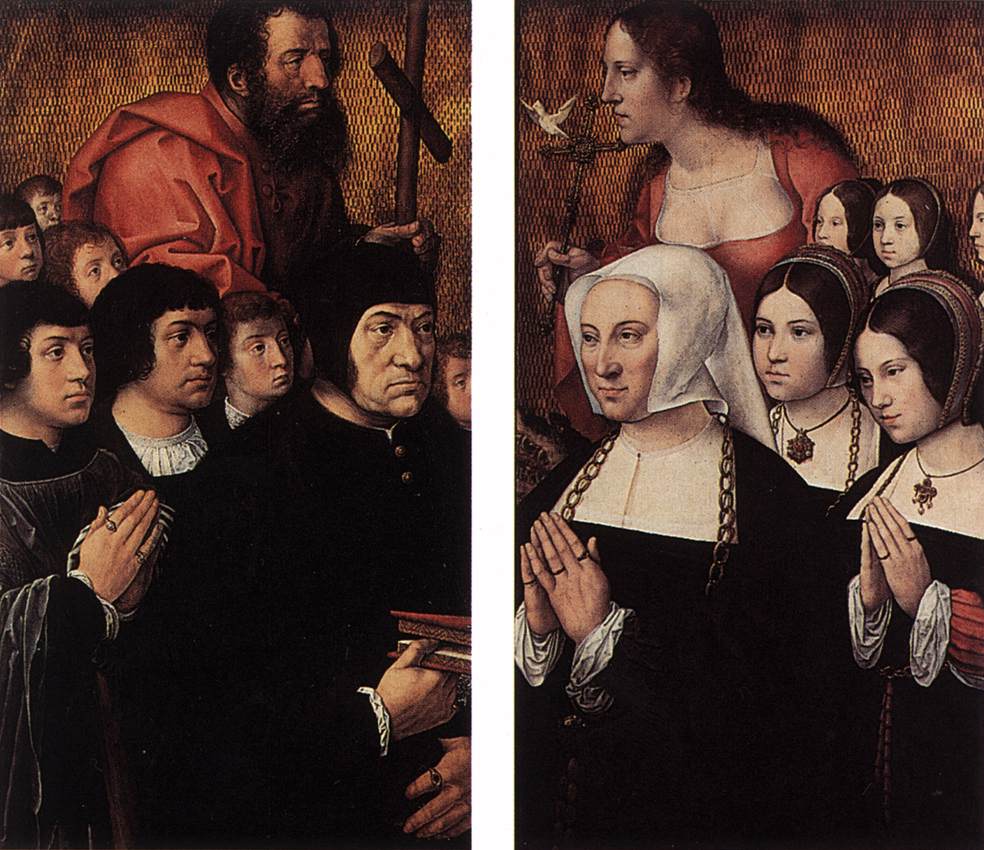
Having described Henry’s appearance in The Naturalist of the Sea-shore: the life of Philip Henry Gosse, Edmund then includes a fascinating footnote: “A very remarkable accidental portrait of my father, as he looked when he was about sixty years of age, exists in the museum at Brussels. Philip [Henry] Gosse might have sat for the man, holding a crimson missal, who kneels in the left-hand wing of the triptych, by Bernard van Orley (No. 40 in the Catalogue), except that the nose is too large and flat. The eyes and mouth, the general form of the face, and the colour of the skin are marvellously identical.” 3 The painting to which Edmund refers is The Haneton Triptych, Haneton being the figure holding the missal, with his seven sons behind him. It is a reverential and highly Catholic work, the wings being on either side of a Pietà, and Edmund would have been very aware of this. Throughout his adult life, Henry Gosse had a strong dislike of Catholicism and being likened to someone holding a missal and gazing on the Pietà would have made him very angry. Of course, we do not know whether Edmund was just drawing our attention to Henry’s likeness in the footnote (13 years after that in the earlier photograph above), or whether he was making an initial foray into the ground covered in Father and Son. I suspect it was the latter and that is why we have to find the work from the clues provided, rather than in an explicit reference.


1 Edmund Gosse (1907) Father and Son reprinted in 1989 in Penguin Twentieth Century Classics. London, Penguin.

2 Roger S. Wotton (2012) Walking with Gosse: Natural History, Creation and Religious Conflicts. Southampton, Clio Publishing.

3 Edmund Gosse (1896) The Naturalist of the Sea-Shore: The Life of Philip Henry Gosse. London, Heinemann [First published in 1890]