Showing posts with label Mythology. Show all posts

Thursday, 23 February 2017

The fish that stops ships


Kieren Pitts' excellent little book Hitchers and Thieves [1] introduces us to phoresy (a process where an organism of one species "hitches a lift" on an organism of a different species). It is a habit that many insects and arachnids have adopted, sometimes with the evolution of specialised adaptations, but it is also found in other groups and Hitchers and Thieves begins with a description of remoras. These small fish can swim well, but have an adhesion disc on the dorsal surface of the head that enables them to attach to much larger, rapidly-swimming fish or reptiles. Remoras also attach to ships.


There are thirteen species of remoras in seven genera, all having a similar design (see above – images by Albert Kok and Jonathan Bird). The origin of the adhesion disc has been traced back to the mid-late Eocene (56-39 million years ago) and it evolved from components of the dorsal fin, described in technical language by Friedman et al.[2]:

It is clear that many key transformations, most notably modification of fin spines into laterally expanded lamellae, took place while the disc occupied a postcranial position. At this stage, lamellae were still joined along the midline, comparable with the condition of dorsal fin spines in generalized percomorphs. The second stage was characterized by anterior migration of the disc, the separation of lamellae into paired ossifications, the development of pectination along the posterior margins of the lamellae and an increase in the number of segments in the disc.

Having acquired the disc from the modified dorsal fin spines, further small-scale modifications in some remoras, such as the development of spinules, increased their powers of adhesion [3]. An attached remora must resist drag forces provided by its fast-moving host, but studies in fluid dynamics [4] show that the remora's streamlined shape, evolved when it was free-living, minimises this force.

Remoras feed over the surface of their hosts and are commonly held to eat parasites attached to scales, gills, or other body parts [5]. While analysis of the gut contents of several species of remoras confirms this diet, it is worth pointing out that fragments of parasite exoskeleton are easily identified, whereas much of the material in the gut is not. In addition to parasites, mucus (exopolymers) is ingested and organic matter adsorbed to the mucus often present over the surface of the host may provide an important source of nutrition. Remoras attaching to ships feed on plants and invertebrates growing on the hull, as well as the exopolymers exuded by the community of this surface.

Even this brief review of their adaptations show remoras to be remarkable fish and their Natural History has fascinated observers since ancient times. They have acquired a reputation for slowing, or stopping, ships and, as Pitts points out [1], the name remora (meaning delay or hindrance in Latin) derives from this mythological role. More detail of this mythology is provided by Carroll Camden [6] from descriptions of remoras made by Elizabethans. His essay begins:

One of the strangest examples of unnatural natural history which caught the fancy of Elizabethan writers is the curious account of the little fish called the remora. It has further interest because an examination of the various uses to which the story was put reveals the casual way in which many Elizabethans treated factual knowledge.

The myth is ancient, Pliny describing the remora as "a sucking fish which clings to the hulls of ships and slows them"; amazing considering the size of the fish relative to a ship. Early descriptions of the fish and their suckers were elaborated with each repetition and Camden's essay [6] gives many examples of absurd, yet accepted, "truths" about remoras held by Elizabethans. He also offers an explanation of the basis for such tales:

Thus we have a more or less reasonable explanation of the remora-myth. It is not that the fish actually delays the ship but merely that when a slow ship is beached and scraped the sailors observe at times a remora among the seaweed, moss, barnacles, and other material attached to the bottom; they therefore conclude that the remora can stop a ship, whereas actually it attaches itself to the ship because the soft and tender delaying matter is attractive to remoras.

Fouling of hulls by attachment of barnacles and other living organisms is known to reduce performance and the scraping down of hulls is familiar to many boat owners. But why single out remoras as the agents of slowing a ship? We are amused by such absurdity today yet we are as capable of creating myths as the Elizabethans and the ancients. There are many odd superstitions around animals and plants and, like the remora-myth, they have adherents today. We like to believe that we are living in a more rational age, but I wonder how future scholars will regard some of the certainties of belief that we hold? If Elizabethans were casual in the way they treated factual knowledge, as Camden shows, are we still guilty of the same process?


[1] Kieren Pitts (2003) Hitchers and Thieves. Chicago, Raintree.

[2] Matt Friedman, Zerina Johanson, Richard C Harrington, Thomas J. Near and Mark R. Graham. (2013) An early fossil remora (Echeneoidea) reveals the evolutionary assembly of the adhesion disc. Proceedings of the Royal Society B 280: 2013200.

[3] Michael Beckert, Brooke E. Flammang and Jason H. Nadler (2015) Remora fish suction pad attachment is enhanced by spinule friction. Journal of Experimental Biology 218: 3551-3558.

[4] Michael Beckert, Brooke E. Flammang, Erik J. Anderson and Jason H. Nadler (2016) Theoretical and computational fluid dynamics of an attached remora (Echeneis naucrates). Zoology 119: 430-438.

[5] Bruce O'Toole (2002) Phylogeny of the species of the superfamily Echeneoidea (Perciformes: Carangoidei: Echeneidae, Rachycentridae, and Coryphaenidae), with an interpretation of echeneid hitchhiking behaviour. Canadian Journal of Zoology 80: 596-623.

[6] Carroll Camden (1957) Spenser's "Little Fish, that Men call Remora". Rice Institute Pamphlet – Rice University Studies 44.1.


Wednesday, 7 May 2014

Giant Albatrosses: mythology and mastery of flight


The most well-known albatross is the fictional one that played a central role in Samuel Taylor Coleridge’s The Rime of the Ancient Mariner. 1 During a voyage in the Southern Ocean, the Mariner’s ship became surrounded by ice and four verses of the poem describe what happened next:

The Ice was here, the Ice was there,
The Ice was all around:
It crack’d and growl’d, and roar’d and howl’d -
Like noises of a swound.

At length did cross an Albatross,
Thorough the Fog it came;
And an it were a Christian Soul,
We hail’d it in God’s name.

The Marineres gave it biscuit-worms,
And round and round it flew:
The Ice did split with a Thunder-fit;
The Helmsman steer’d us thro’.

And a good south wind sprung up behind;
The Albatross did follow;
And every day, for food or play
Came to the Marinere’s hollo!

The albatross is seen to have supernatural powers and is interpreted as a religious symbol by Coleridge. Unfortunately, we then learn that the Mariner kills the albatross with a shot from a crossbow:

And I had done an hellish thing
And it would work ‘em woe:
For all averr’d, I had kill’d the Bird
That made the Breeze to blow.


The Mariner then had to wear the slain bird around his neck, while the ship was becalmed because the albatross, such a good indicator of winds, was no longer their guide. The crew faced increasing heat and the Mariner’s shipmates were killed by dehydration, but he survived and, when rains came, he was able to drink the fresh water. After the Mariner blessed the sight of many-coloured “water-snakes” that surrounded the ship, the albatross fell from his neck and he managed to get back to tell the tale.

There’s more in the poem, of course, but the albatross joins the Mariner as the main player in the drama. It is fitting that albatrosses are regarded as having supernatural powers as they fly efficiently and without apparent effort. They are also very large birds, with the six species of Giant Albatrosses (Diomedea spp.) being found throughout the Southern Oceans, where they complete long-distance flights, little seen by humans.


Albatrosses have long, narrow wings just like those found on glider aircraft. This high aspect ratio (we can refer to this as the length of the wing divided by its depth from front to back) means that lift is generated over most of the wing’s surface when it is fully extended. Lift is achieved by the wing profile that is convex above and less concave below; so air travels further over the upper surface than it does under the wing. This results in low pressure over the upper surface that “sucks” the wing, and thus the albatross, upwards, counterbalancing sinking resulting from the bird’s body mass. The same principle of generating lift applies to all birds using gliding flight but lift is also affected by the angle of the wing and by active flapping.  The advantages of the long, narrow wing of the albatross are clear when the dominant mode of locomotion is by gliding, but quite different attributes are needed for rapid take-off, when each cycle of flapping displaces air downwards and rearwards. Albatrosses taking off from the ground generate airspeed by running with their long wings flapping in a necessarily narrow arc. Takeoff, whether from land or sea, is often clumsy and sometimes requires a more than one attempt. Once the albatross is airborne, flapping flight is maintained for a short period before winds are used to allow gliding.


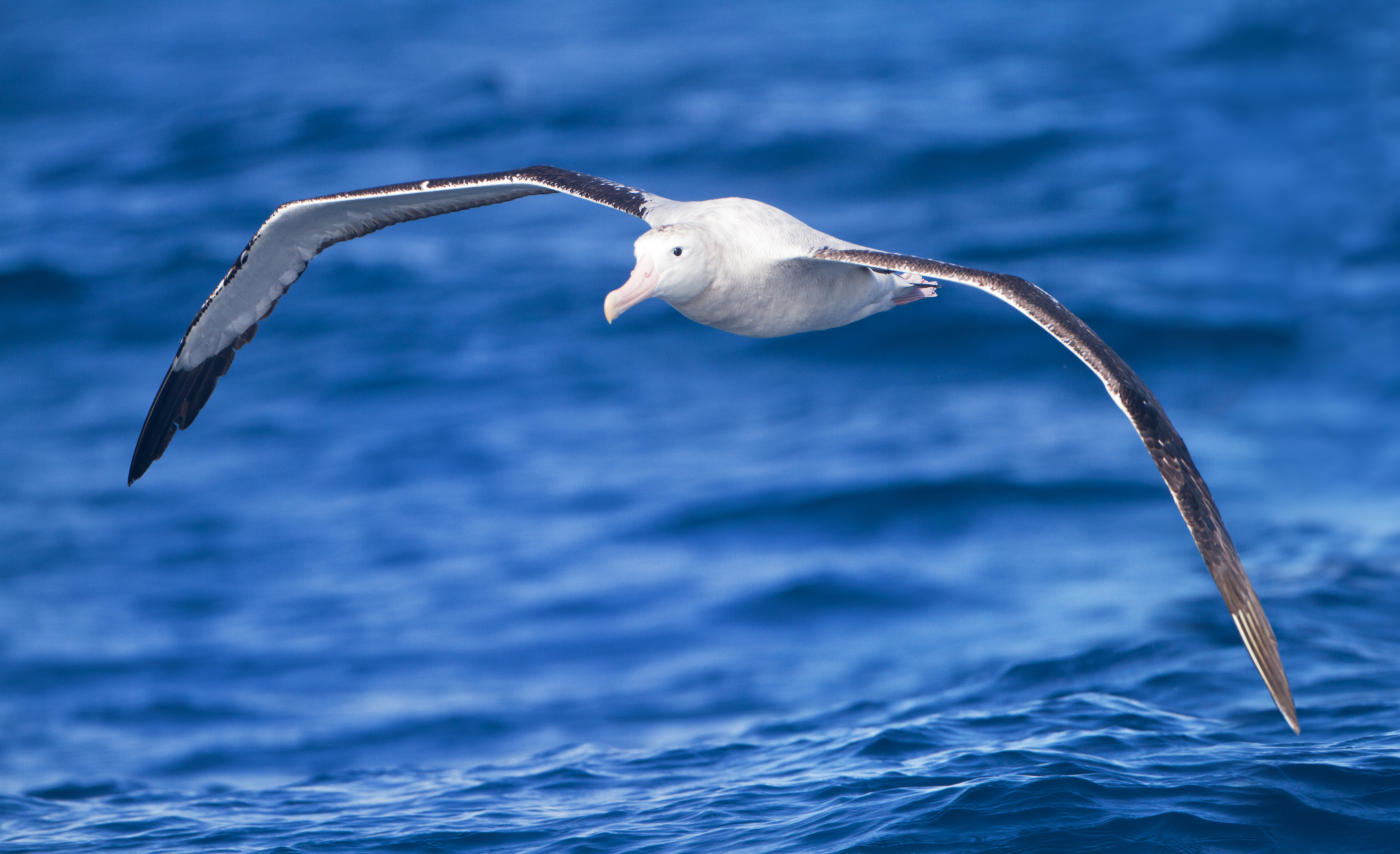
In the Southern Ocean haunts of the Giant Albatrosses there are near continuous strong winds and they are at their fastest at some distance above the ocean. Albatrosses can thus fly into the wind and generate lift before turning and gaining momentum as they fly down towards the sea surface, before once again turning into the wind. This is achieved without flapping and it allows energy-efficient flying over long distances. There is also a fascinating use of the winds that blow over the surface of the sea to create waves. Albatrosses fly parallel to the wave front using the upward deflection of the winds here to provide lift and, flying close to the water surface, they also use ground effect. This results from the pressure difference between the upper and lower surfaces of the wing and is pronounced at the wing tip where turbulent vortices result. In the picture below, an albatross is gliding close to the sea surface and, with the wing tips pointing downwards (anhedral), uses vortices projected to the water surface, resulting in enhanced lift and reduced drag. Albatrosses are not the only birds to use this method of flight enhancement; pelicans use it too and that is why the Boeing Corporation developed the Pelican aircraft concept, 2 using lift from the wing and also from the pronounced ground effect at the wing tip. The Boeing project is a theoretical extension of the Ekranoplan flying prototypes. 3


We thus come to designs made by humans using features that birds have had for millions of years. Creationists believe that birds are also designed, but Evolutionists suggest the selection of adaptations over time. For example, reptiles developed feathery coverings and these became modified into feathers of various forms, some of which clothed the fore limbs to produce the wing structure and covering. There are many other changes that allow birds to fly, but few can match Giant Albatrosses as masters of flight, even though they are challenged by takeoff. It’s no wonder that sailors like the Ancient Mariner, encountering albatrosses in the Southern Ocean, afforded them mythological status.


1 Samuel Taylor Coleridge (1798) The Rime of the Ancient Mariner in Lyrical Ballads, with a few Other Poems. London, J. & A. Arch.


Monday, 2 September 2013

Plagues of flies


I love northern Sweden. There is something about the forests, mountains and rivers that I find very attractive, with the contrast between the long days of summer and the short, very cold days of winter bringing something to the mix. However, there is a downside and that is the number of biting flies, with females that need to take a blood meal before they can mature eggs. I’ve been their target on many occasions and easily the worst was while I was collecting aquatic animals in a small stream, part of a research project in which I was involved. I knew there were mosquitoes around, but it became really bad and I had to turn up the round neck of my jumper and pull down my woolly hat so that no area of my face and neck was exposed. Despite these precautions, I still received many bites and I could hear the constant “singing” of the mosquitoes. I was very pleased to get away from there.
 
As Henry Gosse wrote in The Romance of Natural History,1 “One needs to spend a night among musquitoes to understand what a true plague of flies is” and, in that book, he also introduces us to the Golubacser [Golubatz] fly (which he identifies as Simulium Columbaschense [colombaschense], a blackfly). Gosse quotes the comments of a traveller (Edmund Spencer):

These singular and venomous insects, somewhat resembling musquitoes, generally make their appearance during the first great heat of the summer, in such numbers as to appear like vast volumes of smoke. Their attacks are always directed against every description of quadruped, and so potent is the poison they communicate, that even the ox is unable to withstand its influence, for he always expires in less than two hours. This results, not so much from the virulence of the poison, as that every vulnerable part is simultaneously covered with these most destructive insects; when the wretched animals, frenzied with pain, rush wild through the fields till death puts a period to their sufferings, or they accelerate dissolution by plunging headlong into the rivers.

It is worth remembering that only female blackflies bite and they inject saliva which contains anticoagulants to ensure the flow of blood. It is likely that the quadrupeds that Spencer describes were tormented by the number of bites, the shock that the mass of bites promoted, and an immune response to the insect saliva. Humans bitten by blackflies are also familiar with these reactions. The “vast volumes of smoke” may refer to the numbers of female flies, but is more likely to be a description of the mating swarms formed by the non-biting male flies to attract females.

Roger Crosskey, the authority on blackflies, describes the area of Banat on the Danube as being the principal area for these flies, that “excited much interest in the eighteenth century” 2 and that embark upon “their massive wind-assisted migrations across country - reaching southwards deep into Serbia and eastward into Romania, and sometimes killing animals 150 km and more away from the Danube.” Fortunately, both for humans and their livestock, the fast-flowing sections of the river that were the habitat for many millions of Simulium colombaschense larvae have been transformed by dam-building and the insects are no longer devastating pests. However, there are many regions of the World where major pest outbreaks of other blackflies occur, although few with the notoriety of the Golubatz fly.

Biting midges (ceratopogonids) are another group of flies that can reach pest proportions in high latitudes and their miniscule size belies their effect when attacking in numbers. Again, it is the female flies which bite, but neither male nor female flies of their relatives, the dancing midges (chironomids) and lake flies (chaoborids), need to take a blood meal, although many people are not convinced of the fact. Both types of flies are found in staggering numbers in some locations.

Lake Myvatn (Myvatn = midge lake) in Iceland is rich in algal nutrients and is thus highly productive. Dancing midge larvae take advantage of the abundant food (algae + algal and microbial by-products) and grow in astonishing numbers before pupating and then swimming to the surface of the lake, where they emerge as adults and begin flying. There are so many of them 3 that domestic animals are provided with shelters in which to escape the torment of being surrounded by the flies and the dangerous risk of inhaling them. Although the flies do not bite, males form smoke-like swarms to attract females, just like the blackflies in Gosse’s quote, and livestock may provide suitable swarming marker sites, as there are no trees.

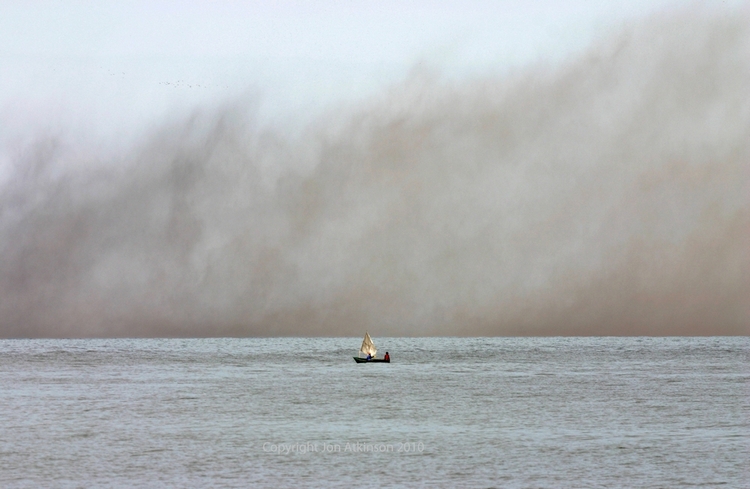
Lake flies may also be found in huge numbers, forming clouds of insects over Lake Victoria, for example. 4 The larvae of these insects feed on plankton in the surface waters and, just like the dancing midge larvae of Myvatn, they transform to pupae that swim to the surface to allow emergence of the adults. Such large numbers of flies occur that they are collected by villagers around the margins of the lake and made into “Kungu cakes” that are piled on market stalls and provide a good source of protein - flies carried by winds may also be the source of manna (as described in The Bible). 5 The cast skins of the pupae, just like those of dancing midges, are washed ashore and these provide fertiliser, as do the millions of dead insect bodies, including those of females that have laid their eggs into the water to complete the life cycle.

Dense swarms of blackflies, biting midges, dancing midges and lake flies are natural, but it would be surprising if mythologies did not develop about their significance and that a divine force was responsible for their extraordinary quantities. In some years, conditions are such that even larger numbers of flies are produced than usual and this can result in the idea of plagues that are somehow sent to punish because of their adverse effects. The 10 Plagues of Egypt are among the most well-known of these types of events, with dancing midges, blackflies and mosquitoes likely to be the source of three of the Plagues, occurring because of unusual climatic events over a short time period.6 We humans love to explain impressive natural phenomena in terms of the supernatural, when we should really be in awe of the evolutionary processes that have resulted in the successful exploitation of resources. However, we seem to prefer being imaginative rather than rational and “plagues” threaten our sense of control over the Natural World.


1 Philip Henry Gosse (1860) The Romance of Natural History. London, J. Nisbet and Co.
2 Roger W. Crosskey (1990) The Natural History of Blackflies. Chichester, John Wiley.
3 http://uwmyvatn.blogspot.co.uk/2012/01/lots-o-midges-i.html
4 http://jon-atkinson.com/African_Landscapes.html
5 http://www.opticon1826.com/article/view/opt.091004
6 http://www.opticon1826.com/article/view/opt.030706