Friday, 1 April 2022

The Tale of Tim and David

I’m very proud to have been a professor at UCL and I met some wonderful people during my time there: students, academics, and support staff. When one reads the history of the place in Harte and North’s The World of University College London 1828-1978 [1] (the book has subsequently been updated), feelings are not just of pride, but also of humility, as so many great academics have graced the college. 

One of the pleasures of working at UCL was being able to pursue my interests in both research and teaching, but that also brought a downside, for I was the only person in my department working in Aquatic Biology and I was very grateful for the collaborations that I developed elsewhere in the UK, in Sweden and in the USA. In the end, I realised that my time would best be spent on scholarship, as well as in practical research, and I wrote several reviews that cut across disciplines and sub-disciplines. This was good for me and, I hope, for those wanting to break down barriers in Aquatic Biology, and I am so grateful that I was allowed to do this unhindered. That work certainly enhanced, and informed, my teaching. 

During my time at UCL, changes in higher education were occurring and the pressure to obtain research grants, high fee-paying overseas students, etc. were uppermost. Universities were being run more and more on business lines and, at UCL, there was a heavy stress on Medicine and Biomedicine, as these were areas where funding was generous for many projects. UCL attracted many very able researchers in these disciplines. 

It was in the field of biomedical research where I feel a bit confused and disappointed by the senior administrators at UCL and that takes me on to the title of  “The Tale of Tim and David”. Tim is Sir Tim Hunt (a Nobel Laureate) and David is Professor David Latchman, now Master of Birkbeck, University of London and described on his website [2] as “a leading UK university academic, author, and philanthropist”. Let me begin by referring to two pieces in The Guardian online. 

These are selected comments from an article in 2015 about Sir Tim, after he made a silly remark at a conference [3]: 

As jokes go, Sir Tim Hunt’s brief standup routine about women in science last week must rank as one of the worst acts of academic self-harm in history. 

“I stood up and went mad,” he admits. “I was very nervous and a bit confused but, yes, I made those remarks – which were inexcusable – but I made them in a totally jocular, ironic way. There was some polite applause and that was it, I thought. I thought everything was OK. No one accused me of being a sexist pig.” 

Collins [Professor Mary Collins, wife of Sir Tim and an eminent professor at UCL, Sir Tim being an honorary researcher there] was called by University College London. “I was told by a senior that Tim had to resign immediately or be sacked – though I was told it would be treated as a low-key affair. Tim duly emailed his resignation when he got home. The university promptly announced his resignation on its website and started tweeting that they had got rid of him. Essentially they had hung both of us out to dry.. .. What they did was unacceptable.” 

This is what was written in 2020 about David [4]: 

David Latchman, professor of genetics at University College London.. ..has angered senior academics by presiding over a laboratory that published fraudulent research, mostly on genetics and heart disease, for more than a decade. The number of fabricated results and the length of time over which the deception took place made the case one of the worst instances of research fraud uncovered in a British university. 

..two investigations at UCL.. .. were deeply critical of Latchman. Both found that his failure to run the lab properly, and his position as author on many of the doctored papers, amounted to “recklessness”, and upheld an allegation of research misconduct against him. 

Latchman no longer has a lab and has stopped supervising research, but he is still a part-time professor of human genetics at UCL, and master of Birkbeck. 

I have little more information than these two newspaper stories and I am not in a position to make judgement, nor would I wish to, as I do not have access to the details. However, I am struck by the difference in the “transgressions” made by the two eminent scientists: one made a silly comment and the other (apparently unknowingly) allowed the falsification of results in research. While Sir Tim was cast out, David was allowed to continue in his post. Why? Was it something to do with the philanthropy mentioned at the head of David’s website? Did money, and lawyers, talk? All this happened after I left UCL in 2012, but it leaves a bad taste and I reflect on the tolerance, integrity and collegiality of the college that I once knew well. 

[I’ve never met Sir Tim Hunt, but I have met David Latchman on a few occasions and found him pleasant, and informed, company. Professor Mary Collins was my Dean at the end of my career at UCL.]


[1] Negley Harte and John North (1979) The World of University College London 1828-1978. Portsmouth, Eyre & Spottiswoode 

[2] https://davidlatchman.net/ 

[3] https://www.theguardian.com/science/2015/jun/13/tim-hunt-hung-out-to-dry-interview-mary-collins 

[4] https://www.theguardian.com/education/2020/feb/01/david-latchman-geneticist-should-resign-over-his-team-science-fraud


Thursday, 24 March 2022

Susan Bell – a little known, but significant, figure in the Nineteenth Century

Thomas Gosse was an artist, his son Philip Henry Gosse a famous natural historian, his grandson Sir Edmund Gosse a noted literary figure, and nephew Thomas Bell a professor and President of the Linnean Society. Although we know much about these men, especially of Henry and Edmund, their stories may have been different, and perhaps less well-known, if it was not for Susan Bell and two other women: Emily Bowes and Nellie Epps.

Susan was the sister of Thomas Gosse and, according to him, “of a more refined and cultivated mind than the rest” of his family [1]. Being 15 years older, she had a strong influence on Thomas and he writes in his unpublished autobiography [2]: 

I had always an inclination for drawing.. ..I would often take a piece of chalk and draw the outlines of various common and familiar objects on the wall or on the kitchen door. My parents, witnessing my propensity as described, thought it would be useless to bring me up to a common trade, and therefore were resolved at length to give it encouragement. Accordingly, early in 1777 my school education was resigned for the practice of drawing at home; and here my sister Susan, afterwards Mrs Bell, became my tutoress. A drawing-book was bought for me, and another borrowed, with other necessary items. Thus I went on learning by degrees the art of drawing, in order that I might subsequently become a painter by profession.

From these beginnings, Thomas had instruction from various experts and became a student at the Royal Academy in Somerset House, attending classes and lectures, and he then became a pupil engraver. Armed with this training, Thomas became an itinerant painter “not on paper but on ivory” [1] - a painter specialising in miniatures. Thwaite [1] remarks: “He carried with him little more than his Bible, his Theocritus and the tools of his trade, but he was clothed with the armour of righteousness and stoicism.” 


Henry Gosse, like his father, received instruction in drawing from Susan and she also passed on to him her passion for natural history, after he had moved, with his family, to Poole, where Susan lived (and seen above in a near-contemporary view by Turner – her house is shown in [3]). She had married Thomas Bell, a surgeon, and her son, also Thomas Bell, was born in 1792, so was 18 years older than Henry. Thomas went on to have a distinguished career in both Zoology and Dentistry, being “responsible for innovations in the use of various dental instruments and [he] was the first to treat teeth as living structures by applying scientific surgery to dental disease” [4]. Thomas’ work in zoology focussed mainly on crustaceans, amphibians and reptiles, and he was responsible for describing animals in the latter group that had been collected on the voyage of HMS Beagle. In addition to his position as Professor of Zoology at King’s College London, Thomas also served as President of the Linnean Society and chaired the famous meeting on 1st July 1858, when papers by Charles Darwin and Alfred Russell Wallace on the origin of species were presented (neither author being present).

Although on friendly terms with Darwin, Thomas Bell “remained hostile to the theory of evolution throughout his life” [4], but further in the piece by Cleevely [4], we read that: 

Darwin always regarded him as a delightful, kind-hearted man, and believed that a more good-natured person did not exist but that his overwhelming administrative roles and professional work prevented him from achieving very much.  

He was certainly invaluable to Henry Gosse, as it was Thomas Bell who introduced Henry to the publisher John Van Voorst, who accepted Henry’s first book The Canadian Naturalist. He also recommended Henry to be the author of books on natural history, then being planned by SPCK (The Society for Promoting Christian Knowledge), and the income from Henry’s publications allowed him to begin his career as a writer, illustrator and lecturer.

Clearly then, Aunt Bell was both an important direct, and also indirect, influence on Henry Gosse and his love of natural history. It should also be noted that both Henry and Thomas were uncomfortable with the idea of evolution by natural selection, and this became acute for Henry who went on to publish Omphalos, his “attempt to untie the geological knot.” The knot was the apparent conflict between the increasingly accepted view that the evolution of plants and animals occurred over long periods of time, and the description of Creation in the book of Genesis in The Holy Bible. As Henry’s belief in biblical accounts was absolute, he explained in Omphalos that rock strata and fossils, of which he had an excellent knowledge, were created along with living organisms within the six days of Creation. To him, they were “prochronic” and his theory was revelatory to him – he really thought he had resolved the conflict. Very few others agreed and the theory of prochronic existence met with derision in some quarters and neither the scientific, or the religious, establishment could accept Herny’s idea. This shook Henry, especially as he had ordered a long print run, as he expected the book to be a big seller.

Omphalos was published in 1857, the same year that Henry’s wife Emily had died, painfully, from breast cancer, leaving him with the care of their young son, Edmund. Henry and Edmund moved to Torquay just weeks before Omphalos appeared and, writing in 1890, two years after Henry’s death, Edmund suggested that [5]: 

..it seems to me possible that if my mother had lived, he might have been prevented from putting himself so fatally and prominently into opposition to the new ideas. He might probably have been content to have others to fight out the question on a philosophical basis, and might himself have quietly continued observing facts, and noting his observations with his early elegance and accuracy.

It is likely, therefore, that Emily could have persuaded Henry not to write Omphalos. What is certain is that Emily and Henry shared a profound Christian faith, while being different in personality. Edmund writes [5] that “her mind was a singularly gay and cheerful one” and he believes that she had a strong influence on Henry’s writing in books like A Naturalist’s Rambles on the Devonshire Coast and Tenby that were both informative and full of enthusiasm, leading his readers to explore natural history for themselves. So, we not only owe a debt to Henry, but also to Emily and, alongside Aunt Bell, she was a major influence on him.

As he grew up, Edmund became distanced from his father in many ways, but especially over religious beliefs and practice, and their relationship became difficult. Edmund married Nellie Epps, a painter who had studied with the pre-Raphaelites, and she played an important role in maintaining contact between the two men. Nellie was much liked by Henry and his second wife, Eliza, who was herself a warm supporter of all that Henry did. Eliza also had a cordial relationship with Edmund, something that was established when he was a boy.

Three outstanding, yet little known, women and I am pleased to be able to add some notes about Aunt Bell to the earlier pieces that I wrote on Emily [6] and Nellie [7], both of whom I admire very much [8]. We know a great deal about Henry and Edmund Gosse, and a little about Thomas Gosse and Thomas Bell, but all four were very lucky in having relations and/or partners who were such a positive influence on those around them. I would like these women to have their proper place in history.


[1] Ann Thwaite (2002) Glimpses of the Wonderful: The Life of Philip Henry Gosse 1810-1888. London, Faber and Faber

[2] Edmund Gosse (1915) Fragments of the Autobiography of Thomas Gosse. The Burlington Magazine for Connoisseurs 27: 141-150

[3] https://www.wessexmuseums.org.uk/wp-content/uploads/2020/10/Pooles-early-naturalists-Gosse-and-Bell-final-1.pdf

[4] R.J.Cleevely (2004) Bell, Thomas (1792-1880). The Oxford Dictionary of National Biography. https://doi.org/10.1093/ref:odnb/2029

[5] Edmund Gosse (1896) The Naturalist of the Sea-Shore: The Life of Philip Henry Gosse. London, William Heinemann. 

[6] https://rwotton.blogspot.com/2013/10/emily-gosse-notable-evangelical.html

[7] https://rwotton.blogspot.com/2017/08/nellie-epps-nineteenth-century-wonder.html 

[8] Roger S Wotton (2020) Walking with Gosse: Natural History, Creation and Religious Conflicts. e-book, available widely.


Tuesday, 1 March 2022

Visits to the coffee shop

Twice a week, I enjoy having a flat white at my local coffee shop, choosing a time (about 11.00) when there are not too many people about and there is thus a choice of tables. My ritual is the same each time: order the coffee, collect it, settle at a table, and then read the paper that I have bought from the M&S shop that is next door to my habitual haunt. I take my time over the coffee (unless it gets busy and I need to give up my table, unlike the “home office” customers) and then walk back home. Nine times out of ten I feel better than when I arrived at the shop and I can’t really explain why. It’s not because of the stimulus of caffeine, although that may play a small part, but more about making me feel part of a bigger world; something about which psychiatrists would have their own comments to make. I also enjoy coffee with friends, but my solo visits have a quite different quality, suiting my mildly autistic nature.

Sometimes, a piece in the newspaper has a special appeal and that happened this morning when I read the review by Ellen Peirson-Hagger of Sheila Heti’s book Pure Colour in the "i" newspaper for 25th February 2022. It contained a paragraph that really made me think (both the review and the paragraph are shown below).


The question that was posed touched a nerve ending and I started to ask myself why I am moved deeply by some works of art – I guess that is something we all do, but I can only speak from my own experience.

When I’m in the right mood, I can be so moved by some pieces of music that I almost feel shaken. Something very deep within me is getting touched and I can easily see how this could be interpreted as “the breath of God”. What is this feeling? I don’t know the answer, but the effect is profound. Does it help to know that the composers that most affect me in this way are Elgar, Vaughan Williams and Sibelius? All three wrote music that was evocative of places that I know and where I have been “at one” with both Nature and Landscape. Of course, it is easy to say that my feelings are those of a Romantic and that it is all very emotional, but that doesn’t explain why I am that way. It feels like an attempt to find “light at the end of a tunnel”.

Other arts also affect me, but not to such a profound emotional level, although some paintings I return to stare at every time I visit galleries on repeat visits. It might be works by Turner or by Murillo, and there is no consistency of subject matter, just something that draws me. Turner I find fascinating, because he was seeking to portray something about the essence of Nature: Murillo because there is no artist better at conveying human tenderness. Like my reaction to certain pieces of music, the feelings can be (inadequately) described, but they cannot be shared.

It leaves me with the question of whether what I feel is similar to what others feel and whether that deep feeling causes them to believe in God. It’s interesting what can come from reading one’s paper in the local coffee shop.


Monday, 3 January 2022

Torquay Boys’ Grammar School, South Devon Tech. - and pranks


Many of us look back on school days as being some of the best of our life. For me, there were a few good times, but mostly it was not a happy experience, and I don’t feel disappointed that my old school has now been demolished. In the image above, the east entrance to the school, with its rather grand portico, remains, as does the eastern internal staircase (just visible in the background of this image by Tom Jolliffe – with the handrail still in place) that led to the first floor. 

Passing though the entrance shown in the image, one entered a corridor that had the Head’s Study on the left, the Secretary’s office on the right and a succession of classrooms also on the right, with the Biology Laboratory at the end of the corridor (to the left of the corridor were windows looking out on to one of the “playgrounds”). The Biology Lab. plays an important part in the following narrative.

Having passed O-levels in 1962, I took A-levels in Chemistry, Botany and Zoology (I dropped Physics after one year). Chemistry was then taught at the school in a relatively new two-storey block that had replaced an old hut, where Mr Roberts had earlier taught us (1A of the 1958 intake) to recite the mantra “Acid + Base = Salt + Water”. The hut was so old that the knots in the floorboards were raised and shiny, the rest of the boards being worn away by the scuffing shoes of generations of students. As I recall, A-level Chemistry was taught on the first floor of the new building and I had the misfortune of having Mr Crabtree as my teacher. He was clearly an able chemist, but he bullied me on occasions, one of which I recall clearly when he tapped me repeatedly on the head while saying, with raised voice, “valency, Wotton, valency!”. I’m not sure what I had done to deserve this response, but I admit that I didn’t have much interest in chemistry, as was apparent to Mr Crabtree. My fascination with natural history made the A-levels in Botany and Zoology much more to my taste, but, unfortunately, I was not a good scholar.

 These are quotes from my book “Walking with Gosse” [1]: 

As Biology was not among the most popular subjects at TBGS, we took A-Levels in both Botany and Zoology at the South Devon Technical College, in a building adjacent to the school. Teaching was shared between the two institutions, with Botany taught by Mr Hood from the Grammar School and Zoology by Mr Cosway from the Tech…

 …and another excerpt [1]: 

…I always enjoyed visiting Paignton Zoo to gaze at the animals and I joined the “Peacock Association” (the Friends of the Zoo) to gain free entry and to attend meetings with guest speakers. On the south side of the Zoo was an area closed to the public, with a high double gate that led to mature woodland and a hillside that was grazed by rabbits. Mr Hood had kept a record of the distribution of plants on the hillside over several years and a group of us Botany students was taken there to continue mapping the site using quadrats. It was something that was organised each year to teach botanical surveying techniques and I really enjoyed this field work. My earlier flower collecting meant that I could identify many plants, although I now used Latin names rather than the common ones, and I went back to the site on my own a few times to expand the survey in other areas. This impressed, and surprised, Mr Hood who, like Mr Cosway, didn’t think I had much of a future academically [the latter having recommended that I give up Zoology]. 

I liked Mr Hood, as he clearly loved plants and seemed independent-minded, although we only had occasional glimpses of the human side of our schoolmasters. He had spent time in India with the Army and was almost a caricature of someone from that background, having a large moustache and habitually wearing a rumpled tweed sports jacket and cavalry twills. Occasionally, he talked to us about the Western Ghats and some of his Indian adventures and these were very exotic for me, an insular Paigntonian.

The freedom of the Tech. was such that I never worked as hard as I should have done in classes and it also meant that, with a couple of friends, we thought little of skipping school to go collecting marine animals from the local shore (see below). We should have been in the School Library, but identifying the animals in our collections was much more fun and we also brought back specimens and set them up in aquarium tanks.


Our form room was the Biology Lab. in the main school building and it was the scene of several pranks. One came from our collections, as we soon discovered that seaweed kept in a large jar decomposed to produce a shocking and pervasive smell. What could be more fun than to secrete an open jar of rotting wrack near a radiator in the corridor and then retrieve it once the area had become filled with its perfume? We also discovered that bubbling gas into a sink of water to which “Teepol” had been added produced large quantities of foam that would spread along a bench and that throwing a lighted match into the foam would produce a wonderful sheet of flame that burned itself out in a second or two.

Perhaps the most infamous prank came when we went to a local pub and bought a couple of flagons of cider that we distilled to produce applejack. We knew well enough that distillates might contain harmful chemicals, in addition to ethyl alcohol, so we were reluctant to drink the stuff that we had made. I can still remember the smell of it though, and the pleasure to be obtained by our behaviour and, as with all the other pranks, the school was seemingly unaware of our activities. As mentioned earlier, the Head’s Study was just along our corridor and “Joe” Harmer (MA Cantab. FRAS) didn’t have a highly-developed sense of humour. If I’d been caught there would have been trouble (and more doubt about my academic abilities), even though I was only a passive participant in the activities. Visits to the shore were an exception, as I was fascinated by all that I discovered there, and played an active role in searches.

My chances of gaining a good reference on my university application form would also have been affected if my behaviour during the 1964 Sixth Form Conference had been discovered. These conferences were held in different schools each year and there were lots of group debates that were very enjoyable: conferences were also a chance to meet girls. At the one held at TBGS, the day started with a religious service at a local church and then there were sessions until lunchtime, during which three of us (highly illegally) went to “The Rising Sun”. After a couple of pints of beer each, we left to walk back to school, singing our version of the 1964 hit by The Animals:

There is a house in Torre, Torquay

They call the Rising Sun 

And it’s been the ruin of many a poor boy

And God I know, I’m one 

Well, it didn’t lead to my ruin, but it might have done. On return to the conference, I had the misfortune to sit next to a teacher from another school and had to ask him to let me out as I needed to get rid of some of the fluid that I’d accumulated. He must have found it odd that I left the debate so soon after it started, and also that I smelt a little of alcohol. An anxious few days followed, but I got away with it and I did get my university place and that’s where I changed beyond recognition. I was now much more diligent and I have to say that it was at university where it all started for me. School was just part of the build-up, although I recognise the dedication, and excellence, of some masters and the friendship of fellow students. While rarely happy to see buildings being demolished (another image by Tom Jolliffe is shown below), there’s some satisfaction in seeing the end of the old TBGS. My time there wasn’t the happiest period of my life.

[1] Roger S Wotton (2020) Walking with Gosse. e-book (available widely).


Wednesday, 15 December 2021

Skylarks and their inspirational song

One of my favourite local walks in summer is along a path below Ivinghoe Beacon, then climbing up to the ridge to look out over the extensive lowlands below. In the past, there was an added bonus, as there were several skylark nests in the fields that formed the first part of the walk and it was a joy to listen to their song and then try to spot them high up: very high up, for they take a bit of finding without binoculars. It is only the males that sing in this way and the flight is used to advertise their breeding territory. They may fly up several hundred metres before “hovering” for a minute or two, then descending rapidly. Singing is constant on the upward flight and when the skylark appears suspended at its zenith. 

Sadly, there are no longer skylarks in the fields next to Ivinghoe Beacon; at least, I haven’t heard them. Changes in farming practice and, especially, the time of year when grain is planted is one reason why these birds are now on the British conservation Red list [1]. Grain crops planted in early winter grow too tall for the larks in the breeding season, as they need easy access to the nest. 

Although they are rather dull in colour (see the image above) compared to some other birds, the effect of skylark song (heard in [1]) is far from dull and it has inspired many poets, for example, John Milton and George Meredith:

John Milton: L'Allegro (lines 40-44)


To hear the lark begin his flight

And singing startle the dull night

From his watch-tower in the skies

Till the dappled dawn doth rise


George Meredith: The Lark Ascending 

(lines 1-4; 65-70: and 121-122):


He rises and begins to round,

He drops the silver chain of sound,

Of many links without a break,

In chirrup, whistle, slur and shake.


For singing till his heaven fills,

‘Tis love of earth that he instils,

And ever winging up and up,

Our valley is his golden cup

And he the wine which overflows

to lift us with him as he goes.


Till lost on his aërial rings

In light, and then the fancy sings. 

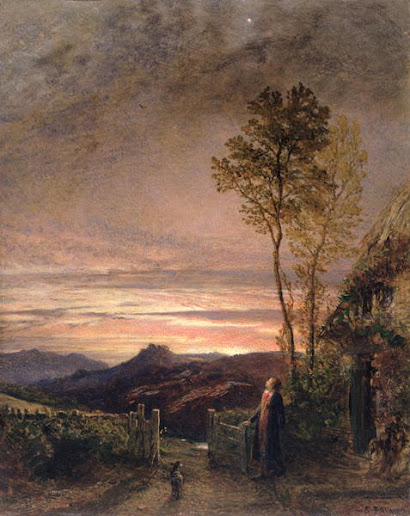
The lines from Milton stimulated Samuel Palmer to paint The Rising of the Skylark (shown below). As Milton’s lines suggest, the lark is high in the sky at dawn, being visible only as a speck identified by following the gaze of the human observer by the gate. It is an idyllic scene and its atmosphere owes something to Turner, recognised at that time for his genius in painting light. Palmer created this Romantic view in 1839 while he was based in Shoreham in Kent, with a house close to the River Darent. 

The valley of the Darent had a special significance for Palmer and it does for me, too, in a lesser way. Not, I’m afraid, for any artistic endeavours, but it was where I conducted experiments on aquatic insect larvae and I collected material from the chalk stream to work on in the laboratory. Having been very keen on Art History since undergraduate years, I always nodded at Palmer’s house when I arrived in Shoreham and parked next to the bridge by his house before starting my collection in the river. 

The quoted lines from George Meredith were inscribed on the manuscript of Ralph Vaughan Williams' The Lark Ascending, that shared its title with that of the poem. It was written just before the outbreak of the First World War, but didn’t receive its first performance in orchestral form until 1921. It has been recorded by many artists and a link to a recent performance is given below [2].


Vaughan Williams’ work was voted to be the most popular of all pieces of music by listeners to Desert Island Discs [3] and also placed first in Classic FM’s Hall of Fame [4]. That is not a surprise, as it has lyrical beauty and feels connected to British, and, more specifically, English folk music; a genre from which Vaughan Williams gained inspiration. Hearing this music in his head must a have been a solace to the composer as he served in both the Medical Corps and the Royal Artillery during the First World War, just as George Butterworth must have found comfort in recalling his lovely The Banks of Green Willow. That piece was also inspired by English folk tunes and was composed just before the war broke out, but, sadly, Butterworth was killed in the trenches [5]. Vaughan Williams survived, but he did suffer deafness from the noise of gunfire.

I love the works by Palmer and Vaughan Williams and their Romanticism touches a nerve with me. Given their popularity, it seems that I am not alone. The drab, but beautifully singing, skylark has been an inspiration for many other poets, painters and composers and I hope that we can do something to keep their numbers up, and even restore them to their earlier abundance. Skylarks inspire us, but we should remember that their song did not evolve for our benefit, but for theirs.


[1] https://www.rspb.org.uk/birds-and-wildlife/wildlife-guides/bird-a-z/skylark/

[2] https://www.youtube.com/watch?v=ZR2JlDnT2l8&ab_channel=RichardBrittain 

[3] https://www.bbc.co.uk/programmes/p04qpmw9

[4] https://www.udiscovermusic.com/classical-features/vaughan-williams-lark-ascending/

[5] http://www.rwotton.blogspot.com/2013/02/the-banks-of-green-willow.html


My thanks to Alexander Wotton who was the (unknowing) catalyst for this article.


Palmer’s painting is held by the National Museum of Wales: https://museum.wales/art/online/?action=show_item&item=1436

The full poem L’Allegro by John Milton is available here: https://www.poetryfoundation.org/poems/44731/lallegro

The full poem The Lark Ascending by George Meredith is available here: https://allpoetry.com/The-Lark-Ascending


Wednesday, 1 December 2021

School summer holidays in the early 1960s

I attended Torquay Boys’ Grammar School from 1958-1965 (now demolished to make way for housing – see the image below, taken by Tom Jolliffe, just before the end [1]). Weekdays for 36 weeks of the year were spent learning some interesting things, some that were needed to pass examinations, and other activities like Games and Gym that someone considered to be good for me. There were a few excellent masters, some that were good, and then the rest, but, fortunately, only one or two that were very unpleasant. Of these, some were bullies and some so struck the fear of God into us that it was a relief when their classes ended. 


It was not a disappointment when summer holidays came around and Assembly on the last day of term always featured “Lord, dismiss us with Thy blessing”, sung with something of a sense of relief. One year, the piano in the Hall was modified by having drawing pins inserted in all the hammers and the student who played had a look of mock surprise at the resulting sound. Of course, we enjoyed this thoroughly, although we knew better than to laugh. Some masters smirked a little, but “Joe”, the Head Master, took it personally and looked like thunder. “Joe” was John Harmer MA (Cantab.) FRAS and he always appeared in an immaculate gown that somehow added to his sense of importance.

It was said that “Joe” was handy with a cane, a punishment that was confined to the privacy of his office. There was no chance of me finding out as I was always well-behaved, going through my school career with just a single detention and only one whacking. That came from “Hoppy” Hopwood when he discovered several of us in our form room when we should have been in the playground. “Hoppy” taught music and was very enthusiastic about his subject and also in giving taps with his black plimsoll. They were a feature of many music lessons.

 Anyway, at the end of the summer term there was six weeks break, but this coincided with the large influx of tourists to the holiday towns of Torbay. At the start of my career at TBGS that was good, as the increased number of trains meant some good trainspotting, but I tired of that in early adolescence as I wanted to get away from the crowds of holidaymakers. My interest then turned to walking around the coast and in the countryside, and I couldn’t resist looking in rock pools and streams, and being astonished by all the different animals and plants that I saw. 

The other passion was to buy Holiday Runabout Tickets, sometimes in pairs. These allowed unlimited travel over specified local railway lines and, as many small branch lines were still open, a chance to explore parts of Devon, Somerset and Dorset in a way that couldn’t be done on foot or by bus (no-one in our family had a car). Some of the branch line trains consisted of a single carriage pulled by a small steam engine and they wound their way through the countryside at a leisurely pace, stopping at small stations that were often far from the villages that they were built to serve. On one trip from Torrington to Halwill Junction, our train picked up a freight wagon en route and towed that down the line, a practice that I had never experienced before, but a regular feature of this form of rural transport at the time. 

There were few passengers on these trains and it was inevitable that the lines would be closed for economic reasons, but I was so pleased to have had the chance to ride over them (you can get some of the atmosphere by viewing a videoclip [2]). It’s no wonder that I became a fan of John Betjeman.

What a splendid contrast it all was to school life and I looked forward to these summer holiday journeys very much for a couple of years. After the branch lines closed, I developed other interests, while maintaining my passion for walking and natural history. The latter are constants that have been with me throughout the last sixty years; the Grammar School buildings and the branch lines disappearing into the world of nostalgia.


[1] Tom Jolliffe / Former Torquay Boys' Grammar School / CC BY-SA 2.0

[2] https://www.youtube.com/watch?v=ak9WgSYzQ50&ab_channel=ACEWEO-


Monday, 15 November 2021

Outsiders and the world of scientific publication

All areas of life are influenced by establishment views – where those in authority, or have expertise, influence the acceptance of new views or opinions. In an earlier post, I described why the conclusions drawn by John Vaughan Thompson were not readily accepted, and suggested that there were three factors why this was so [1]:

(i) His background as an independent, amateur researcher made him an “outsider”;

(ii) His work was published privately and was not widely available; and

(iii) His discoveries challenged the scientific establishment of the time.

Does this apply today?

In the nineteenth century, when Thompson was active, there was much still to be discovered about the life history and behaviour of organisms, and we now know so much more. Yet there continue to be many observers and amateur researchers who have a fund of knowledge that is not published in scientific journals and does not become part of the mainstream.

During the early 1970s, I was a PhD student working at the Moor House Field Station, high in the Pennines. It was a remote place that was once a hunting lodge, at least 5 miles from the nearest village [2], and needed a permanent caretaker to maintain the buildings, machinery, and land. At the time, it was someone called Jim and he had a passion for the natural world and, especially, for the biology of dippers (Cinclus cinclus) [3], that were relatively common in moorland streams like Moss Burn (see above) and other tributaries of the River Tees. As a result, Jim had a great insight into the breeding, distribution, and behaviour of these fascinating birds and it was always a pleasure to get him talking about them. I encouraged him to write about his observations, but he wouldn’t do so, and thus his knowledge was only known to those who engaged him in conversation.

How would someone like Jim share their knowledge in the 2020s? By conversation, certainly, but we now have the internet and all manner of sites on which observations can be posted. Of course, there are problems of accessing the information, and searches using keywords can come up with huge numbers of entries that must then be sifted through. Some sites allow labels that aid search engines but we all experience the difficulty of access, even though much information is readily accessible! This is the world of “grey literature” and would someone interested in publishing in an academic journal use Jim’s observations? Almost certainly not.

Some mainstream journals accept observations, but the majority require papers based on research and/or scholarship, to be submitted according to their house style and rules for submission. Many journals feature in abstracts and search engines like “Web of Knowledge”, but there are several hurdles to overcome before a paper is accepted. The most prestigious ones will not send all submitted papers out to referees, and rejection can also come after receipt of referees’ comments. In my (limited) experience it is uncommon for a paper to be accepted as submitted, and “minor revisions” or “major revisions” are usually required. To an author this can be a frustrating process, as referees may have agendas: most, however, take their role as referees seriously and want to help the author and the editor. Once accepted, there is then the wait for publication, but all this is for the academic community, not for someone with important observations that can add to the grey literature, much of which is not peer reviewed. If John Vaughan Thompson had attempted to publish in one of the leading journals, he would likely have seen his papers rejected, given the response he received. Such is the power of the establishment in any discipline.


[1] https://rwotton.blogspot.com/2021/10/being-outsider-story-of-john-vaughan.html

[2] https://rwotton.blogspot.com/2018/04/tempus-fugit.html 

[3] https://www.rspb.org.uk/birds-and-wildlife/wildlife-guides/bird-a-z/dipper/