Showing posts with label Vaughan Williams. Show all posts

Tuesday, 1 March 2022

Visits to the coffee shop

Twice a week, I enjoy having a flat white at my local coffee shop, choosing a time (about 11.00) when there are not too many people about and there is thus a choice of tables. My ritual is the same each time: order the coffee, collect it, settle at a table, and then read the paper that I have bought from the M&S shop that is next door to my habitual haunt. I take my time over the coffee (unless it gets busy and I need to give up my table, unlike the “home office” customers) and then walk back home. Nine times out of ten I feel better than when I arrived at the shop and I can’t really explain why. It’s not because of the stimulus of caffeine, although that may play a small part, but more about making me feel part of a bigger world; something about which psychiatrists would have their own comments to make. I also enjoy coffee with friends, but my solo visits have a quite different quality, suiting my mildly autistic nature.

Sometimes, a piece in the newspaper has a special appeal and that happened this morning when I read the review by Ellen Peirson-Hagger of Sheila Heti’s book Pure Colour in the "i" newspaper for 25th February 2022. It contained a paragraph that really made me think (both the review and the paragraph are shown below).


The question that was posed touched a nerve ending and I started to ask myself why I am moved deeply by some works of art – I guess that is something we all do, but I can only speak from my own experience.

When I’m in the right mood, I can be so moved by some pieces of music that I almost feel shaken. Something very deep within me is getting touched and I can easily see how this could be interpreted as “the breath of God”. What is this feeling? I don’t know the answer, but the effect is profound. Does it help to know that the composers that most affect me in this way are Elgar, Vaughan Williams and Sibelius? All three wrote music that was evocative of places that I know and where I have been “at one” with both Nature and Landscape. Of course, it is easy to say that my feelings are those of a Romantic and that it is all very emotional, but that doesn’t explain why I am that way. It feels like an attempt to find “light at the end of a tunnel”.

Other arts also affect me, but not to such a profound emotional level, although some paintings I return to stare at every time I visit galleries on repeat visits. It might be works by Turner or by Murillo, and there is no consistency of subject matter, just something that draws me. Turner I find fascinating, because he was seeking to portray something about the essence of Nature: Murillo because there is no artist better at conveying human tenderness. Like my reaction to certain pieces of music, the feelings can be (inadequately) described, but they cannot be shared.

It leaves me with the question of whether what I feel is similar to what others feel and whether that deep feeling causes them to believe in God. It’s interesting what can come from reading one’s paper in the local coffee shop.


Wednesday, 15 December 2021

Skylarks and their inspirational song

One of my favourite local walks in summer is along a path below Ivinghoe Beacon, then climbing up to the ridge to look out over the extensive lowlands below. In the past, there was an added bonus, as there were several skylark nests in the fields that formed the first part of the walk and it was a joy to listen to their song and then try to spot them high up: very high up, for they take a bit of finding without binoculars. It is only the males that sing in this way and the flight is used to advertise their breeding territory. They may fly up several hundred metres before “hovering” for a minute or two, then descending rapidly. Singing is constant on the upward flight and when the skylark appears suspended at its zenith. 

Sadly, there are no longer skylarks in the fields next to Ivinghoe Beacon; at least, I haven’t heard them. Changes in farming practice and, especially, the time of year when grain is planted is one reason why these birds are now on the British conservation Red list [1]. Grain crops planted in early winter grow too tall for the larks in the breeding season, as they need easy access to the nest. 

Although they are rather dull in colour (see the image above) compared to some other birds, the effect of skylark song (heard in [1]) is far from dull and it has inspired many poets, for example, John Milton and George Meredith:

John Milton: L'Allegro (lines 40-44)


To hear the lark begin his flight

And singing startle the dull night

From his watch-tower in the skies

Till the dappled dawn doth rise


George Meredith: The Lark Ascending 

(lines 1-4; 65-70: and 121-122):


He rises and begins to round,

He drops the silver chain of sound,

Of many links without a break,

In chirrup, whistle, slur and shake.


For singing till his heaven fills,

‘Tis love of earth that he instils,

And ever winging up and up,

Our valley is his golden cup

And he the wine which overflows

to lift us with him as he goes.


Till lost on his aƫrial rings

In light, and then the fancy sings. 

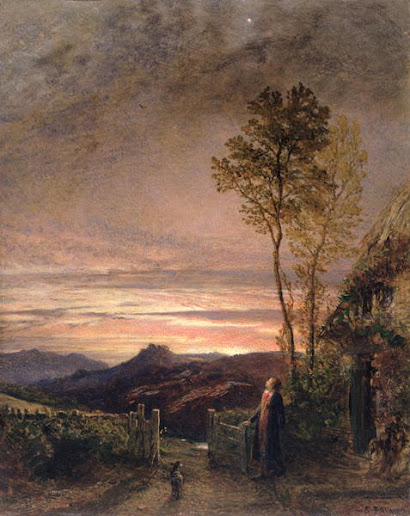
The lines from Milton stimulated Samuel Palmer to paint The Rising of the Skylark (shown below). As Milton’s lines suggest, the lark is high in the sky at dawn, being visible only as a speck identified by following the gaze of the human observer by the gate. It is an idyllic scene and its atmosphere owes something to Turner, recognised at that time for his genius in painting light. Palmer created this Romantic view in 1839 while he was based in Shoreham in Kent, with a house close to the River Darent. 

The valley of the Darent had a special significance for Palmer and it does for me, too, in a lesser way. Not, I’m afraid, for any artistic endeavours, but it was where I conducted experiments on aquatic insect larvae and I collected material from the chalk stream to work on in the laboratory. Having been very keen on Art History since undergraduate years, I always nodded at Palmer’s house when I arrived in Shoreham and parked next to the bridge by his house before starting my collection in the river. 

The quoted lines from George Meredith were inscribed on the manuscript of Ralph Vaughan Williams' The Lark Ascending, that shared its title with that of the poem. It was written just before the outbreak of the First World War, but didn’t receive its first performance in orchestral form until 1921. It has been recorded by many artists and a link to a recent performance is given below [2].


Vaughan Williams’ work was voted to be the most popular of all pieces of music by listeners to Desert Island Discs [3] and also placed first in Classic FM’s Hall of Fame [4]. That is not a surprise, as it has lyrical beauty and feels connected to British, and, more specifically, English folk music; a genre from which Vaughan Williams gained inspiration. Hearing this music in his head must a have been a solace to the composer as he served in both the Medical Corps and the Royal Artillery during the First World War, just as George Butterworth must have found comfort in recalling his lovely The Banks of Green Willow. That piece was also inspired by English folk tunes and was composed just before the war broke out, but, sadly, Butterworth was killed in the trenches [5]. Vaughan Williams survived, but he did suffer deafness from the noise of gunfire.

I love the works by Palmer and Vaughan Williams and their Romanticism touches a nerve with me. Given their popularity, it seems that I am not alone. The drab, but beautifully singing, skylark has been an inspiration for many other poets, painters and composers and I hope that we can do something to keep their numbers up, and even restore them to their earlier abundance. Skylarks inspire us, but we should remember that their song did not evolve for our benefit, but for theirs.


[1] https://www.rspb.org.uk/birds-and-wildlife/wildlife-guides/bird-a-z/skylark/

[2] https://www.youtube.com/watch?v=ZR2JlDnT2l8&ab_channel=RichardBrittain 

[3] https://www.bbc.co.uk/programmes/p04qpmw9

[4] https://www.udiscovermusic.com/classical-features/vaughan-williams-lark-ascending/

[5] http://www.rwotton.blogspot.com/2013/02/the-banks-of-green-willow.html


My thanks to Alexander Wotton who was the (unknowing) catalyst for this article.


Palmer’s painting is held by the National Museum of Wales: https://museum.wales/art/online/?action=show_item&item=1436

The full poem L’Allegro by John Milton is available here: https://www.poetryfoundation.org/poems/44731/lallegro

The full poem The Lark Ascending by George Meredith is available here: https://allpoetry.com/The-Lark-Ascending