Wednesday, 7 October 2020

"Walking with Gosse" as an e-book


The COVID-19 pandemic influences everything at present. When the lockdown was announced in the UK, I decided that I needed something to occupy my time, so pressed ahead with a re-write of Walking with Gosse, first published as a paperback in 2012.

Since 2012, I have continued my interest in the story of Henry and Edmund Gosse, so there was a chance to make a revision, and update, of the book and, as the paperback was rather difficult to get hold of, I decided that an e-book was the best way forward. I knew nothing about e-book publishing before setting out, other than that it was a means of making books easily accessible on mobile telephones, tablets and desktop computers, so I needed advice. This came from Dr Bob Carling, who has wide experience in publishing, and he took me through the stages needed to transform my MSWord files into the form acceptable to Amazon, Barnes & Noble, and other e-book publishers. As I am a technophobe, it would not have been possible to publish this new version of Walking with Gosse without Bob’s help and technical expertise, just as I could not have published the paperback without the help of Dr Susan England of Clio Publishing.

One of the advantages of an e-book is that it allows a “clickable” list of contents to allow readers to navigate through the text, although I very much hope that the book is read from cover to cover, as that was the way it was conceived. It is part autobiographical (Part 1), part biographical (Parts 2-5), and part commentary on our current approach to natural history, creation and religious conflicts (Part 6).

The list of contents of Walking with Gosse is given below (as an appetiser):


List of contents


Preface


Part 1

 Growing up at the seaside

 Being a Christian

Schools, parents, and an interest in natural history

 Leaving home for University


Part 2

 Henry Gosse, The Aquarium and looking through microscopes

Henry Gosse’s early life and the development of his interest in natural history

Henry Gosse becomes a professional natural historian and writer

The development of Henry Gosse’s religious beliefs


Henry Gosse’s own family


Henry Gosse as a teacher, lecturer and leader of field courses


Recognition as a scientist


Part 3

Omphalos

 Reactions to Omphalos and Henry’s need to incorporate his religious views into his writing


The Romance of Natural History

 Sea serpents

Extinction, animals that fall from the sky, and mermaids


Part 4


Father and Son


Early life in London


Moving to St Marychurch


Edmund becomes a Saint


Edmund’s baptism and the move to a new chapel


Tom Cringle’s Log, meeting Eliza, and the beginnings of independence


Edmund’s Epilogue in Father and Son


Part 5


Learning more about Edmund


Eliza Gosse’s view of Henry


William Pengelly – a deeply religious man who believed in “creation by evolution”


Henry Gosse and Charles Kingsley


A feeling of connection to Henry and Edmund


Part 6

 Henry Gosse and or contemporary world

 Henry Gosse and the negativity of religious faith

 Creation, evolution and the origin of life

 When believing in creation seems like an easy option 

Tackling the supernatural 

Dr Dryasdust and contemporary trends in Biology

 Being interested in teaching and lecturing

 Natural history and the media

 Epilogue


References


Acknowledgements


Appendix 1

 Henry’s scientific publications


Appendix 2

 Henry’s solely religious writing


A series of posts about Walking with Gosse will appear on my blog over the next few months. They will highlight some of the sections of the book and give what scriptwriters might call the backstory. In the meantime, I hope that you enjoy the book.


Tuesday, 8 September 2020

The white dapperling – a mushroom that isn’t poisonous…


Fungi are remarkable organisms, essential for the recycling of nutrients by breaking down detritus. Most of us recognise mushrooms and toadstools – the fruiting bodies of many fungi – but we are less familiar with the huge numbers of wind-borne spores that they produce. Should the spores land in a suitable location, a complex mat of hyphae (threads that form the mycelium) then spreads underground, or through other substrata, using enzymes to digest organic matter and promote further growth. Mostly, the mycelium is also a mystery to us, but we know that the fruiting bodies must have grown from something because they don’t have roots. We can only speculate on how the fascinating life cycle of fungi evolved [1] and how the hyphae became organised for their various functions, including the rapid growth of fruiting bodies.

Last week, two unusual mushrooms appeared overnight on our lawn. They were white, with white spore-bearing gills and each appeared to grow from a bag-like structure around the base of the stem. They intrigued me sufficiently to pick one and take photographs of it (see below). Like many of us, I am aware that some mushrooms are highly toxic [1], so I treated the specimen I picked with caution. Fortunately, our local garage has a free supply of plastic gloves to prevent contact between hands and petrol, and I donned some of these (previously purloined for use in the age of COVID-19) to avoid direct contact. Even so, I washed my hands several times when I came back into the house (also a COVID-19 habit) as I was sure there was a possibility it was one of the deadly forms [1].


I needed help with identification and put the images on the Facebook page of the British Mycological Society. Fortunately, one of the members, Geoffrey Kibby, a well-known expert, suggested that my mushroom might be a specimen of Leucoagaricus leucothites that is common in lawns and which may cause gastrointestinal upsets in some humans, but is considered edible by others [2]. It seems I was being over-cautious.

Being a romantic, I was fascinated by the common name of “our” mushroom - the white dapperling – and that started me thinking once again about the common names that we give organisms [3]. Fungi are a rich source of such names and some are wonderfully descriptive, as a scan of any field guide will show. Some common names are connected to folklore, as mushrooms and toadstools have always fascinated us, and we have projected all manner of attributes to different types. As a result, common names are easy to remember and are used when we chat about mushrooms and toadstools, although many species are known only by their official name. Here is an abbreviated list taken from two of the best guides [4,5] together with the Latin binomial for each (some of which change from time to time) [3]:

Old Man of the Woods – Strobilomyces floccopus
Slippery Jack – Suillus luteus
Penny Bun – Boletus edulis
Slimy Spike Cap – Gomphidius glutinosus
Caesar’s Mushroom – Amanita caesarea
Death Cap – Amanita phalloides
Destroying Angel – Amanita virosa
The Blusher – Amanita rubescens
Stinking Parasol – Lepiota cristata
Amethyst Deceiver – Laccaria amethystea
Tawny Funnel Cap – Clitocybe flaccida
Clustered Tough Shank - Collibia confluens
Poached Egg Fungus – Oudemansiella mucida
Herald of the Winter – Hygrophorus hypothejus
Curry-scented Milk Cap – Lactarius camphoratus
The Charcoal Burner – Russula cyanoxantha
The Sickener – Russula emetica
Poison Pie – Hebeloma crustuliniforme
Lawyer’s Wig – Coprinus comatus
Fairies’ Bonnets – Coprinus disseminatus
Weeping Widow – Lacrymaria velutina
Chicken of the Woods – Laetiporus sulphureus
Witches’ Butter – Exidia plana
Jelly Babies – Leotia lubrica


Great names for fascinating organisms, aren’t they?

P.S. I wonder where the fruiting body that produced the spores that resulted in "our" white dapperlings was located?


[3]

[4] Stefan Buczacki (1992) Mushrooms and Toadstools of Britain and Europe. London, HarperCollins.

[5] Roger Phillips (1994) Mushrooms and other fungi of Great Britain and Europe. London, Macmillan.


Friday, 15 May 2020

Monkeys and tulipomania


Greed is part of human nature and, from time to time, this is exploited in schemes that promise enormous wealth - and thus status. In recent times we’ve had explosions in the value of bitcoin, and giddy prices paid for shares of profitless technology companies in the dotcom boom of the late 1990s. In 1969, there was large-scale speculation in a mining company called Poseidon, rumoured to have struck it rich; and going much further back, we had the South Sea Bubble, when a raft of speculative investments rose spectacularly in value. All were followed by slumps and, while some people made large amounts of money by timing the market, many who were sucked in to the speculation lost a large part of their investment.

There are many other examples, but perhaps the oddest was the huge prices paid for certain types of tulips in Holland in the early 17th Century. Anna Pavord’s excellent book The Tulip describes what happened in the speculation and this is a brief excerpt [1]:

..tulip prices continued to rise inexorably. By 1623 the fabled flower “Semper Augustus” was already selling for 1,000 florins a bulb (the average income was about 150 florins).. ..”Semper Augustus” held its price over a long period.. ..In 1624 only twelve bulbs of the variety were known to exist, valued at 1,200 florins each; by 1625 the asking price had more than doubled. By 1633 though, estimates of 5,500 florins were floating round each bulb, almost doubling to 10,000 florins at the height of the tulipomania. The highest price ever asked for “Semper Augustus” was.. ..more than the cost of the most expensive houses on the canals at the centre of Amsterdam


“Semper Augustus” (see above) was prized for its “breaking” (the patterns of many types on an otherwise single-coloured bloom) that resulted from the action of a virus that could not be transmitted by seed, but only from offsets produced after flowering. These tulips were thus limited in numbers, as propagation took time, and there was also no guarantee that the flower produced in the next generation would be the same as the parent, as the expression of the virus attack could vary.

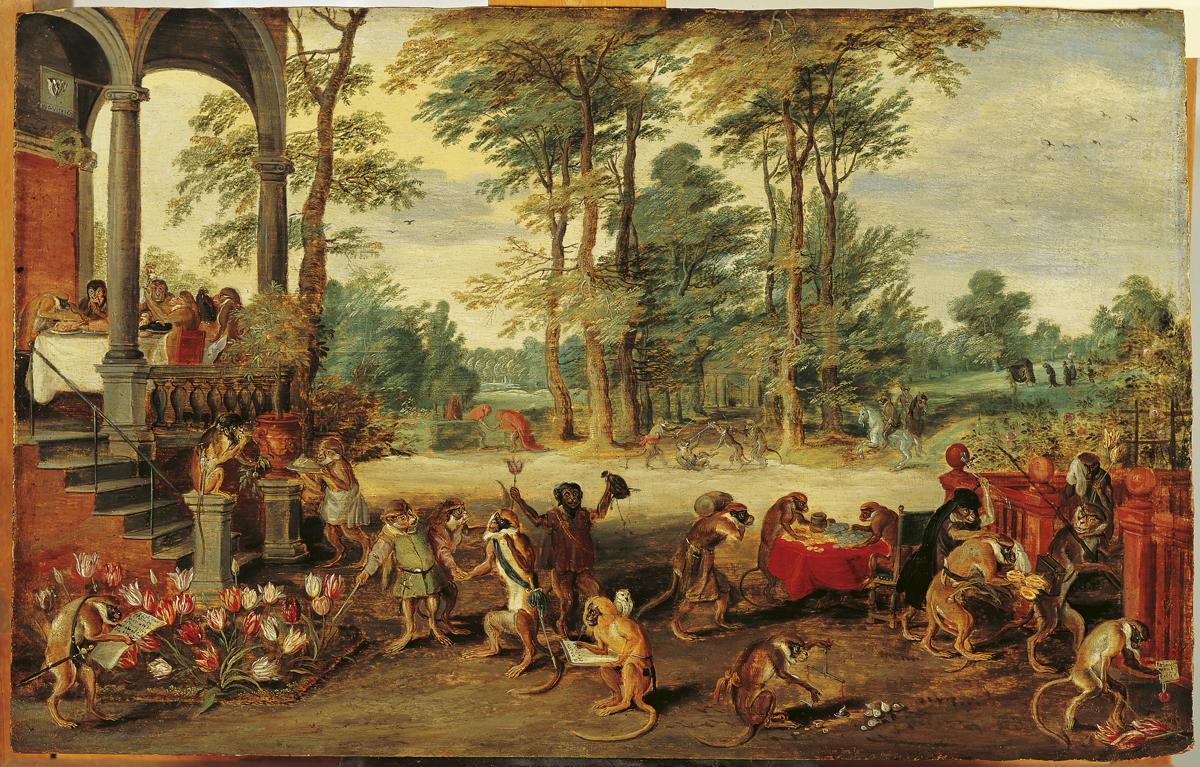
All was therefore set for exploitation by speculators and that is what is shown in the painting by Jan Brueghel the Younger, where humans have been replaced by monkeys. The use of monkeys to represent humans was made popular by Jan Brueghel the Younger’s grandfather, the innovative, and justly famous, Pieter Bruegel the Elder (shifts in the spelling of their name were used by members of the family) in a painting entitled Two Monkeys. Jan’s father, Jan Breughel the Elder also painted Feasting Monkeys, so he would have known about this satirical device. It became popular among Flemish painters of the time and led to the Singeries of early 18th Century France, that featured monkeys in a range of settings [2]. Monkeys were not depicted because of any allusion to human evolution; more to their usefulness as symbols of exaggerated human behaviour.


Jan Brueghel the Younger’s painting Satire on Tulip Mania, from the collection of the Frans Hals Museum (see above and [3] for a larger-scale version), depicts the fate of various players involved in tulipomania. Flowering tulips, including examples of “Semper Augustus”, are displayed in front of a large mansion, where the owners are enjoying the high life, supported by the vast sums of money being paid for tulips. A sale is being prepared for a noble monkey who is determined not to be left out, and the price to be paid is being negotiated, agreed, and formalised by a contract. To the right of the picture we see gamblers (tulipomania was a form of gambling), a monkey urinating on tulips (clearly ones that were not deemed good enough after they had been purchased – the monkey holds a contract note), and other monkeys being led into a courtroom dock (for getting into debt by speculating in tulips). In the background, it appears that a duel is being fought, and a lonely funeral procession moves away in the distance. Both indicate the folly of being drawn into such a strange competition for status.

As satire, the painting reminds us of some of the works painted by Hogarth to point out the mores of society. Tulipomania was certainly a strange event, but the desire to become rich, and having possessions that convey status, is always with us. It’s just that sometimes these desires get out of control and we lose our powers of reasoning.


[1] Anna Pavord (1999) The Tulip. London, Bloomsbury Publishing.


Monday, 11 May 2020

Castles in paintings


Castles were built for defence and also acted as symbols of power. Moats and drawbridges added to the fortifications, and walls were massive, and built to withstand attack by all manner of weapons, from rocks slung by trebuchets to iron balls fired from large cannon. Even if the outer walls were breached, or undermined, there were inner defences like keeps. If all attacks failed to result in surrender, then there was always siege and the starving of the castle occupants into submission.

There are hundreds of paintings that feature castles, but let me give six examples, grouped into three categories:

Castles as safe retreats

St George and the Dragon (1502) by Vittore Carpaccio


In The Golden Legend, Jacobus da Varagine (ca. 1230 -1298) describes how St George killed a dragon that terrorised the people of Silene, and rescued a princess who was to be the latest victim. In this painting, Carpaccio shows us the three principal characters in the drama, with the foreground strewn with the remains of previous victims, including humans, other vertebrates, and invertebrates. Among the remains is the shell of a large marine snail that the dragon must have captured from the nearby sea.

In the background, we have ships and other craft (being a Venetian, Carpaccio was familiar with these), and the town from which the princess has become isolated. There are several castles that would provide protection, but they are too far away, something that would have been perceived readily by mediaeval viewers of the painting.

Madonna del Prato (1505) by Giovanni Bellini


Bellini shows Mary in a pastoral setting, cradling the infant Jesus. As we look to the middle distance, we see cows and a cowherd, and a crane with wings partially outstretched, resembling the wings of an angel. Another bird sits in the branches of a dead tree, acting as a contrast to the crane, and this bird is black and is a symbol of death, a device sometimes used in paintings. On the right, we see the town from which the Madonna and Child are isolated, the castellated walls emphasising that it is a place of refuge. All viewers know Jesus’ eventual fate.

Castles as impregnable fortresses

The Enchanted Castle [Landscape with Psyche outside the Palace of Cupid] (1664) by Claude Lorrain


The story of Cupid and Psyche is told in Metamorphoses by Apuleius, written in the second century of the common era. It is a complex story of love and passion, with Psyche falling hopelessly in love with Cupid, even though she had only met him in darkness. After she lit a candle to see what he looked like, Cupid ended the relationship and Psyche attempted suicide. The story did have a happy ending though, as they were reunited and Psyche became immortal.

In this painting we see Psyche yearning to see Cupid, who is in an impregnable castle and is thus unattainable. The symbolism is powerful and the melancholy atmosphere created by Claude certainly adds to the tension of the scene, with the luminosity of the background highlighting the adjacent landscape and casting the castle into shadow. It is a powerful painting.

Château de Chillon (1874) by Gustave Courbet


Château de Chillon was built on a rocky island on the shores of Lake Geneva, near Montreux. From the 12th to the 16th Centuries it was occupied by the Counts of Savoy and was then captured by the Bernese and, later, by the Vaudois. It has a commanding strategic position on the lake and alongside a trade route. In Courbet’s painting, we feel a sense of impregnability and the castle is the only obvious sign of human influence in an otherwise natural landscape.

The slope of the mountains in the background emphasises the isolation of the castle and the sunlight falling on one wall, echoed by the light on the distant mountainside, draws our attention to its massive construction. Further emphasis comes with the luminosity of the background behind the castle, focussing our attention on its imposing strength. The castle symbolises the power of the Counts, and also shows that humans can produce buildings whose grandeur matches that of Nature. However, we know that castles are only transient.

Castle ruins and despair

The Ruins of Castle Landskron in Pomerania (ca. 1825) by Caspar David Friedrich


Best known for his paintings of remote figures in harsh landscapes, Friedrich shows us how a ruined castle can convey a haunting sense of loneliness. It is isolated within the landscape, and what was once a bustling place, is now empty, with extensive damage around the windows, as well as to the main walls. We are left to wonder what life was like at Landskron, and what happened to its last residents: any power and influence has certainly gone and we are left with just a vestige, as successive owners neglected the castle and allowed it to fall into ruin. Painted in watercolours, Friedrich uses a light palette and we focus solely on the castle, and what became of it.

Hadleigh Castle. The Mouth of the Thames – morning after a stormy night (1828-9) by John Constable


If we get a sense of loneliness and quiet melancholia from Friedrich’s picture, we get rather different feelings from Constable’s painting of Hadleigh Castle. We know from the full title of the work that it shows the castle after an earlier storm, with the turbulent sky conveying the impression that it is still very squally. Being painted in oils, it has a much more disturbed feel than the watercolour by Friedrich, and both the castle and the sky convey a sense of anger. This is not surprising, as Constable’s wife had died in 1828 and anger is part of bereavement. The portrayal of a ruined castle, painted this boldly, gives an insight into how emotionally vulnerable Constable must have been when he painted it. Hadleigh Castle is all about pain and we can feel it.


There are so many other paintings that feature castles and it was difficult to choose six. My three categories for the symbolism of castles is not exclusive and it is interesting that castles are among the buildings that we most like to visit, whether intact or in ruins. They certainly stir the imagination.


 Large-scale illustrations of these works can be seen in these links:

St George and the Dragon (1502) by Vittore Carpaccio


Madonna del Prato (1505) by Giovanni Bellini

The Enchanted Castle [Landscape with Psyche outside the Palace of Cupid (1664) by Claude Lorrain

Château de Chillon (1874) by Gustave Courbet

The Ruins of Castle Landskron in Pomerania (ca. 1825) by Caspar David Friedrich

Hadleigh Castle. The Mouth of the Thames – morning after a stormy night (1828-9) by John Constable


Wednesday, 25 March 2020

How a great auk “flew” from Durham to Glasgow


Fifty years ago, I travelled to Durham University to be interviewed for a PhD studentship to work with Dr Lewis Davies on the blackly larvae (Simuliidae) living in streams in Upper Teesdale. I had always liked moorland and the project involved regular sampling of streams on the Pennines, to collect larvae and then analyse the life histories and production of the populations. Among the questions I was asked at the interview were whether I was prepared to work on my own on the fells and whether I had a driver’s licence, as the studentship came with a short wheelbase Land Rover that would allow access to some of the rougher tracks that I would need to use. I was positive about the first, but I hadn’t passed my driving test and would need to do so. Despite this answer, I was offered the post and accepted readily.

I then needed to take an intensive course of driving lessons that resulted in a pass in what was a very high-pressure test. It was such a relief as I was very keen to go to Durham and I had been impressed by the wonderful city and, especially, the people whom I had met in the Department of Zoology. It wasn’t only the people that impressed – so did the stuffed great auk that had a prominent position at the foot of the staircase in the Zoology Building. I knew that these birds had become extinct but had never before seen a museum specimen and I found it fascinating.

When I moved to Durham, the great auk became a “friend” as I had to pass it as I made my way upstairs to the common room, where we took coffee. Recently, I was intrigued to read about its history, and current location, in a paper by R.A.Baker  in the Archives of Natural History [1]. It is worth quoting from his paper:

The ”Durham” Great Auk had a long association with the University of Durham, from about 1834 to 1977 – a span of over 140 years.. ..Canon Thomas Gisborne (1758-1846), a Prebend at Durham and early benefactor, bought and presented the Great Auk to the new university.. .. When science was re-established at Durham in 1924, the Great Auk was transferred to the newly-built Dawson building and insured against fire and theft. J.J.O.Mason, the Head of Science at the time, recalled “When I came, I begged it for the new department (Science), remarking that some day we should have a Zoology department, which would be glad of it.”.. ..By the late 1970s the Head of the Department of Zoology at Durham, Professor David Barker, decided to sell the specimen.. ..Some disquiet was expressed after the sale was agreed. The sale went ahead on the agreement that the money raised would be placed in a fund “to make purchases to maintain the quality of the zoological specimens teaching collection”.. .. The auction of the “Durham” Great Auk took place at Sotheby’s in London on Wednesday 21 September 1977 and was sold to a Michael Pilkington for £4200.. .Mr Pilkington eventually decided to sell the Auk, and gave the museum [the Kelvingrove Museum in Glasgow, where it had been on loan] the first option on it. The Glasgow Great Auk Appeal, launched the day before the 150th anniversary of its extinction, helped to raise sufficient funds for the museum to purchase the specimen for £30,000 in 1994.

It continues to be exhibited at the Kelvingrove Museum (see below), although I have not been to visit my old “friend”


What is the attraction of extinct animals? We are all familiar with the enthusiasm that many have for dinosaurs and the ammonite fossils of the Jurassic Coast, and these animals became extinct millions of years ago, overtaken by evolution and climate change. Those factors may also explain the much more recent demise of mammoths (like dinosaurs, strong favourites with the public), but very recent extinctions, like that of the great auk and some other flightless birds, were the result of human exploitation. We know that Ole Worm (1588-1654) had a live specimen from the Faroe Islands that he fed on herrings and he also had at least one stuffed great auk in his private museum [2]. With the rise of interest by collectors in rarities, and with little defence against humans, great auks didn’t stand a chance, having already been taken as food and for their feathers [3,4]. Perhaps our fascination with them results from a sense of loss and a recognition that we have been responsible for their being wiped out - and knowing that we will never see one alive? 

It is all a long way from collecting blackfly larvae in Upper Teesdale, but the Durham great auk certainly had, and continues to have, a strong appeal for me. I think it is a pity that it was sold (at what appears a knockdown price), but good to know it “lives on” in Glasgow.


[1] R.A.Baker (1999) Going, going, gone – the “Durham” Great Auk. Archives of Natural History 26:113-119.

[2] A.V.DeLozoya, D.G.García and J.Parish (2016) A great auk for the Sun King. Archives of Natural History 43:41-56.

[3] W.R.P.Bourne (1993) The story of the Great Auk Pinguinis impennis. Archives of Natural History 20: 257-278.

[4] T.R.Birkhead (1994) How collectors killed… New Scientist Issue 1227 May 28th 1994.

Tuesday, 17 March 2020

COVID 19 – and more bad press for bats


In an earlier blog post [1], I asked the question “What’s not to like about bats?”. Accepting that bats are not universally popular, I pointed out that, for many, they are associated with unpleasantness and feature in several stories about witches. This is illustrated in the frightening image of Goya’s Witches’ Sabbath, where bats fly over the witches’ heads as they worship the devil in the form of a goat (see below, with detail).


Further in the blog post [1], I wrote:

This association with the “dark world” stems from the crepuscular and nocturnal habits of bats, and our nervousness about what happens during darkness – a “fear of the night” and anxiety about the possible presence of evil spirits. There is also something about the rapid flight of bats that some find disturbing and one belief is that they can become entangled in hair. ..A further prominent feature of folklore is that bat blood, or other extracts from the animals, cure eye diseases; arising, no doubt, from the ability of bats to be active in darkness.

We can now add another negative to the reputation of these fascinating mammals with the discovery that bats may be the source of the COVID19 global pandemic. In a paper published in The Lancet [2], Lu et al. write:

..on the basis of current data, it seems likely that the 2019-nCoV causing the Wuhan outbreak might also be initially hosted by bats, and might have been transmitted to humans via currently unknown wild animal(s) sold at the Huanan seafood markets.

One suggested intermediary is the pangolin, but other animals present in the market are more likely. But then, what if some of the Huanan stallholders knew of the folklore that bat blood aids the cure of eye diseases and rubbed infected bat blood into their eyes? This practice was known from Ancient Egypt, but mythologies travel. We will probably never know if this happened, but I hope that one of the solutions to our problems with this coronavirus is not the attempted extermination of bats, when the pandemic almost certainly results from the activities of humans.


[2] Roujian Lu + 34 co-authors (2020) Genomic characterisation and epidemiology of 2019 novel coronavirus: implications for virus origins and receptor binding. The Lancet 395:565-574.


Wednesday, 11 March 2020

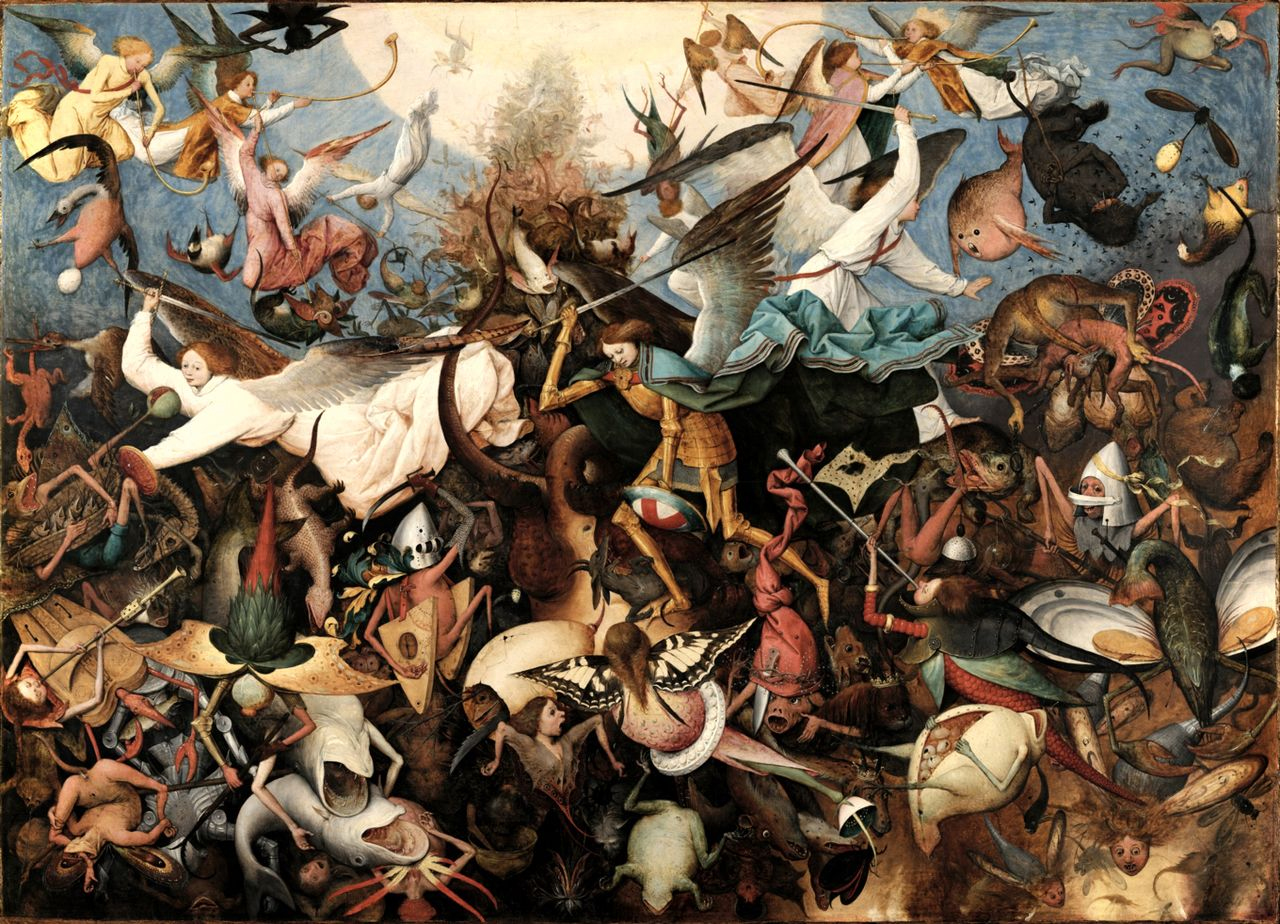
The zoology of Bruegel’s The Fall of the Rebel Angels


Pieter Bruegel the Elder is best known for scenes of everyday life and he can be regarded as the first well-known exponent of genre painting. The Fall of the Rebel Angels shows a quite different topic: the expulsion of Lucifer from Heaven by St Michael and a group of angels loyal to God. Bruegel shows us St Michael (with his shield bearing the cross of the resurrection), but it is difficult to make out Lucifer in his many-headed form. Heavenly light shines from the top of the picture, through the blue sky, and we then move down to the darkness of the abyss of Hell. Some animals are present in the sky, together with angels, and most are descending into Hell, which is not fiery, as it is described in The Holy Bible and as it is usually shown in paintings. The only hint of fire in Bruegel’s work turns out to be a feathery headdress.


An excellent commentary on the painting has been provided by the Royal Museums of Fine Art in Brussels, where the painting is exhibited [1]. As mentioned in this commentary, several of the animals shown are based on those from collections of curiosities, which were becoming popular as sources of wonder at the unfamiliar.

I would like to make some additional comments on some of the animals shown in the painting.

The puffer fish

Bruegel shows a puffer fish with the body distended. One defence mechanism used by these fish is to rapidly take water into the stomach to “inflate” the body and make spines stand out: the same mechanism is used when the fish gulp air should they be caught out of the water. In this state, puffer fish have been preserved by drying and it is likely that Bruegel saw a preserved specimen displayed in a collection of curiosities. While the eyes look unnatural, he shows the fused teeth that are used by the living fish to bite into their prey [2].

Interestingly, some puffer fish have another defence mechanism in the production of chemicals within the liver that are highly toxic to humans. So much so, that raw fugu – a delicacy in some parts of the world – requires preparation by specially-trained chefs. It tempts us to think that the inflation of the body, and the production of toxins, evolved to prevent predation by humans, but both must have existed long before the evolution of humans.


Two dead fish and bloated frogs

The fish are shown with their mouths open as if gasping, an indication of distress that Bruegel clearly wished to convey. The same intention of providing images that cause us to become frightened comes in the bloated frog, whether bloating was caused by decomposition or, should the frog be female, by being filled with eggs that will now not be laid. A second frog-like creature is shown with the abdomen split open to show what appears to be spawn, but this animal is different to Bruegel’s frog (having what looks like the “parson’s nose” of a chicken at the end of the abdomen). I have no idea what Bruegel was trying to show here.


Mussels + a crustacean

In this image we see two open mussel shells containing the body of each mollusc. The two mussels, each shown inside one of their shell valves, have clearly been cooked as, in life, the mantle (the pink/yellow fold) is closely applied to the shell for almost all of its length. Lying between the two mussels is what appears to be a crustacean, blue in colour like a lobster when alive, and the whole reminds us of a flying creature, with the mussel shells forming “wings”.


The stenogastrine wasp

Although stylised, the stenogastrine wasp is probably included as a threat and also as a bizarre creature that would also have occurred in a collection of curiosities. These wasps, like other social insects, are likely to be female and possessed of a mild sting. However, they are not usually aggressive and their appearance more frightening than reality, especially when shown at such a large size relative to other recognisable animals in the painting.


The falling birds

Two birds are shown falling into the abyss. One appears to be laying an egg, but it is impossible to identify what type of bird it might be: the other resembles a great auk, now extinct. Interestingly, Ole Worm (1588-1654), the Danish natural historian and physician, kept a great auk as a pet and, after its death and preservation, it might have found its way into his splendid cabinet of curiosities [3].


We can spend much time in speculating on what Bruegel intended in his use of images of animals, both real and imaginary. His view of the expulsion of Lucifer is certainly unique and is based on his imagination, with no attempt made to show the realistic scale of the different components. Dead terrestrial and aquatic animals are present in all parts of the painting, together with images that are supernatural and were likely to have been strongly influenced by the earlier works of Hieronymus Bosch (as mentioned in the commentary).

It is an extraordinary painting.