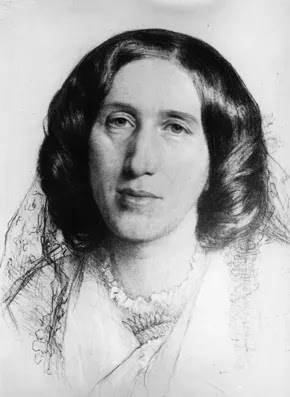
Evangelical Christians play important roles in George Eliot’s first two novels: Scenes of Clerical Life (really three separate novellas in one volume) and Adam Bede. As is well known, George Eliot (see above) was the pen name of Marian (earlier Mary Ann, or Mary Anne) Evans and her interest in evangelical Christianity came from when she attended schools in Nuneaton and Coventry. In her Introduction to the Oxford World’s Classics edition of Scenes of Clerical Life, Josie Billington writes [1]:
As an adolescent, coming of age in just the period – the 1830s – she writes of in Scenes, Mary Anne Evans was swept up in the religious current of Evangelicalism.. ..If the Oxford Movement sought to turn back the legacy of the Reformation, Evangelicalism sought to complete what the Reformation had begun, expunging the ceremony and sacrament which were the remaining formal vestiges of Roman Catholicism and rediscovering the vital puritan impulses of original Protestantism.. ..Evangelicalism offered a belief that was hard and uncompromising, yet passionately earnest and totalizing, which in the first half of the nineteenth century had a profound impact not just on the rural towns of England, but on the nation’s cultural and intellectual life in general.
Never fully committed to evangelical Christianity, Marian went on to reject it, while retaining sympathies for the “good side” of some of those who believed wholeheartedly in this approach. Her views are discussed in an essay by Donald C. Masters [2]:
While George Eliot (1819-1880) came to dislike the Evangelical viewpoint, her treatment of Evangelicals, particularly in her early novels, was much more sympathetic than that of other Victorian novelists.. ..Like many other disillusioned Christians she retained her belief in the Christian ethic. She liked the Evangelicals in spite of their doctrines and what she regarded as their naïveté and narrowness, because they made people better..
..Her early letters.. ..suggest that her acceptance of Evangelical principles was merely an intellectual process. She never made the complete personal commitment that is the secret and core of the Evangelical position.. ..She had lost faith in the Bible, the essential basis of the Evangelical tradition and described it.. ..as “histories consisting of mangled truth and fiction.”
Many of us who have encountered evangelical Christianity, and subsequently turned away from it without making “the commitment”, can recognise George Eliot’s feelings. I have described my own experience [3]:
My last contact with formal Christianity came at Torquay Boys’ Grammar School, where I went to meetings of the Christian Union, in which my elder brother was a leader. We sat around a table and listened to speakers, or to tapes of Billy Graham preaching. We also had prayer meetings when we all had to take part. Prayers were for the usual things connected with our salvation but, being a school, we also prayed for masters who were Christian, to boost their religious, as well as their educational, mission. I always dreaded prayer meetings and was not comfortable at any of the other meetings either. Unlike some of those present, I found Billy Graham strange and rather too energetic, and neither could I summon up much enthusiasm for a guest speaker who spent many minutes propounding the correct pronunciation of Bethphage.
There were tracts for us to hand out in the school, delivered in bulk from the Evangelical Tract Society.. ..I couldn’t hand out such things and had quite a collection by the time I stopped attending the Christian Union.
It is not difficult, then, to see how personal experience of religious groups affects one’s reading of George Eliot’s novels. Like Marian, I rejected the thinking of evangelical Christians (on many grounds) and, like her, try to see their good human qualities, although I worry about their tendency to proselytise to those going through hard times.

In addition to Evangelicals, another feature of George Eliot’s novels is the presence of young children, often described in detail and forming important threads to the various storylines. Marian loved children, but she was unable to have any of her own. The reason was not biological, as far as I know, more that she didn’t marry until she was in her sixties and spent most of her adult life living with George Henry Lewes (see above), who was already married and had children. If “living in sin” was bad enough in the eyes of many in Victorian society, having children while in such a relationship would be viewed very severely indeed. Certainly, Marian’s cohabitation with Lewes caused much pain to her upright family and this, in turn, was the source of much sadness to her.
The couple had a very close relationship, with Marian depending on George for reassurance and advice. He was from a theatrical family and both acted in, and wrote, plays: he also wrote novels, was an expert on Goethe, published an outstanding review of philosophy through the ages, contributed to many leading artistic journals, and was also what we would now call a networker [4]. Although unprepossessing in appearance (some called him ugly), he was popular for his conversation and energy and he knew many of the movers and shakers in Victorian literary society. He was one himself.
Lewes met Marian through John Chapman, the publisher of the Westminster Review [5]. Chapman was a “free-thinker” and Marian lived in his household, where relationships between Mr and Mrs Chapman, their governess, and Marian were complicated. In Ashton’s account [5] we read that Chapman “visited Marian Evans’ room, where she played the piano for him and taught him German.” It was all too much for Mrs Chapman and Marian left the household, but returned in 1851 when Chapman asked her back to help him as part of the editorial team on the Review, where her “sharp brain, wide knowledge, willing labour, and ability to deal tactfully yet firmly with touchy contributors” [5] was invaluable.
During 1852, Marian was spending much time with Herbert Spencer, the philosopher and biologist to whom she had been introduced by Chapman, and they “were so often in one another’s company that ‘all the world is setting us down as engaged’, Marian would have liked nothing better, but Spencer was less keen.” [5] The result was that, in 1853, Lewes replaced Spencer in her affections and this was the start of a deep relationship that only ended with Lewes’ death. He was a great support to Marian and advised her during her first, tentative steps as a novelist and he played the same role after she had become famous and was being hailed as a very significant writer. Marian had come a long way from those evangelical Christian schooldays in Warwickshire and Lewes had also progressed in his interests. Like his hero Goethe, he then became interested in practical science.
In the early years of his relationship with Marian, Lewes had been chided by T.H.Huxley as a “’mere’ book scientist ‘without the discipline and knowledge which result from being a worker also’”. This came after a review that Lewes had written and it perhaps inspired him to join the Victorian craze for the study of marine natural history. The leading figure in popularising this interest was Philip Henry Gosse, who had written A Naturalist’s Rambles on the Devonshire Coast (1853, centred on Torquay and Ilfracombe), The Aquarium (1854) and Tenby (published in March 1856, centred on the Welsh seaside town). Lewes read all these books and, in the summer of 1856, he and Marian left for Ilfracombe (where they befriended another enthusiast, Mr Tugwell, the curate of Ilfracombe) and then Tenby; following this with visits to the Scilly Isles and Jersey in spring and early summer of 1857. It was during the first section of this marine shore adventure that the pair discussed the possibility of Marian’s writing a novel. The Sad Fortunes of the Rev Amos Barton was commenced in the autumn of 1856 and became the first part of Scenes of Clerical Life published, anonymously, in instalments in Blackwood’s Magazine through 1857 and as a book in two volumes in 1858. She was not an enthusiast for studying shore life, so Lewes’ avid work on the coast allowed Marian time to think about the content of her embryo novel.
Lewes’ work was published in instalments in Blackwood’s Magazine through 1856/7 and came out in book form, published by Blackwood and Sons and dedicated to Richard Owen, as Sea-side Studies in 1858. In the preface, Lewes pays homage to Huxley (perhaps the latter’s comment stung?) and there are frequent references to Gosse throughout the book. Both men showed a particular interest in sea anemones and, indeed they had a dispute over one aspect of the biology of some of these animals [6]. It is interesting to make a comparison of the two men.

Whereas Lewes was a free-thinking agnostic (if he must be classified), Philip Henry Gosse (above) was a strict believer in the literal truth of the Bible [3] and an evangelical Christian. In 1857 he moved to St Marychurch in Torquay after the death of his wife Emily, who had accompanied him to Torquay, Ilfracombe and Tenby on the collecting trips that resulted in his earlier books. Emily was a writer of religious tracts (like those I failed to hand out during my school days) and as deeply committed as her husband to evangelical Christianity. Her painful death, leaving Henry Gosse with his young son Edmund (later Sir Edmund), was the main reason that he decided to move.
At the time of the move to Torquay, he was expecting high sales of his book Omphalos, that was to be published in late autumn 1857, and he was looking forward to the attention that it would bring. Although there are many references to God and Creation in Henry’s books, Omphalos saw him tackle head-on the conflict between the Biblical Creation and the idea of geological time scales, that were becoming accepted by the mid-1850s. It is subtitled “an attempt to untie the geological knot” and it was Henry’s attempt to ease an obvious conflict: his idea being that rock strata and fossils were all created over the short period of the Biblical Creation. In Omphalos, he showed a thorough knowledge of geology and palaeontology and knew that large time periods were involved, but clung to his odd theory, for which he was duly mocked. Through all the difficulties of 1857, Henry didn’t question his beliefs; rather he became even more ensconced in evangelical Christianity. He reduced his attendance at meetings of the learned societies and didn’t have much personal contact with members the scientific community, although he had correspondence with many people, including Darwin.
There are many that still adhere to the Creationist views shown by Henry Gosse, although they make little attempt to provide a rational explanation to account for the differences between their views and those of the scientific community. At least Henry made an attempt, even if his explanation was unacceptable to both scientists and believers; Charles Kingsley, for example, chastised Gosse for suggesting the God appears to be telling lies [3]. It seems that evangelical Christians who believe in the literal truth of the Bible have the opinion that there can be no opposition to their view and cannot tolerate any other explanations.
Lewes took a very different approach, as described by David Williams [4]:
He thinks, or at any rate he wishes, that the scientific explorers and the religious no-compromise men.. .. can be brought together to ‘sit round a table’, as we put it, that Huxley and Darwin can amicably confer with the tractarians and the Evangelicals and come out of the room with a formula acceptable to both sides.
There has been movement among some evangelical Christians and we are all familiar with the little car badge of a fish with limbs, bearing the word “Darwin” at its centre. Perhaps the only major difference for many is whether there was a Creator, or whether all that we see around us is the result of chance events.
After the adverse comments about Omphalos, Henry Gosse spent much time collecting marine creatures from the shores of South Devon [3]. He was in the throes of producing his major monograph on sea anemones, that was to be a standard work on these animals for many years and is still consulted today. It contains brilliant illustrations, as Gosse was a very capable artist in watercolours [7].
In a letter sent to Tugwell in November 1856, Lewes writes [8]:
It would be a pleasant thing for you to write the monograph on Actinae with W. Thompson; & as to the money, you can’t expect much from such labour, but may consider yourself lucky to be free of expense. At the same time you have a formidable rival in Gosse, who is I believe engaged on a monograph.
This shows Lewes’ respect for Gosse as an expert in sea anemones, but in a later letter to Hutton on 5th May 1859 we read [8]:
Gosse’s book is too poor for a review; & I have long been making notes of the history I shall sketch which will I hope be far more entertaining than a review.
I assume that Lewes is referring here to Omphalos, as Actinologica Britannica appeared in book form in 1860, having previously been published in twelve parts from 1858-1860 [9]. Despite their disagreement over some points [6], Lewes clearly respected Gosse as a natural historian.
We know that Lewes and Marian visited Torquay in 1868 and, while the former continued with dissections for a future publication, Marian was preparing ideas for Middlemarch and it is possible that there were some indirect references to Torquay in that book [10]. We also learn that Marian and Lewes enjoyed walks at Babbacombe, adjacent to St Marychurch [10], and one wonders whether they called on Gosse, or encountered him while walking. I cannot find reference to a meeting and would be intrigued to know how it might have gone and what Marian would have made of this evangelical Christian and a man who was not afraid of proselytising. The urge to spread the Gospel came through in many of Henry Gosse’s books, but rarely with the intensity of the extraordinary conclusion of A Year at the Shore, published in 1865, three years before George and Marian arrived in Torquay [11]:
I cannot conclude
this volume without recording my solemn and deliberate protest against the
infidelity with which, to a very painful extent, modern physical science is
associated. I allude not only to the ground which the conclusions of modern
geologists take, in opposition to the veracity of the “God which cannot lie,”
though the distinct statements which He has made to us concerning Creation are
now, as if by common consent, put aside, with silent contempt, as effete
fables, unworthy of a moment’s thought, and this too before vast assemblages of
persons, not one of whom lifts his voice for the truth of God. These assaults
are at least open and unmasked. But there is in our scientific literature, and
specially in that which takes a popular form, a tone equally dangerous and more
insidious. It altogether ignores the awful truths of God’s revelation, that all
mankind are guilty and condemned and spiritually dead in Adam; that we are by
nature children of wrath; that the whole world lieth in the wicked one; and
that the wrath of God abideth on it: it ignores the glorious facts of atonement
by the precious blood of Christ, and of acceptance in Him. It substitutes for
these a mere sentimental admiration of nature, and teaches that the love of the
beautiful makes man acceptable to God, and secures His favour. How often do we
see quoted and be-praised, as if it were an indisputable axiom, the sentiment
of a poet who ought to have known better,–
“He prayeth best who
loveth best
All things, both
great and small;” –
a sentiment as silly as it is unscriptural; for what connexion can there be between the love of the inferior creatures, and the acceptableness of a sinner praying to the Holy God? It is the intervention of Christ Jesus, the anointed Priest, which alone gives prayer acceptance… There is no sentimental or scientific road to heaven. There is absolutely nothing in the study of created things, however single, however intense, which will admit sinful man into the presence of God, or fit him to enjoy it. If there were, what need was there that the glorious Son, the everlasting Word, should be made flesh, and give His life a ransom for many? … If I have come to God as a guilty sinner, and have found acceptance, and reconciliation, and sonship, in the blood of His only-begotten Son, then I may come down from that elevation, and study creation with advantage and profit; but to attempt to scale heaven with the ladder of natural history, is nothing else than Cain's religion; it is the presentation of the fruit of the earth, instead of the blood of the Lamb … This will be, in all probability, the last occasion of my coming in literary guise before the public: how can I better take my leave than with the solemn testimony of the Spirit of God, which I affectionately commend to my readers, – … THERE IS NO WAY INTO THE HOLIEST BUT BY THE BLOOD OF JESUS. FINIS.
Henry Gosse was not only a proselytising evangelical Christian, but the leader of his group of Brethren in St Marychurch. He thus retreated into his own support group and this made it increasingly difficult for him to accept any religious views other than those he supported. It was religious differences, and the views of Henry on who one should have as friends, that was the basis of the conflict with his son, Edmund, described (with some elaboration?) in the latter’s famous book Father and Son [12]. This volume, more than any other work, has shaped our view of Henry [3], a pity as, if one could find a way of negotiating the religious hurdle, with all its side effects, he was a very nice man and would certainly be good company on rambles or on the shore.
As we have seen, Marian Evans and Geoge Lewes were more accepting of those with religious differences and the former certainly recognised these human sides of evangelical Christians, although she was aware of their dogmatism and inflexibility. I think they would have enjoyed meeting Gosse, but what would Henry make of them? He would balk at their lack of faith in his version of Christianity and he would also strongly disapprove of their relationship. Henry did re-marry after the tragic death of Emily and his second wife, Eliza, while also being a member of the Brethren appeared to be a little more flexible in her approach to Edmund’s “sinfulness” than was his father. Edmund was also helped in his relationship with his father by his wife, the painter Nellie Epps, whom I have described as a “Nineteenth Century Wonder Woman” [13]. Nellie’s sister, Laura Alma-Tadema drew a profile of Marian in 1877 [14] and it would be amusing to know what the artist felt about her sitter and what views she shared with the Gosse family.
[1] Josie Billington (1988) Introduction to George Eliot’s Scenes of Clerical Life. Oxford, Oxford University Press World’s Classics.
[2] Donald C. Masters (1962) George Eliot and the Evangelicals. The Dalhousie Review 41: 505-512.
[3] Roger S Wotton (2020) Walking with Gosse: Natural History, Creation and Religious Conflicts. e-book.
[4] David Williams (1983) Mr George Eliot: A Biography of George Henry Lewes. London, Hodder and Stoughton.
[5] Rosemary Ashton (2008) Lewes, George Henry (1817-1878). https://doi.org/10.1093/ref:odnb/16562
[6] https://rwotton.blogspot.com/2016/11/the-human-side-of-science.html
[7] https://rwotton.blogspot.com/2017/04/stunning-biological-illustrations.html
[8] William Baker (ed.) (1995) The Letters of George Henry Lewes Volume 1. Victoria, Canada, ELS Editions.
[9] R.B.Freeman and Douglas Wetheimer (1980) Philip Henry Gosse: A Bibliography. Folkestone, Wm. Dawon & Sons.
[10] Kathleen McCormack (2005) George Eliot’s English Travels: Composite characters and coded communications. Abingdon, Routledge.
[11] Philip Henry Gosse (1865) A Year at the Shore. London, Alexander Strahan.
[12] Edmund Gosse (1907) Father and Son: A Study of Two Temperaments. London, William Heinemann Ltd.
[13] https://rwotton.blogspot.com/2017/08/nellie-epps-nineteenth-century-wonder.html
[14] https://www.npg.org.uk/collections/search/portrait/mw01628


