Showing posts with label Protection. Show all posts

Thursday, 24 September 2015

The evolution of a fascinating mutualism


How did mutualisms between individuals of different species develop? These associations take many forms, but some symbioses evolve so that dependence results; the best known examples being lichens, where fungi and algae live together to mutual advantage.

A symbiosis is found between a species of hermit crab, Pagurus prideaux and a sea anemone Adamsia palliata (pictured below, the Adamsia having pink spots), although it is not essential for the survival of each [1]. There are many species of hermit crabs, but all are characterised by having a soft abdomen that is held within a snail shell left behind after the gastropod has died. This is a remarkable association between a living animal and the remains of another and, as an individual crab grows, it leaves one shell and searches for another that is more suitable for its increasing size. The aperture of shells occupied by P. prideaux usually has an individual of A. palliata attached to it, located the entrance in a position where it doesn't have a marked effect on the centre of gravity of the shell.


The advantages of symbiosis between sea anemones and hermit crabs have been reviewed by Gusmão and Daly [2], with the sea anemones benefitting from an increase both in dispersal and in the chance of encountering food; and the hermit crabs being protected against predators by the stinging cells of the sea anemone. So how does the sedentary sea anemone move to the snail shell occupied by the crab? The locating behaviour was described by Philip Henry Gosse, the great nineteenth-century Natural Historian. Here is his observation [3]:

Carefully taking up the shell with the aquarium-tongs, and bringing it close to the surface, but not out of water, I gently dislodged the Adamsia with my fingers, and allowed it to fall prone upon the bottom. I then released the shell with its tenant, and drove the latter towards the spot where the zoophyte lay.

No sooner did the Crab touch the Adamsia than he [sic] took hold of it with his claws, first with one, then with both, and I saw in an instant what he was going to do. In the most orderly and expert manner he proceeded to apply the Adamsia to the shell. He found it lying base upward, and therefore the first thing was to turn it quite round. With the alternate grasps of the two pincer-claws, nipping up the flesh of the Adamsia rudely enough, as it seemed, he got hold of it so that he could press the base against the proper part of the shell, the inner lip. Then he remained quite still, holding it firmly pressed, for about ten minutes; at the end of which time he cautiously drew away first one claw, and then the other; and, beginning to walk away, I had the pleasure to see that the Adamsia was once more fairly adhering..

Long-term attachment is aided by the secretion of chitin, this being a feature of several sea anemones and not just Adamsia. However, the chitin produced by Adamsia forms an extension of the snail shell and, in the following description of the process [4], the reference to chitine and a horny membrane come from the observations of Henry Gosse:

..sea anemones of the genus Adamsia living on gastropod shells inhabited by hermit crabs may extend the shell's lip by secreting what is variously called a cuticle, "chitine", a horny membrane, or solidified mucus.

This is what Gosse wrote in Actinologia Britannica [5]

Very frequently, there is found intervening between the Adamsia and the shell to which it is affixed, a film of membrane, of a horny texture, somewhat brittle, of a translucent dark greenish-brown colour. After death this film is found adherent to the surface of the shell, from which, however, it easily peels when dry.. ..From several specimens.. .. I have been able to learn the nature and object of this membrane.. ..it appears to me manifest that the membrane is a provision for the support of the growing Adamsia.. .. it is composed mainly of chitine, having no calcareous element.. .. The membrane is not invariably present.

Gosse goes on to say [5]:

Pagurus Prideauxii seems to be as dependent on the Adamsia, as the latter is on it.. ..Why one species of Soldier-crab must needs seek the companionship of this Anemone, while other Soldier-crabs are able to live alone; and why this species of Anemone must needs associate with the Soldier-crab, while others kinds of Anemone are solitary, I can by no means answer.

As described above, we now have information of the mutualism and how it benefits both partners. For Henry Gosse (whose beautiful illustration is shown below), the association of the hermit crab and gastropod shells and the mutualism between Pagurus prideaux and Adamsia palliata were yet more wonderful examples of the complexity of God's Creation.


For those of us that believe in evolution, it is fascinating to speculate on the various steps that must have taken place to allow the association between the crab and the shell, and then the crab and the sea anemone. The secretion of chitin by the sea anemone was a pre-adaptation and may have originally been a means of ensuring that broken, or friable, substrata could be colonised. It now results in the secure attachment to snail shells and gives the hermit crab the advantage of changing shells less frequently. How did the crab learn to transplant a sea anemone on to a new shell; and why this one species?

Evolution fills one with a sense of wonder, doesn't it?


[1] R. M. L. Ates (1995) Pagurus prideaux and Adamsia palliata are not obligate symbionts. Crustaceana 68: 522-524.

[2] Luciano C. Gusmão and Marymegan Daly (2010) Evolution of sea anemones (Cnidaria: Actinaria: Hormathiidae) symbiotic with hermit crabs. Molecular Phylogenetics and Evolution 56: 868-877.

[3] Philip Henry Gosse (1865) A year at the shore. London, Alexander Strahan.

[4] Daphne Fautin Dunn and Martin H. Liberman (1983) Chitin in sea anemone shells. Science 221: 157-159.

[5] Philip Henry Gosse (1860) Actinologia Britannica: a history of the British sea-anemones and madrepores. London, Van Voorst.

Monday, 31 August 2015

We can't exist without slime


What is your reaction to slime? Most people find the substance, and even the thought of it, distasteful and yet we would not be alive if it was not for slime in one form or another.

Slime consists of chemical polymers that expand on contact with water, producing a clear, sticky substance that is ubiquitous and which we recognise from its slipperiness and its ability to stick to surfaces. The compounds that make up slime are referred to as exopolymers, or EPS, by those that study them and they consist principally of carbohydrates and proteins, although many other chemicals may also be found in the EPS produced by different organisms. They are truly ubiquitous: bacteria using them to attach to substrates; single-celled algae release them when producing an excess of carbohydrate during photosynthesis; and multicellular organisms use them for protection, locomotion, to aid in feeding, to aid buoyancy, and as a means of attachment [1].


During evolution, some cells in multicellular organisms became adapted to have the sole function of producing the EPS that result in slime. These goblet cells (see above) discharge their contents to become hydrated and we are familiar with the resulting sliminess of animals like worms, slugs and fish. 

I talked about EPS to an audience of trout fishers and this was recorded by the Wild Trout Trust [2] and one of the illustrations is shown below, together with the link to the video. I could only give a very few examples, but you get the drift of my talk: EPS are everywhere and yet they are largely ignored, even by scientists who should know better. Of course, there are prejudices to be overcome and at one conference dinner I was given a special prize for "the most revolting talk" given during the sessions. An award made in good humour, of course, but indicating that the subject was one that most find unpleasant. This is a pity, because EPS are one of the most important families of chemicals known.


It is fair to say that humans would not exist if it was not for slime. This argument has two components: one that develops ideas on the evolution of humans and the other on the very important role slime plays in allowing our survival. Our most distant ancestors lived in water and left this medium when fish transitioned into the amphibians (and then into reptiles and mammals). Reptiles and mammals have body coverings that reduce the loss of moisture, something that is a threat to amphibians and also the first fish making visits to land. Anyone handling a fish is aware that they have a slippery covering and this protects the animal from attack by parasites and may aid locomotion: it is a feature that is retained by amphibians and serves to reduce water loss from their bodies when they are exposed to the air for long periods. It is also a common feature among soft-bodied terrestrial invertebrates such as worms and slugs, while others, like the arthropods, have an impervious exoskeleton that much reduces the threat of desiccation.

Fish slime protects the gills from abrasion and also provides a barrier against osmotic stress, a feature that is very important to salmon as they migrate from the sea to fresh waters. Yet gas exchange occurs from the water to the mucus and then to the tissue of the gill surface and this is a feature retained through the evolution of respiratory organs of amphibians, reptiles and mammals. Human lungs and nasal passages have a coating of mucus, moved by cilia that are a throwback to our very ancient protozoan ancestors, and it can be so plentiful that it has to be removed by blowing, coughing, or swallowing, the latter normally being a continuous and unconscious process. In addition to allowing gas exchange, this mucus acts as a trap for particles, both living and dead, and it is a convention that we blow an excess of the slime into handkerchiefs, often noting the extent of hydration once the mucus becomes dried, demonstrating admirably the extent to which the EPS had undergone considerable expansion when in contact with water. Larger quantities of slime than usual are produced when this first defence mechanism is triggered by infection.

It is not only nasal, and bronchial, tissue that produce mucus in humans, and other mammals, as slime is also found in the digestive tract and in the reproductive system. The slippery quality of mucus acts as a protection for the oesophagus and slime is produced elsewhere in the gut to allow smooth passage of the contents while protecting the wall of the digestive tract. The mucus is not broken down by enzymes and, when aqueous solutions of food chemicals are removed, characteristic compacted faeces result. These are bound with slime produced originally by the gut wall and also by EPS released by the many micro-organisms that are resident within the digestive tract; the microbes protecting themselves against digestion by secreting EPS that then become a binding material for the faeces.

The final use of slime in humans is in reproduction and, especially, in allowing the migration of sperm deposited within the female genital tract. Each sperm swims within seminal fluid that contains EPS and then traverses the cervical mucus and onwards into the uterus, where one sperm fertilises a waiting egg, if one is present. It should also be pointed out that mucus provides a lubricant to facilitate copulation. 

Vital rôles indeed and it is fair to say that we would not exist without slime in one form or another, nor would very many other organisms

Having read this far in the blog post, what are your reactions? Perhaps you agree that I deserve to be thought revolting in writing, and talking, about such things, even though I respect proper taboos in polite company? Yet I am only highlighting the remarkable diversity of uses for slime and EPS and this deserves to be much better known, rather than being given the "Ugh! response" that seems to be most people's reaction to the subject. Why do we feel that way?


[1] Roger S. Wotton (2005) The Essential Role of Exopolymers (EPS) in Aquatic Systems. Oceanography and Marine Biology: An Annual Review 42: 57-94.


Tuesday, 12 November 2013

Caddis flies, earrings and evolution


During my career, I attended many conferences on Aquatic Biology and they always attracted exhibitors demonstrating nets, electronic measuring equipment, collections of the latest books, etc.. Occasionally, there would be something different and, at one conference, I came across a stand where jewellery was for sale. At first, it was not easy to see the connection to life in water, until it was explained that the various earrings and pendants were made from cases that had been produced by caddis fly larvae. Partly because of the novelty, and partly because they were attractive, I bought a pair of earrings that had cases made from fragments of jasper and my wife was pleased with them, and intrigued by the story of their manufacture.


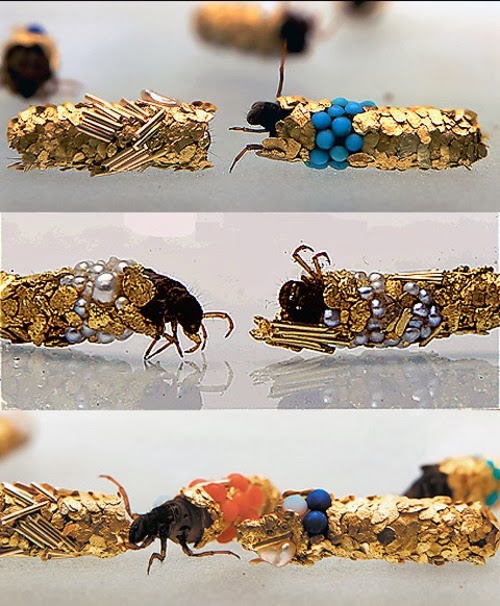
Subsequently, I found that this type of jewellery is available from several sources and, in addition to the use of fragments of natural stone, caddis fly larvae are allowed to build cases with precious stones, pearls and even gold fragments.


Many, but not all, caddis fly larvae build cases, and the materials that they use vary from species to species. Some build cases of vegetation and some of stones of a range of sizes, the common feature being that all the separate pieces of material are cemented together with silk produced by the insects from modified salivary glands, which exit near the mouth. The silk is not only strong but highly adsorptive, and its “stickiness” is not affected by it being produced under water. It was silk that bound the stones of jasper in my wife’s earrings and, having produced a case, it was an easy matter for the jewellers to remove the larva, pick up the cases, dry them and then cover them with lacquer to ensure that they would not fall apart for years. The larva could then start the process all over again, just as it would do in natural conditions if, for some reason, it was separated from its case.

Caddis larvae use cases for protection, camouflage and ballast, but some forms do not make cases, using silk to provide an enclosure to which stones may be attached, or to make feeding nets. These vary from wide aperture nets, useful for capturing materials from a fast current, through to large sac-like nets in which the larva lives while grazing over the material that has accumulated. Some caddis larvae are free-living predators and they have neither cases nor silk nets. Other caddis larvae build cases entirely from layers of silk. Whatever the adaptations shown by the larvae, it is important to remember that the larval stage is but one part of their life cycle. Having completed five larval stages, moulting between each to achieve larger size, the final stage larva spins a cocoon in which to pupate. This cocoon is frequently covered with stones or other materials and is cemented to the substratum using silk. A complete transformation of the insect now occurs, with the adult biting its way from the cocoon and emerging from the water to fly away and complete the life cycle by mating and laying eggs back into the water.


For those who believe in the literal accounts of Creation in Holy Books, the biology of these insects is easy to explain - a deity designed each species, its life cycle and its choice of whether to build a case, or not. Furthermore, the materials that each species used in case construction, and its preferred habitat, were all designed and the insects put in place some time in the first days of life on Earth. All very straightforward, but I am not a Creationist and therefore face some challenging questions - questions that I cannot answer readily (or at all):

1. Why the complex life cycle, with aquatic larval and pupal stages and terrestrial adults?

2. Why the use of silk?

3. Why the choice of different case materials, or the building of nets?

Here are some thoughts on each of these questions:

Why the complex life cycle, with aquatic larval and pupal stages and terrestrial adults?

Primitive insects have larval stages that become progressively larger and it is from the last larval stage that the flying adult emerges. Evidence of this form of metamorphosis is seen by observation of dragonfly larvae, where the growing wing buds are seen throughout larval life, and especially in the last stage. Caddis larvae do not need to grow wing buds, or other adult features, as the re-organisation of body form is completed within the pupal skin. In both types of development, all mechanisms are under genetic control, so the evolution of the genetic template is the basis of everything. We can only speculate on how pupation developed, but it must have resulted from mutations that, taken together, allowed the dramatic transformation from larva to adult. How did it happen; and did it occur gradually, or in an explosion of change? I don’t know.

We know that aquatic insects were originally terrestrial in all their life stages and that they had originally evolved from an ancestral form that was marine. Interestingly, there is evidence that the invasion of fresh waters by different groups of aquatic insects has occurred at different points in geological time, 1 from ca. 200,000,000 years ago through to more recent times (perhaps just tens of millions of years ago). Interestingly, while there are many types of aquatic insects in streams, rivers, ponds and lakes, they are rare in marine habitats.

Why the use of silk?

The ancestors of caddis flies, and some other insects, evolved the secretion of silk from the salivary glands, the original secretions being use in feeding. Silk consist of a complex of materials, including very strong protein filaments and, once evolved, the insects had an excellent mechanism for joining components of cases or for making tent-like refuges. As silk is equally effective under water, this feature was of advantage when the invasion of flowing and still fresh waters occurred.


Why the choice of different case materials, or the building of nets?

Having invaded water, ancestral caddis flies would need to acquire food. The production of silk nets allowed the capture of particles from flowing water but the water could also cause the displacement of larvae. This may be the origin of stone cases as ballast, as well as for protection. If larvae were protected from being swept away, and avoided predation by having cases that were made of the materials that surrounded them, they would have had an increased chance of survival. Thus, the genetic basis of the case-building habit will have been passed to future generations. Different types of cases show adaptation to different habitats and ponds with abundant vegetation will provide different selection pressures than streams or lake shores with stony substrata. As the caddis larvae spread throughout fresh waters, the formation of different species resulted from the selection of characteristics that promoted separation of ancestral breeding stocks and thus a diminished chance of inter-breeding, something which also occurred with the geographical separation of adults, together with changes in their breeding behaviour and apparatus. This process of speciation explains the many different forms that we see today.

It is difficult to comprehend the time periods over which evolution has occurred. However, thinking about the possible evolution of caddis flies is, to use a modern term, awesome and, for me, much more compelling than ideas based on Creation and a Designer. However, if it’s information you want on the various events during evolution.......


1 Timothy M Bradley et al. (2009) Episodes in insect evolution. Integrative and Comparative Biology 49: 590-606.


Sources of illustrations: