Showing posts with label Exopolymers. Show all posts

Thursday, 10 November 2016

Huxley's Bathybius – an early example of an organic aggregate


In a 1983 paper, the oceanographer Tony Rice offers an explanation for the appearance of Bathybius haeckelii, thought to have been a living organism by T.H.Huxley [1]. Rice writes [2]:

In the 100 years or so since Huxley's Bathybius was relegated to the status of an interesting but embarrassing error, knowledge of deep-sea biology has increased enormously, for many thousands of samples both from mid-water and from the deep-sea floor have been collected and examined. Consequently, although the deep ocean is still the least well-understood environment on earth because of its relative inaccessibility, some basic facts about its biological processes are now well-established...
     
.. With the exception of the minor local input from the activities of chemo-autotrophic bacteria, the food supply on which all deep sea animals are ultimately dependent originates in the near surface layers. In temperate waters, at least, the surface productivity is very seasonal, being highest in spring and summer when the phytoplankton is growing rapidly, and very low during the winter months. Although some of this material reaches the sea floor in the form of large, fast-sinking carcasses of fishes and whales, the main supply probably arrives as small particles, including the bodies of small plants and animals and faecal pellets, which may take many weeks to sink through the water column.

We now know that the sinking material also contains large numbers of flocs and other aggregates bound by the exudates of both bacteria and algae [3]. It is these that give the appearance of fluff that can be found over the ocean floor and which are difficult to collect in dredges, but which are clearly visible in sediment traps [2].

All this is a bit technical.

In the simplest terms, what Huxley observed was a large floc that contained components from near-surface organisms; the conclusion of contemporary scientists being that it was a precipitate of calcium sulphate, caused by preservation of a sample of sea bed in alcohol. This put an end to questions about the organic matter that was also present and the our seeming need to focus on organisms, rather than on total organic matter, was also a problem. We continue this focus, rather than taking the whole package of living and dead organic matter into account.

Let me give an example. What do you see when you look at this image from NOAA [4]?


Most will see an interesting creature – a whiplash squid – and wonder about its biology and mode of life. What about all the white dots in the rest of the picture, illuminated like the particles visible in the beam of a cinema projector? Don't  these raise questions?

While we know more about these particles and aggregates than we did when Tony Rice wrote his article, we still tend to ignore them in favour of our interest in organisms. It is true that the organic matter present in oceans, and other water bodies, is largely dependent on organisms for its production [3], but we must always consider the whole organic, and inorganic, package when trying to understand the biology of water bodies. What a pity that way of thinking didn't start with Huxley's observations on Bathybius.  


[2] A.L.Rice (1983) Thomas Henry Huxley and the strange case of Bathybius haeckelii; a possible alternative explanation. Archives of Natural History 11:169-180.

[3] Roger S. Wotton (2005) The essential role of exopolymers (EPS) in aquatic systems. Oceanography and Marine Biology: An Annual Review 42:57-94.


Thursday, 14 January 2016

The amazing three-toed sloth


There are two common types of sloth – the three-toed (below) and the two-toed – living in Central and South American forests. Three-toed sloths do not move around as widely as their distant relatives [1] and they usually have a greenish colouration. This was described by Charles Waterton in his pioneering observations of sloths in their natural environment made at the beginning of the Nineteenth Century [2]:

I observed, when he was climbing, he never used his arms both together, but first one and then the other, and so on alternately.. ..His fur has so much the hue of the moss which grows on the branches of the trees, that it is very difficult to make him out when he is at rest.


If Waterton had a microscope, he would have observed that the green colouration resulted from algae growing over the surface of the hairs making up the coat; hairs of the three-toed sloth having [3]:

..irregular transverse cracks that increase in number and size with age. A wide variety of organisms have been reported to occur in the grooves and cracks of sloth hair.. ..the greenish color of the hair.. ..is due to green algae, which in most cases have been identified as Trichophilus welckeri.. ..The hair of the three-toed sloth absorbs water like a sponge, perhaps making it an even more ideal habitat for algae, and prompting speculations that the sloth perhaps receives nutrients from the alga via diffusion along the spongy outer portion of the hairs, followed by absorption into the skin. The algae growing on sloth hair may also produce exopolymeric substances that may give the hair a desired texture or allow beneficial bacteria to grow.

This is speculation, but we know that exopolymers are ubiquitous and have many important roles to play, both for the organisms that exude them and in the wider environment [4]. It is likely that they are a significant part of the sloth fur ecosystem.

Algae are not found abundantly in the fur of very young sloths and they are probably acquired during close contact with the mother [3]. It has been suggested that the relationship of Trichophilus welckeri with the sloth is mutualisitic [3]; the alga gaining nutrients that are released by the microbial community on the hairs and also befitting from being carried up into the canopy where light is more available for photosynthesis. The sloth grazes this good quality food resource (it is rich in lipids [1]) during grooming and it also benefits from the green colouration that the algae convey to the fur, acting, as Waterton pointed out, as a form of camouflage.

Renowned as slow movers, sloths have a very low metabolic rate that enables them to survive on a poor-quality diet, but considerable energy is expended in climbing down to the ground to defecate and in climbing back up to the canopy, with the sloth made heavier by the water retained in the fur. Three-toed sloths defecate on the ground in scrapes that they prepare with their hind claws, while clinging to vines or other trailing vegetation with their fore limbs. The mass of faecal pellets is then covered with leaves and the sloths begin their steady climb back to the canopy [5]. The sloths are vulnerable when on, or close to, the ground and the greatest mortality of sloths occurs during this activity. As the diet is poor and the rate of metabolism low, visits to defecate are approximately weekly, but why has the three-toed sloth evolved this habit, when two-toed sloths defecate from the canopy? The advantage to the sloth may be that egesta provide a fertiliser for their preferred trees (each three-toed sloth not moving far from a few favoured trees); the possibility of using the latrine as a form of marking or communication; and the opposite effect of hiding odours from predators that may hunt from the ground and be more mobile than the sloths [1].


So far we have seen an association between algae, micro-organisms and sloths, but the fur also harbours several types of invertebrates, one of which is found only on sloths and has a remarkable life cycle adapted to the behaviour of its host. This is the moth Cryptoses cholopei (above). Gravid females collected from sloths laid their eggs on any solid surface but the larvae that hatched did not feed on sloth hair, or on leaves, but only on sloth dung [5]. During sloth defecation, female moths descend to the faecal mass to lay their eggs and larvae emerge to feed exclusively on the faecal pellets. They do so within silk tubes [5] that bind pellets and which also form a cocoon for pupation. Adult moths then emerge to fly up into the canopy and locate a three-toed sloth and complete the life-cycle. Cryptoses gains from the relationship through:

(i) the enhancement of oviposition-site location (that is, being carried by the sloth to the next fresh dung pile), (ii) the use of the sloth as a refuge from avian predators, and, perhaps, (iii) the enhancement of its diet with secretions of the host or associated algae [5].

The second explanation may not be completely true, as jays have been seen feeding on the fur of sloths [6], but there are a wide variety of other invertebrate colonists that may provide food for the birds. Indeed, the ecosystem within the fur of the three-toed sloth is a complex one, consisting of algae, micro-organisms and protozoans, a wide range of invertebrates and the exudates of the sloth and of all the other members of the community. Among the micro-organisms are fungi that digest detritus, including dead moths, and which, in turn, release nitrogen-rich nutrients that can be utilised in growth by bacteria and algae. The fungal community is diverse [7] and some of the fungi living in sloth fur produce antibiotics that may affect the rest of the community living there. As Higginbotham and colleagues write [7]:

The high abundance and diversity of fungi associated with sloth hair, coupled with their bioactivity, may speak to a biological importance to sloths that is yet unexplored.

As if watching sloths is not wonderful enough, their exobiology presents an extraordinary story. How fascinated Charles Waterton would have been if the sloth fur ecosystem had been known to him. Isn't Natural History amazing? Just think of how much more we have yet to learn about the world around us.


[1] Jonathan N. Pauli, Jorge E. Mendoza, Shawn A. Steffan, Cayelan C. Carey, Paul J. Weimer and M. Zachariah Peery (2014) A syndrome of mutualism reinforces the lifestyle of a sloth. Proceedings of the Royal Society B 281: 20133006.

[2] Charles Waterton (1825) Wanderings in South America, the North-west of the United States, and the Antilles, in the years 1812, 1816, 1820, and 1824. London, J. Mawman.

[3] Milla Suutari, Markus Majaneva, David P. Fewer, Bryson Voirin, Annette Aiello, Thomas Friedl, Adriano G. Chiarello and Jaanika Blomster (2010) Molecular evidence for a diverse green algal community growing in the hair of sloths and a specific association with Trichophilus welckeri (Chlorophyta, Ulvophyceae). Evolutionary Biology 10:86

[4] Roger S. Wotton (2005) The essential role of exopolymers (EPS) in aquatic systems. Oceanography and Marine Biology: An Annual Review 42:57-94.

[5] Jeffrey J. Waage and G. Gene Montgomery (1976) Cryptoses cholopei: a coprophagous moth that lives on a sloth. Science 193:157-158.

[6] Kelsey D. Neam (2015) The odd couple: interactions between a sloth and a brown jay. Frontiers in Ecology and the Environment 13:170-171.

[7] Sarah Higginbotham, Weng Ruh Wong, Roger G. Linington, Carmenza Spadafora, Liliana Iturrado and A. Elizabeth Arnold (2014) Sloth hair as a novel source of fungi with potent anti-parasitic, anti-cancer and anti-bacterial bioactivity. PLOS ONE 9:e84549.

Wednesday, 12 February 2014

Impressive sea foams


Ten years ago, I had a holiday in Denmark with my wife and daughter and we spent a few days in the wonderful city of Copenhagen. As we wandered along the waterfront, I noticed that there were large amounts of foam accumulated at one end of a dock and I started explaining (how typical of an academic) that this was the result of natural processes and not pollution. We were surprised to then turn round and find a TV crew just behind us. The reporter had been sent to cover the appearance of the foam and she had overheard my comments and asked me to talk about the origins of the foam to camera. I explained that, although the accumulations look unpleasant, they disperse and do not usually create a bad odour.

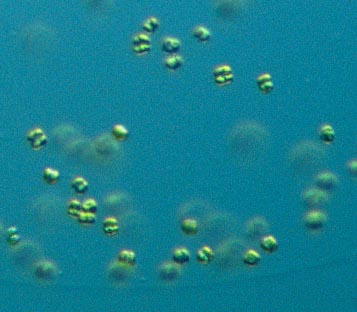
In contrast to this small accumulation in Copenhagen, sea foams can be of much larger dimension, creating banks of foam over a metre deep on shore, with winds carrying the flocs inland. One genus of algae is well-known as the origin of foams - Phaeocystis. These algae are found as single cells or, commonly, in large groups embedded in a globe of transparent mucus (see below). When nutrients are plentiful, and when day length increases, the excellent conditions for algal growth result in blooms. Excess carbohydrate, resulting from photosynthesis, is exuded from the cells to form a field of exopolymers 1 around each cell and, in Phaeocystis, the exudates from cells combine and a globe of mucus results, in which individual algae become embedded. The globe protects individual cells from capture by herbivores and acts as a means of retaining nutrients close to each cell. As the mucus consists largely of water bound within a matrix of carbohydrate to give structure, it is energetically cheap to produce. 1


So, how does Phaeocystis contribute to masses of sea foam? Let’s begin with an analogy. When we make meringue, we whip transparent egg whites (mainly protein in water) to include air, and the masses of tiny bubbles that we create are trapped within the developing meringue, each coated by some of the protein. The trapped bubbles then give the whole its white appearance. Now back to Phaeocystis. When huge numbers of globes at, or near, the surface of the sea are whipped up by waves, the mucilaginous colonies are broken up and their organic matter covers bubbles, so the whole becomes whisked into foam. The more algae, the more foam, and it is easy to see how this light, floating mass can then be blown ashore. Like all foams, it consists largely of gas and is white because of all the bubbles that are included, although green or brown colouration sometimes occurs. This is because algae or brown organic compounds are also bound into the mass, or become stuck to its surface.


All surf creates foams because bubbles are covered with the organic matter that accumulates at the water surface and this means bubbles do not collapse instantly, like those produced by shaking tap water vigorously, for example. We’ve all seen the white masses of coated bubbles that form when waves break, but the huge accumulations that can occur after Phaeocystis blooms are in a different league.


1 Roger S Wotton (2005) The essential role of exopolymers (EPS) in aquatic systems. Oceanography and Marine Biology: An Annual Review 42: 57-94.


Thursday, 17 October 2013

More on the Natural History of the Unmentionable


The Renforsen rapids on the Vindel River in Sweden are at their most tumultuous during snow melt in the mountains and surrounding lands. A large volume of water then passes downstream and Renforsen becomes highly turbulent, as can be seen in the photograph below. The water contains many fine mineral particles and fragments of organic matter, but also some most important aggregates.


In 2001, the late Björn Malmqvist and I, together with Yixin Zhang, took water samples at Renforsen and found that they contained faecal pellets that we recognised came from blackfly larvae living on, and within, the substratum of the river. These insects collect particles from the water passing over them and push the material collected through their tube-like gut in about 45 minutes. There is no mixing and less than 5% of the material taken in is digested or otherwise assimilated, with the final section of the gut compressing the gut contents to produce pellets. Larvae feed continuously, so each larva is like a machine for converting very many tiny particles into much larger faecal aggregates. As there are millions upon millions of larvae on the bed of the river, it would be expected that there will be huge numbers of faecal pellets in transport. That is what we found. 1


93.7, 47.5 and 69.2 tonnes dry mass of blackfly larval faecal pellets passed an imaginary line across the river at Renforsen each day during three successive summers. 1 Without the blackfly larvae producing aggregates, it is likely that much more material would have been carried downstream and, eventually, to the sea. Of course, this is the fate of some of the faecal pellets, but many are retained within the river as they fall through the water of the slower-flowing reaches. They thus have an important impact on the river community in transferring matter from the water column to the substratum, where most micro-organisms, algae and animals live. Our findings so impressed the producers of the Swedish children’s TV series Myror i brallan (“Ants in your pants”) that a section of one of their programmes in November 2011 was devoted to the story of this transformation, 2 with the presenter saying: “Every day, the amount of blackfly poo drifting down a river would fill a whole house.......”


If the numbers of pellets produced is impressive, so is their constitution, as most of them appear to be intact despite the highly turbulent flow. This is partly because they are small and are thus bounced around in the current, but also results from the way they are stuck together. In the photograph above, the blackfly faecal pellet from the Vindel River (about 0.5 mm across) is blue in colour and this was the result of staining with a dye for complex carbohydrates (exopolymers). It is clear that these binding agents are found throughout the aggregate, yet the exopolymers are not produced by the larva, but are collected from the water column or exuded by micro-organisms and algae that have been ingested. The secretions are “Nature’s glue” and are the principal binding agent of the faecal pellets of all animals, although some animals produce their own exopolymers in the form of mucus from cells in the gut wall.

Not only do pellets remain intact as they pass through rapids, but they stay as aggregates for weeks after they pass to the substratum, so their value to the microbial, plant and animal community is not only short term. They provide nutrients and also food for the many animals that eat them. It is a pity that faecal pellets and their fate has been so little studied, although attitudes to their importance in flowing fresh waters is changing. 3 Perhaps scientists are affected by the general approach to the subject? It is not what most people first think of when discussing the Natural History of streams and rivers and one can imagine this conversation as being typical:

“So, you’re an Aquatic Biologist”

“Yes. I’m so pleased to be able to have spent a lot of time doing something that I loved from childhood”

“What do you study? Whales and dolphins?”

“I’m afraid not. I have spent most of my career looking at rivers and streams”

“At salmon and trout?”

“Actually, I’m fascinated by the importance of faecal pellets produced by invertebrates”

“Faecal pellets? Oh... ...how interesting...”

Of course, the exchange has not taken place, but it might have done, as it shows the popular liking for large organisms and distaste for excreta, as discussed in my previous blog post on this subject. Fortunately, the young viewers of Swedish TV were provided with an enlightened exception to this general rule and that is an example for us all.


1 Malmqvist, B., Wotton, R.S. and Zhang, Y. (2001) Suspension feeders transform massive amounts of seston in large northern rivers. Oikos 92: 35-43.


My thanks to Dr Brendan McKie for alerting me to the Myror i brallan programme.