Showing posts with label Emotions. Show all posts

Thursday, 1 September 2022

Trevor Grimshaw and Caspar David Friedrich

One of the last works of Trevor Grimshaw is a book of black-and-white photographs entitled Stilled Life [1], the subject being the redundant steam locomotives that were stored at Woodham’s Scrapyard in Barry, South Wales (an image in colour taken by Peter Brabham is shown below). For all of us that have happy memories of these splendid machines in action, the scrapyard is a place of melancholy, even though delays in cutting up meant that some locomotives were bought from Dai Woodham and several have subsequently been re-built and returned to working order.

Shortly after the photographs were taken, Trevor Grimshaw died, aged 54, following a fire at his home, something which adds poignancy to his story. In addition to his work as a photographer, Grimshaw was an accomplished artist, creating monochrome images of northern landscapes, two of which (from the Tate Gallery [3]) are illustrated below. Most viewers of these monochrome works associate them with the paintings of L.S.Lowry (who owned three of them [2]), but I think they consciously, or subconsciously, show the influence of Caspar David Friedrich. To emphasise this point, I have converted two of Friedrich’s paintings to greyscale to allow direct comparison.


The first is Abbey in the Oak Wood (below, upper) that was exhibited in the Berlin Academy of Art in 1810 (as one of a pair – the other was Monk by the Sea [4]) in which we see the ruins of an abbey surrounded by trees that may be dead, or maybe had lost all their leaves, as this is a winter scene. In the foreground are monks who are walking towards the ruin. The whole effect is arresting and gloomy, but what does it mean to the viewer? As with all pictures, we can know something of the artist’s intentions, but we also use our own projections. We know that Friedrich was a Protestant [4] and that this picture shows a Catholic ruin and desolation. He was also fascinated by nature and landscape and this is one of Friedrich’s paintings that, to use his phrase, “is to be seen and recognised only in belief” [4]. As Michael Prodger [5] writes in The Spectator: “His Christianity is not insistent but comes wrapped in another - more widely practiced - religion: Nature. He offers the consolations and beauties of both.”


The second painting of Friedrich that I have chosen - Cross by the Baltic Sea (1815) (above, lower) - uses a feature that occurred many times in his work – the appearance of a solitary cross in a landscape. This symbol of Christ, and the redemption of His crucifixion, is placed in locations quite unlike Calvary and, in this painting, is on an outcrop by the sea, with an anchor near its base. Just as in Abbey in the Oak Wood, there is a feeling of slightly threatening mystery and, at the same time, a sense of spiritual hope.

Now let’s look at the two monochrome works by Trevor Grimshaw. In Open Space (1974) (the upper of the Tate images above), a solitary, bare tree is in the foreground, while the foggy background features a church tower and factories, with one chimney belching out smoke that is being carried away on the wind. We recognise that the tree, like those painted by Friedrich, shows desolation and, perhaps, death by pollution from the industry that replaced the natural world. The presence of the church is more difficult to interpret – did it represent something from Grimshaw’s spiritual beliefs, or was it used to indicate something that was longer-lasting, and more valuable, than the factories?

In Northern Townscape (1974) (the lower of the Tate images above), we see another church tower, with factories and several chimneys, one of which is producing dark smoke that suffuses the upper part of the image, while steam is rising from elsewhere in the factory complex. The impression gained is very similar to that in Open Space, but the foreground is dominated by two poles, one of which is clearly a telegraph pole. Both stand isolated, and are connected to nothing – there are no wires – so we gain a sense of isolation and of disconnection to the rest of the scene. Unlike Friedrich’s crosses, however, there seems little hope here and my impression is that Grimshaw did not enjoy the industrial landscapes that he reproduced, despite their attractiveness as structures [5], just as he did not like the rusting steam locomotives he photographed in the scrapyard at Barry.

Of course, I could be very wrong in drawing parallels between Friedrich and Grimshaw, and in interpreting their images in the way that I have done. That I react strongly to their work is an indication of the power of both artists to stimulate both the imagination and the emotions of the viewer.

[1] https://trevorgrimshawphotography.art/about/

[2] https://www.manchestereveningnews.co.uk/news/greater-manchester-news/tribute-to-artist-who-portrayed-bleak-1194546

[3] https://www.tate.org.uk/art/artists/trevor-grimshaw-1220

[4] Johannes Grave (2017) Caspar David Friedrich. Munich, Prestel Verlag.

[5] https://www.spectator.co.uk/article/an-artist-for-our-times


Wednesday, 6 February 2013

Philip Henry Gosse and Nature


Henry Gosse - aged 45 (two years after the publication of "A Naturalist's Rambles on the Devonshire Coast")


Henry Gosse was a great Natural Historian and communicator who believed that making observations of organisms and the environment in which they live has a powerful, positive effect on our emotions. For Henry, it was a confirmation of the magnificence of his God, for he was a devout Christian and believed completely in the Biblical account of Creation. This is what he wrote in the Preface of "A Naturalist's Rambles on the Devonshire Coast":

The following pages I have endeavoured, as far as possible, to make a mirror of the thoughts and feelings that have occupied my own mind during a nine months' residence on the charming shores of North and South Devon. There I have been pursuing an occupation which always possesses for me new delight,- the study of the curious forms, and still more curious instincts, of animated beings. So interesting, so attractive has the pursuit been, so unexpected in many instances the facts revealed by the research, that I have thought the attempt to convey, with pen and pencil, to others the impressions vividly receibed by myself might be a welcome service....

.... I have not made a book of systematic zoology; nor a book of mere zoology of any sort. I venture to ask your companionship, courteous Reader, in my Rambles over field and down in the fresh dewy morning; I ask you to listen with me the carol of the lark, and the hum of the wild bee; I ask you to stand with me at the edge of the precipice and mark the glories of the setting sun; to watch with me the mantling tide as it rolls inward, and roars among the hollow caves; I ask you to share with me the delightful emotions which the contemplation of unbounded beauty and beneficence ever calls up in the cultivated mind.

Hence I have not scrupled to sketch pen-pictures of the lovely and romantic scenery with which both coasts of Devon abound; and to press into my service personal narrative, local anecdote, and traditionary legend; and, in short, any and every thing, that, having conveyed pleasure and interest to myself, I thought might entertain and please my reader. It is not the least of the advantages of the study of natural history, that it strengthens in us "the habit of wishing to discover the good and the beautiful in all that meet and surround us."

If it should be objected that - to treat of the facts which science reveals to us, in any other manner than that technical measured style, which aims not at conveying any pleasurable emotions beyond the mere acquisition of knowledge, and is therefore satisfied with being coldly correct,- is to degrade science below its proper dignity, I would modestly reply that I think otherwise. That the increase of knowledge is in itself a pleasure to a healthy mind is surely true; but is there not in our hearts a chord that thrills in response to the beautiful, the joyous, the perfect in Nature? I aim to convey to my reader, to reflect, as it were, the complacency which is produced in my own mind by the contemplation of the excellence impressed on everything which God has created.

Just to emphasise the importance of accuracy in scientific investigation, Henry goes on to state:

....I would not have it supposed that I have ever stated the facts of Natural History in a loose, vague, imaginative way. Precision is the very soul of science,- precision in observation, truthfulness in record: and I should deem myself unworthy of a place among naturalists, if I were not studious to exhibit the phenomena of Nature with the most scrupulous care and fidelity. Humanum est errare: I dare not suppose I have escaped error; but I am sure it is not the result of wilfulness, I trust it is not of carelessness.

There is no doubting Henry's honesty in all that he did and this certainly applied to his scientific work, which led to him being elected a Fellow of the Royal Society. However, his science had the wider setting that provided a more fulfilling view of Natural History. It is a highly Romantic approach, of course, but that is no bad thing. It is an approach which enhances our appreciation of the World and helps us to recognise our responsibilities in minimising the destruction of Nature.

Although Henry Gosse and I would disagree on many things related to religious belief, I find him to be an inspiration and agree strongly with the sentiments in the Preface. I am not ashamed to call myself a Romantic.

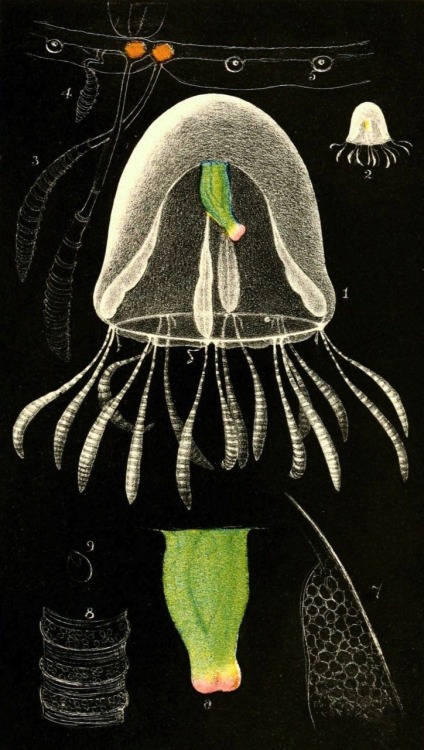
       One of Henry Gosse's beautiful illustrations from "A Naturalist's Rambles on the Devonshire Coast"