Showing posts with label David Attenborough. Show all posts

Friday, 2 August 2019

The sad story of John the Gorilla


Our ancient ancestors were familiar with the animals that shared their surroundings: some were used as food; some were threatening; and others were of little consequence. As we moved from a hunter-gatherer culture to an agrarian one, we began to domesticate animals that could be used as food; a means of providing transport; as an aid to our hunting; or for companionship as pets. During this process we began to anthropomorphise and earlier folklore about animals became increasingly humanised.

In modem times (over the past several millennia) we explored areas of the World that were distant, and the development of trade brought many imports of plants and animals that we could grow, or rear, for food (this was something that occupied the mind of Frank Buckland and others in Victorian times [1]). Creatures could also be for ornament and pleasure (think peacocks, for example). The anthropomorphic interest became highly developed when we discovered apes and, while our dogs had long been considered “honorary humans”, apes looked a bit like us and had a wide range of expressions and habits with which we could identify: for example, Chimps Tea Parties (extended to advertisements for brands of tea) were held in zoological gardens for our amusement, although this practice has now thankfully disappeared.

In addition to their capture for zoos, there was, and is still, a profitable market in capturing baby apes (often after killing their protective mothers) and these are traded to those who want this type of “baby” to live with them – Michael Jackson’s “Bubbles” being a good example (see below, showing Bubbles with Mr Jackson in one of his early identities). Of course, the cute babies grow into powerful, and potentially dangerous adults, and then they must be taken to a centre that can look after them, a return to the wild being out of the question unless the apes can be trained at “schools” to teach them how to survive before their release into their natural habitat.


A well-known case of an ape that was humanised is that of John the Gorilla. He lived with Alyse Cunningham in Sloane Street in London and his story is recounted by E Ray Lankester in his popular Great and Small Things [2]. He describes how John (see below) was traded from Gabon by a French officer who sold him to a London dealer in July 1918, and from whom he was acquired by Major Rupert Penny (Ms Cunningham’s nephew). John came to live in Sloane Street in December 1918 and Ms Cunningham describes his life there [3]:
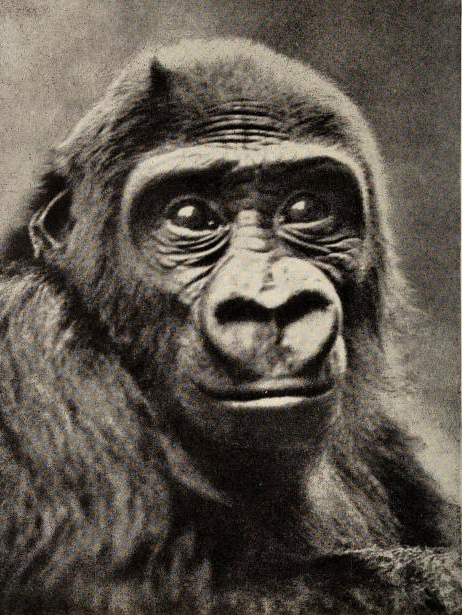


I was getting to like John, and to take a great interest in him. I fed him, washed his hands, face and feet twice a day, and brushed and combed his hair – which he would try and do himself whenever he got hold of the brush or comb. He soon got to like all this. My next idea was to teach him to be strictly clean in his habits..

..we took him out of his cage and allowed him the freedom of the house. Thereafter he would run upstairs to the bathroom of his own accord, turning the door knob of whichever room he was in and also opening the door of the bathroom..

..John loved to have people come to see him in his home.. ..Whenever people came to see him, he would show off like a child. It was his custom to take them by the hand and lead them round and round the room. If he saw that a person was at all nervous about him, he loved running past them, and give them a smack on the leg – and you could see him grin as he did so..

..His table manners were really very good. He always sat at the table, and whenever a meal was ready, would pull his own chair up to his place.. ..He always took afternoon tea – of which he was very fond – and a thin piece of bread with plenty of jam; and he always liked coffee after dinner..

..He was especially fond on my little niece, three years old, who loved to come with her father to stay. John and she used to play together for hours and he seemed to understand what she wanted him to do.


An excellent illustration of the two is given in the article (see above), although the little girl seems far from delighted.

Ms Cunningham goes on to report that John was taken by train “as an ordinary passenger, without even a chain around his neck” to the family’s country cottage; something that must have surprised other passengers. The cottage was in the village of Uley, where John also visited the local school and was something of a celebrity [4].

Eventually, he grew too big and Lankester describes his fate [2]:

I regret to have to state that, owing to the expense involved in keeping John in a private house and the natural anxiety as to whether he could be kept at all in such conditions when he reached maturity, his owner was induced to sell him, in the belief that he was to be specially cared for in a warm climate. He was taken by his new proprietor to the United States, and became very ill owing to his separation from the friend who had hitherto cared for him and loved him.. ..This novel and complete exile utterly prostrated him; it deprived him of all spirit and appetite. An attack of pneumonia killed him soon after his arrival in America.

Contemplating this tragedy, Lankester concludes that “no one should adopt a young gorilla who is not possessed of a large income and able to pay for skilled attendants and courageous companions for him when he is grown up.”

Far better then to leave gorillas, and other great apes, where they are and, if absolutely necessary, visit them to have experiences like those enjoyed by David Attenborough in Life on Earth (easily the best remembered scene in the whole of the excellent series of programmes). Such ecotourism needs strict controls to avoid exploitation, but it is not the main threat to the great apes; that comes from competition for space. As we are the superior species, we win in these encounters and the majority of us do not care. We are so keen to think that we can make the apes like humans, yet we cannot teach them about the rapacious needs of consumer capitalism.

If we turn our approach on its head, what can we learn from the great apes? Asking that question may mean that we have to concede that we are not the best at everything.


[1] Christopher Lever (1992) They Dined on Eland. London, Quiller Press.

[2] Ray Lankester (1923) Great and Small Things. London, Methuen & Co.

[3] Alyse Cunningham (1921) A Gorilla’s Life in Civilization. Bulletin of the Zoological Society of New York, September 1921 pp.118-124.


Monday, 12 January 2015

David Attenborough and the John Frum cult


As a child, I was fascinated by Natural History, and visits to the shore and to the countryside were supplemented by watching programmes on our newly-acquired Radio Rentals black-and-white TV. David Attenborough’s Zoo Quest series were among my favourites, but it was another Attenborough programme that had the strongest effect on me: this was People of Paradise 2. Cargo Cult, first broadcast on 28th April 1960 [1]. I was thirteen years old when I first saw the programme; at a time when I was questioning my religious beliefs. Our family had always attended Winner Street Baptist Church in Paignton but, by April 1960, I had left the church as I found it too parochial. My father insisted that I should still attend some form of Christian worship, so I became a regular attendee at the local Crusaders Union sessions on Sunday afternoons in Paignton YMCA.


People of Paradise 2 focussed on the John Frum cult on Tanna in the New Hebrides (now Vanuatu) and Attenborough began by interviewing an Australian copra trader. He recalled an uprising of the John Frum cult members who carried bamboo models of carbines, complete with bayonets, and had USA painted in red on their chests (both practices continuing today, see below). As we travelled across the island in the programme, we were shown many clearings with red crosses surrounded by fences and near Sulphur Bay, a centre of the cult, a strange enclosure containing a statue of John Frum, a large model of an aircraft with four engines and a cage containing a crudely carved model of a winged rat. There followed an interview with “Nambas”, the chief of the community at Sulphur Bay who was the leader of the John Frum cult on the island. “Nambas” said that he was in contact with John Frum by radio and he had been told that Attenborough and his colleague would be arriving by fast ’plane. The radio was not like white-man’s radio as it did not have wires, but Attenborough was not allowed to see it. “Nambas” then explained that John Frum would come with cargo and this would be “everything” that white people had, the precursor being that all money had to be thrown away, which they had done. When asked about the cross on the lip of the active volcano, “Nambas” said that this was erected because there were many men (soldiers) inside the volcano and these were mostly white, but also contained some red and some black people (the crosses presumably acted as guides and the red colour was of the clothing, replicated among followers of the cult).


As someone living a small-town life in South Devon, the TV programme made a strong impression on me and I was not alone, as Richard Dawkins refers to the interview between David Attenborough and “Nambas” in The God Delusion [2], giving some details that were not included in the original broadcast. I was amazed at the imagination shown by my fellow humans. They had borrowed some ideas from Christianity - the imagery, the idea of John Frum as a saviour who would bring rewards - and superimposed them on the cargo cults that arose in Melanesia after native peoples saw traders coming with ships and, latterly, aircraft.

Since re-viewing that programme on BBC iPlayer - I had not seen it since the first broadcast in 1960 - I have had the chance to read more about the John Frum cult. It was given its strongest boost by the building of an airstrip on the neighbouring island of Éfaté as a staging post in the Second World War battles in the Pacific. Men from Tanna were involved in constructing the airstrip and they observed all the materials that were offloaded, stockpiled and distributed by the US military. It was a powerful reinforcement of the ideas of a Cargo Cult and provided the origins of the physical appearance of John Frum, the use of tall masts to convey radio transmissions, and the need for clearings to allow aircraft to land. It is likely that the red crosses over the island were an amalgam of the Christian symbol and the Red Cross that appears on medical supplies. All of the men’s observations were translated into the forms seen on Tanna and the idea of the US military in the volcano tagged on another layer of invention. The cult that developed was thus a mixture of Christian religious traditions, observation of something that was not understood, and existing tribal culture involving kava drinking in special clearings near villages (it should be pointed out that another group on Tanna have Prince Philip as their equivalent of the John Frum character).

According to scholarly research, the first major uprising of the John Frum movement was in May 1941 following a desertion from the Presbyterian Mission [3,4] and Guiart reports that “a new leader was having an aerodrome built in the name of John Frum to enable the new god’s planes to land with their cargoes of soldiers” [3]. Although John Frum is/was white, it is important to note that the residents of Tanna who had helped in the construction of the airfield on Éfaté had seen African Americans [5] and this explains the multi-ethnicity of the soldiers believed by some to inhabit the volcano. How easy it seems to have the basic idea of a supernatural being and then create myths that believers will be rewarded. We know that has happened with the John Frum movement and this still endures, with the cult being used in advertising by the tourism industry [6]. The movement has thus been in existence for over 70 years, with information being passed down from the original elders to a succession of new leaders.

As a thirteen-year old, I found the Attenborough programme so fascinating that I started to question how religions were founded, what ensured their longevity, and what controlled their imagery. There were no easy answers, but those thoughts marked a turning point, as I moved away from Christianity and towards atheism of a reflective, and non-proselytising, variety.


[2] Richard Dawkins (2006) The God Delusion. London, Bantam Press.

[3] Jean Guiart (1956) Culture contact and the “John Frum” movement on Tanna, New Hebrides. Southwestern Journal of Anthropology 12: 105-115.

[4] Jean Guiart (1952) John Frum Movement in Tanna. Oceania 22: 165-177.

[5] Daniel J Crowley and Magdelen L Crowley. Encounters with folklore. Journal of Folklore Research 33: 155-163


P.S. I give “Nambas” in quotes as this is also the name of the penis sheath traditionally worn by men on Tanna. It have been a pseudonym.


Friday, 28 February 2014

Charles Waterton’s encounter with an orangutan


Charles Waterton, a popular Natural Historian in the Nineteenth Century, had no academic training in Zoology and wrote about his observations of the animals he saw around him wherever he travelled. Although regarded by Charles Darwin as “an amusing strange fellow” after a visit to Waterton’s stately home, Walton Hall, near Wakefield (when Squire Waterton “ran down and caught a leveret in a turnip field”), Darwin nevertheless had a high regard for the detail described in Waterton’s Essays on Natural History. 1

Waterton was a devout Roman Catholic, having been strongly influenced by the Jesuit teaching at his boarding school, Stonyhurst College.  He was a Creationist and recognised that humans are unique in their ability to be rational and in being able to use clothing, fire, manufacturing, etc. An excellent example of Waterton’s writing and approach comes in his observations on an orangutan; not in its native Borneo, but in London Zoo. He was on good terms with the Zoo Superintendent of the time and, in 1851, a keeper allowed Charles to enter the ape’s cage to become more closely acquainted. Only someone with the personality of Charles Waterton would have attempted such a thing, although David Attenborough’s contact with gorillas recorded in Life on Earth may be equivalent, although that was in the wild. Of course, Waterton recognised that he was meeting a captive ape and these are his observations: 2

As I approached the orang-outang, he met me about half way, and we soon entered into an examination of each other’s persons. Nothing struck me more forcibly than the uncommon softness of the inside of his hands. Those of a delicate lady, could not have shewn a finer texture. He took hold of my wrist and fingered the blue veins therein contained; whilst I myself was lost in admiration at the protuberance of his enormous mouth. He most obligingly let me open it, and thus, I had the best opportunity of examining his two fine rows of teeth. We then placed our hands around each other’s necks; and we kept them there awhile, as though we had really been excited by an impulse of fraternal affection.. ..This great ape from Borneo, exhibited a kind and gentle demeanour, and he appeared pleased with my familiarity. Having fully satisfied myself, how completely the natural propensities of a wild animal from the forest, may be mollified, and ultimately subdued by art, and by gentleness of the part of rational man, I took my leave of this interesting prisoner, scraping and bowing, with affected gravity as I retired from his apartment.


The writing suggests a meeting of two individuals with equal levels of curiosity. Charles Waterton is showing us that an orangutan almost has friendly human characteristics, yet he knows that this is unlikely to be the case. He was reminded of this fact shortly after he left the cage and the tone of his writing now changes: 2

..I was most egregiously deceived in the good opinion which I had entertained of him; for scarcely had I retired half a dozen paces from the late scene of action, when an affair occurred which beggars all description. In truth, I cannot describe it: I don’t know how to describe it: my pen refuses to describe it. I can only give an outline, and leave the rest to be imagined. This interesting son of Borneo, advanced with slow and solemn gravity to the bars of his prison, and took up a position exactly in front of the assembled spectators. The ground upon which he stood was dry; but immediately it became a pool of water, by no means from a pure source. Ladies blushed and hid their faces;- whilst gentleman laughed outright. I was scandalised beyond measure, at this manifest want of good breeding on the part of this shaggy gentleman from the forests of Borneo. He confirmed for ever, my early opinion, that, although apes naturally possess uncommon powers of mimicry;- and that these powers can be improved to a surprising degree, under the tutelary hand of man;- nevertheless, neither time, nor teaching, nor treatment, can ever raise apes even to the shadow of an equality with the intellect of rational man.

It is tempting to suggest that the second passage of description is a dashing of the warm anthropomorphic sentiments expressed in the first.

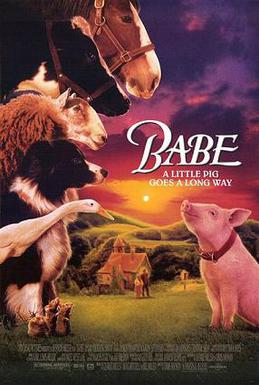
Humans are unique in needing explanations and there is no evidence that any other animal has this capacity, although we know that they can solve problems and create tools to aid their feeding. We also have strong evidence that many higher animals express emotion and young orang-utans, for example, appear to have temper tantrums when not allowed a treat from a keeper, and these seem identical to the tantrums thrown by a human infant when deprived of something they want. It is easy to project human emotions on to animals, just as Charles Waterton did with the “gentleman from Borneo” and this leads eventually to a sentimentalising of animals that can become absurd. As an example, just think of Babe (what a wonderful film that was, by the way - I was carried along with the sentiment just like everyone else). 


We know that humans are unique among living things and yet we don’t always feel comfortable about that. Is that why we anthropomorphise and need to invent theistic explanations for things we do not understand?


1 Julia Blackburn (1989) Charles Waterton 1782-1865: Traveller and Conservationist. London, The Bodley Head.
2 Charles Waterton (1857) Essays on Natural History: Third Series. London, Longman, Brown, Green, Longmans, and Roberts.